
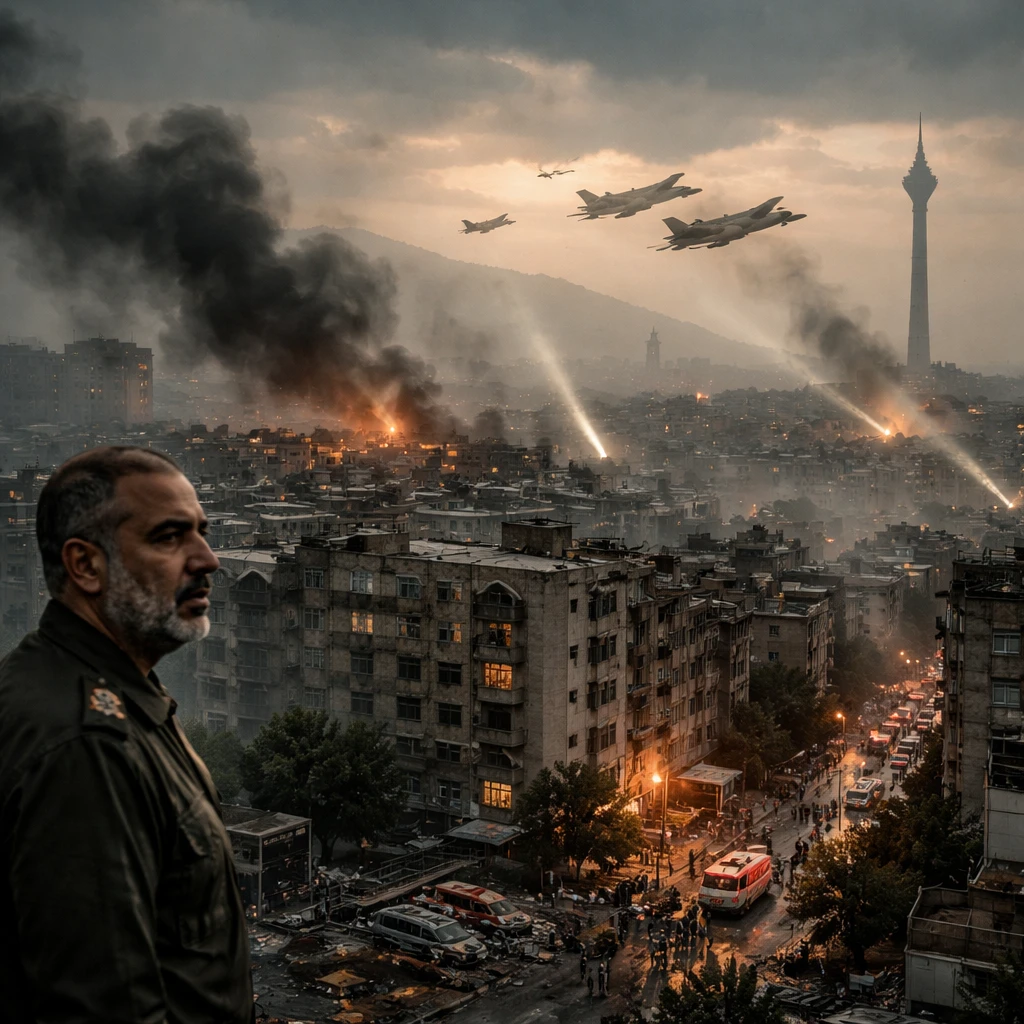
Iranian state media on Monday announced the death of Maj. Gen. Majid Khademi, who served as the head of intelligence for the Islamic Revolutionary Guard Corps. The initial state statement provided no additional details about the circumstances surrounding his death.
Subsequent reports said Khademi had been killed in an attack that the Guard blamed on the United States and Israel. Authorities did not disclose the location of the strike. Independent accounts indicated that multiple airstrikes occurred around Tehran early Monday, with some reports noting that residential areas were hit.
The announcement came as hostilities in the region escalated. The Israeli military said it carried out a new wave of strikes it described as targeting the Iranian regime in Tehran. In response, Iran launched missile fire toward Israel, with officials saying four rounds were sent early Monday.
Officials in the United Arab Emirates, Saudi Arabia and Kuwait reported that their air defense systems intercepted incoming strikes. The exchanges followed a period of rapid escalation and heightened military activity across the region.
The developments also follow public warnings issued by U.S. President Donald Trump. He told Iranian leaders they must reopen the Strait of Hormuz or face severe consequences, adding that Tehran "won't have any power plants and they won't have any bridges standing" if a deal was not reached by Tuesday 8 p.m. ET.
U.S. Central Command said it continued operations in Iran after conducting a rescue of an American aviator who had been trapped in the country for more than 36 hours. The command did not provide further operational details in its statement.
Amid the fighting, several media outlets reported that negotiators have circulated a proposed framework intended to halt hostilities and reopen the Strait of Hormuz. Citing sources familiar with the discussions, those reports said the proposal was prepared by Pakistan, Egypt and Turkey and was shared with both Iran and the United States overnight.
According to the reporting, the plan could take effect as early as Monday. It is said to outline a two-step approach - beginning with an immediate ceasefire and followed by negotiations aimed at reaching a broader agreement. "All elements need to be agreed today," a source told Reuters.
The situation remains fluid, with competing military actions and parallel diplomatic efforts unfolding simultaneously. Details about the strike that reportedly killed Khademi, including its precise location and the full sequence of events, were not disclosed in initial official statements.
Summary
Maj. Gen. Majid Khademi, head of intelligence for Iran's Revolutionary Guard, has been reported dead by state media. Later accounts attributed his death to an attack blamed by the Guard on the United States and Israel. The announcement arrives amid reported airstrikes around Tehran, missile launches toward Israel, and intercepted strikes over Gulf states. At the same time, mediators circulated a ceasefire framework intended to reopen the Strait of Hormuz, while U.S. leadership issued an ultimatum to Tehran.