
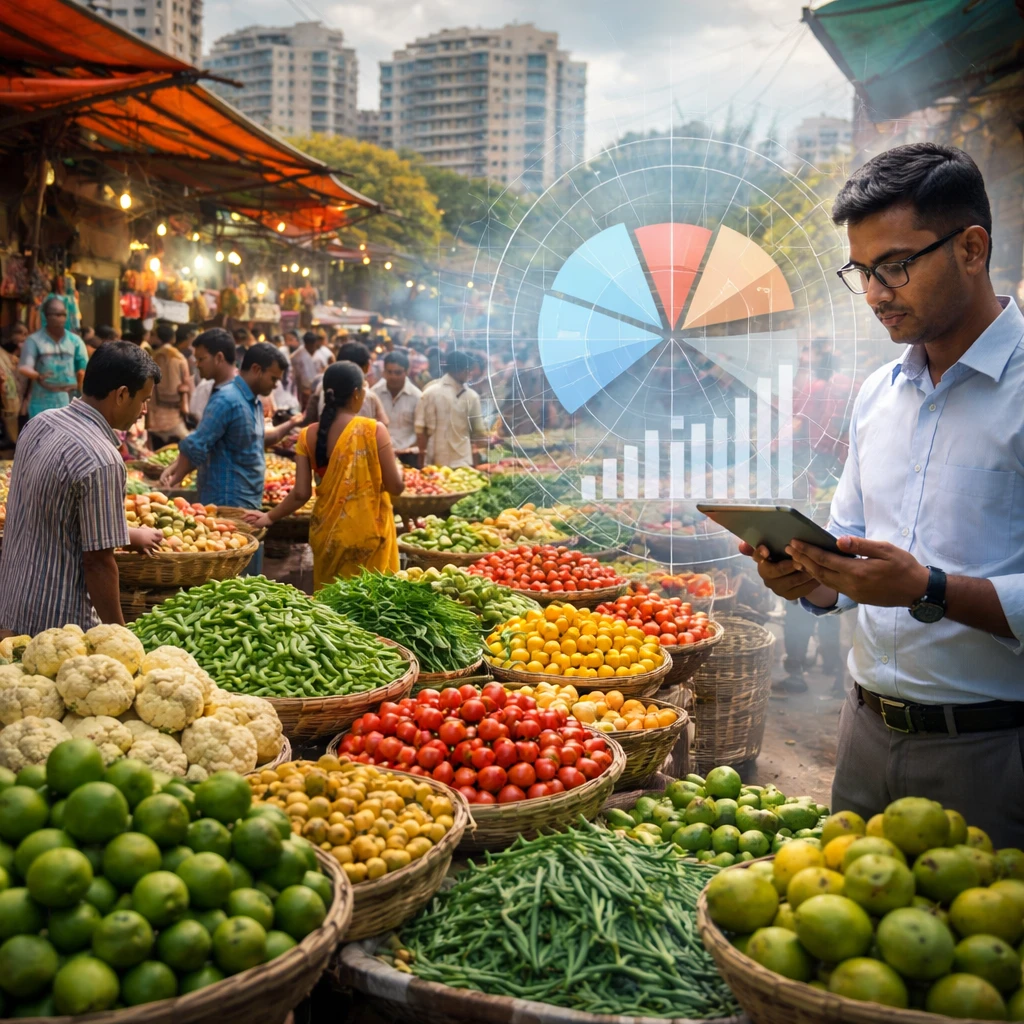
India is resetting the framework for measuring consumer inflation by cutting the food component of its consumer price index (CPI) to 36.75% in a new data series, the statistics ministry said. The adjustment, which rebases the CPI to 2024, is intended to better mirror contemporary consumption patterns and could reduce headline volatility tied to food-price swings.
Food currently makes up 45.86% of the CPI basket used to calculate headline inflation, a level the ministry and economists have argued continues to reflect spending habits from the 2011-12 period. Because food prices are sensitive to variables such as weather and supply disruptions, the revised weighting is expected to moderate sharp movements in headline inflation and provide a clearer backdrop for monetary policy decisions around the central bank's 4% inflation anchor, plus or minus two percentage points.
The updated series will adopt 2024 as the base year, with 2025 serving as an overlapping year that allows historical data from the old 2011-12-based series to be converted into the new base statistically. The change also broadens the number of major spending groups included in the index, increasing them to 12 from the previous six and aligning India’s inflation framework more closely with international norms.
Recent household surveys cited by the ministry show shifts in consumption: food accounts for 39.7% of urban household spending, down from roughly 43% in 2011-12, and about 47% of rural spending, down from 53% previously. The reweighting maintains housing, water, electricity, gas and other fuels at 17.66% of the CPI, keeping shelter and utilities as the second-largest inflation driver.
"For the first time, rural house rent has been included in the CPI. Further, in both rural and urban areas, the sample size for house rent has been increased," said Saurabh Garg, secretary, Ministry of Statistics and Programme Implementation.
Other category weightings reported by the ministry include transport at 8.8%, health at 6.10% and clothing & footwear at 6.38%. The ministry also said categories that reflect services-heavy consumption - restaurants & accommodation, education and information & communication - will each occupy around 3.5% of the basket.
For the first time, the CPI will incorporate price data obtained from e-commerce platforms. The ministry listed specific items and services to be tracked from online sources, including airfares, over-the-top (OTT) media subscriptions, telecom plans and selected services.
The statistics release comes as headline inflation has begun to pick up: India’s headline inflation rose in December to 1.33% year-on-year, the fastest three-month pace, after food-price declines eased. By contrast, November’s inflation reading was 0.71% year-on-year.
This rebasing represents a technical but significant adjustment to how price pressures will be measured going forward, with implications for how policymakers, markets and analysts interpret inflation dynamics across food, housing, services and digital commerce.