
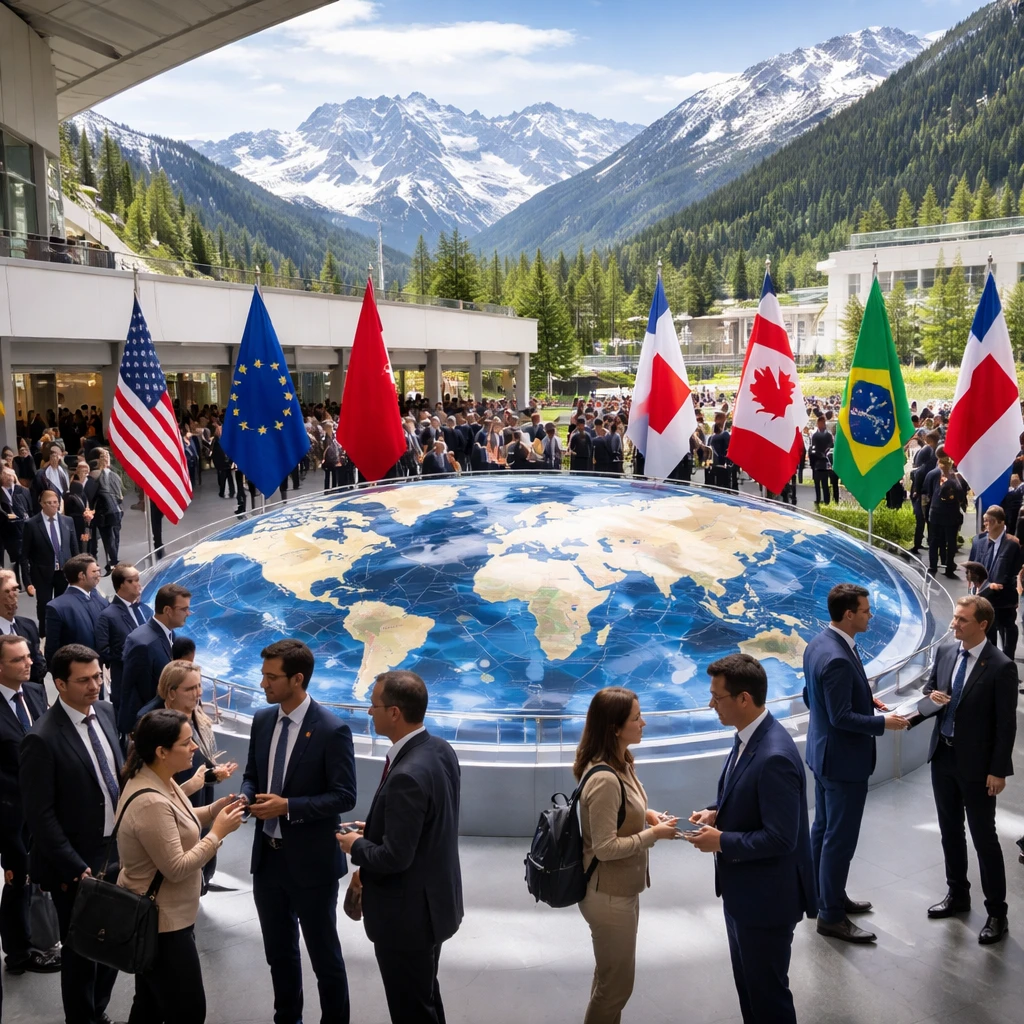
During the annual gathering of global leaders at the World Economic Forum in Davos, Switzerland, significant attention has been drawn to the impact of United States tariffs on international trade relations. Introduced under President Donald Trump, these tariffs have disrupted longstanding trade patterns and accelerated efforts among various nations to strengthen regional trade connections and reduce reliance on the U.S. market.
Canadian Finance Minister François-Philippe Champagne highlighted the unprecedented speed and breadth of these changes in a panel discussion focused on tariff policy. His comments underscored concerns shared by many countries about the instability created by rapidly implemented trade restrictions, which have unsettled global markets and supply chains.
Trump's tariff measures, which marked their peak intensity last year with the highest U.S. tariff levels in nearly a century, have prompted affected nations to seek new trade opportunities. This shift is reflected in increasing intra-regional trade activity and the pursuit of agreements aimed at insulating economies from trade shocks originating with U.S. policy changes.
Champagne emphasized that corporate leaders now prioritize stability, legal certainty, and predictability, factors that seem diminished in the current trading environment. Notably, Canada’s recent agreement with China to reduce tariffs on electric vehicles and agricultural exports such as canola demonstrates proactive steps to establish more resilient trade links.
The signing of a landmark free trade agreement between the European Union and the Mercosur bloc of South American countries this month, after a prolonged negotiation period spanning 25 years, marks a historic milestone. This deal, pending final legal clearances, would become the EU's largest trade pact and further showcases the global inclination toward diversified trading partnerships beyond U.S. dominance.
World Trade Organization Director-General Ngozi Okonjo-Iweala endorsed the trend of supply chain diversification, asserting that it promotes a more balanced distribution of economic growth and employment opportunities internationally. She observed that these measures contribute to enhancing global economic resilience in the face of evolving trade challenges.
Supporting this outlook, research from the Boston Consulting Group projects a decline in the United States' share of global goods trade, anticipating a reduction from approximately 12% down to 9% by 2034. This forecast implies a relative growth of domestic economic endeavors in the U.S. but also signals shifting global trade influences.
Industry representatives from Germany conveyed their concerns regarding the effects of tariffs on raw materials like steel and aluminum, which are increasing production costs and thus impacting the revitalization of American industrial capacity. Data reflecting a 9% fall in German exports to the U.S. during the initial eleven months of 2025 highlight the tangible effect these tariff policies are having on longstanding trade relationships.
German Chambers of Industry and Commerce officials noted that repeated tariff impositions have contributed to a sustained contraction in U.S. manufacturing activity, with recent surveys indicating a continued decline extending into December. Consequently, the general consensus points toward an overall increase in the cost structure for companies engaging in international trade and manufacturing, a trend deemed structural and expected to persist.
Boston Consulting Group analyses further characterize the global trade landscape as segmented into four primary regions: the United States; China; BRICS countries excluding China; and a collective group termed plurilateralists, encompassing most European nations, Canada, Mexico, Japan, Australia, and multiple economies in the Asia-Pacific.
This framework anticipates that commerce between plurilateral members and China’s trade with allied Global South countries will drive the majority of future global trade activity, while U.S. trade growth may proceed at a slower pace.
Supporting these observations with concrete port data, the Port of Long Beach's CEO, Noel Hacegaba, detailed shifts in cargo origins. Where China previously accounted for 70% of traded goods passing through the port to the U.S. market in 2019, that share declined to 60% recently, with heightened activity noted from Southeast Asian countries such as Vietnam, Thailand, and Malaysia.
From a European perspective, Boudewijn Siemons, Chief Executive of the Port of Rotterdam, highlighted the necessity for agility in adapting to new geopolitical realities. He pointed out that Europe’s historic reliance on inexpensive Chinese manufacturing, affordable Russian energy supplies, and U.S. defense arrangements has diminished, necessitating rapid strategic adjustments.
These developments reflect broader global economic transformations, with nations racing to reconfigure trade patterns, enhance supply chain resilience, and fortify regional economic partnerships in the face of an uncertain and evolving international trade environment.