
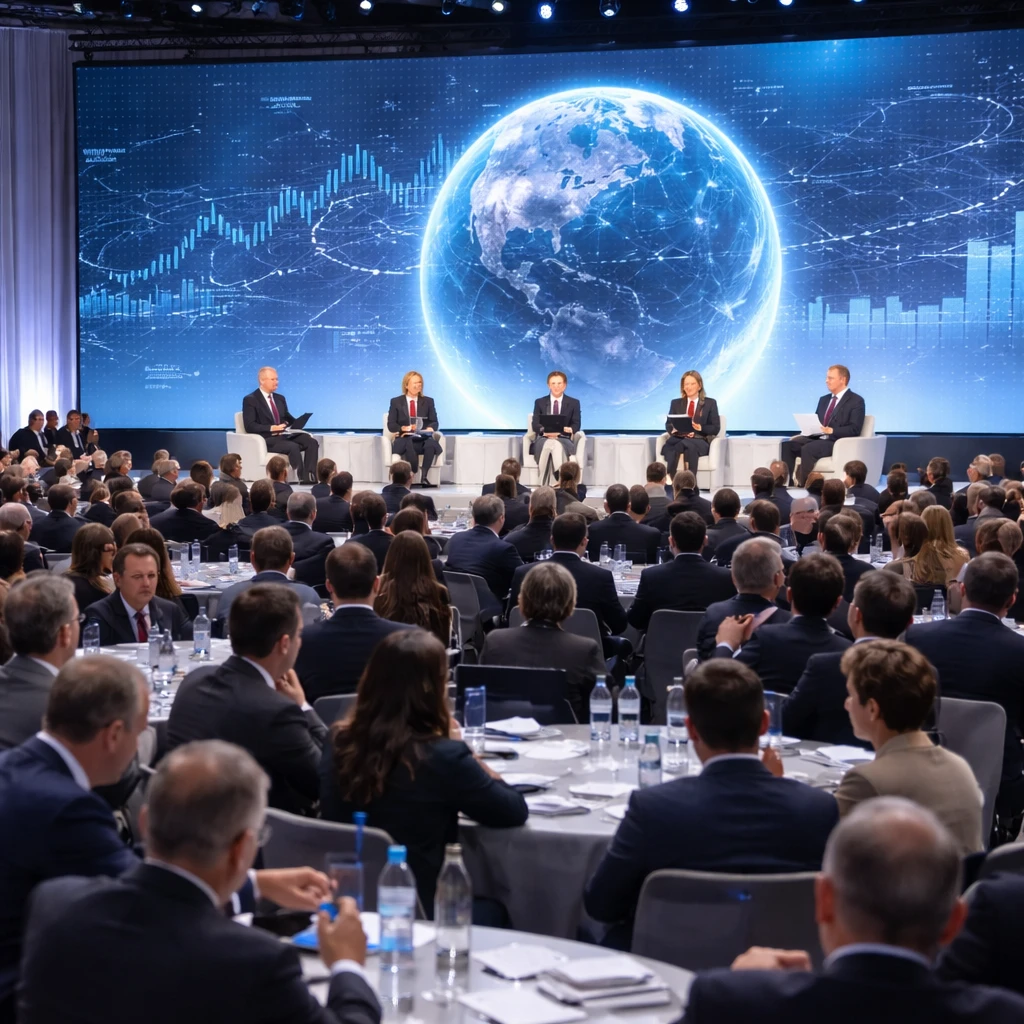
In a gathering at Davos, Switzerland, prominent finance officials expressed divergent views regarding the state of the global order, responding directly to recent claims about a fundamental breakdown in international relations. Contrary to Canadian Prime Minister Mark Carney’s assertion that powerful nations were forsaking established rules and that the world was entering a harsher era dominated by coercion, other finance leaders urged a more nuanced perspective.
Carney had notably cited the ancient Greek historian Thucydides, suggesting a paradigm where "the strong can do what they can, and the weak must suffer what they must," implying a grim shift toward force over cooperative agreements.
However, Christine Lagarde, President of the European Central Bank, diverged from this narrative during her Davos address. She rejected the notion of an outright rupture in the global system, advocating instead for a mindset focused on identifying vulnerabilities, dependencies, and opportunities to enhance autonomy. "We should be exploring alternatives and recognizing the fragilities in the current framework," she remarked, emphasizing an adaptive approach to evolving global dynamics.
Similarly, Ngozi Okonjo-Iweala, Director-General of the World Trade Organization, highlighted the prevailing uncertainty within the international environment but cautioned against excessive pessimism. Recalling recent incidents such as U.S. President Donald Trump's unusual proposal regarding Greenland, she conveyed that while a complete reversion to previous global standards seemed unlikely, constant flux would persist, prompting nations to strengthen internal and regional resilience.
"Countries need to assess their regions critically and prioritize bolstering their own fortitude," Okonjo-Iweala stated, underscoring the imperative for strategic foresight in national policy.
Adding to the discourse, Kristalina Georgieva, International Monetary Fund Managing Director, characterized the ongoing changes as part of a natural and ongoing evolution rather than a sudden rupture. She urged stakeholders to embrace the reality of recurring shocks and disruptions in the global economic landscape. "We are no longer in familiar terrain," she said, invoking the metaphor from the Wizard of Oz to illustrate the enduring transformation away from past norms.
Lagarde also reflected on the spirited debates at Davos, including moments of criticism directed at Europe, notably during a speech by U.S. Commerce Secretary Howard Lutnick. Although she momentarily left a dinner event after his critical remarks, she later adopted a conciliatory tone, acknowledging that such challenges can serve as catalysts for renewed focus and preparedness plans. "The critiques have underscored the necessity for Europe to develop robust contingency strategies," she observed.
The collective dialogues suggest a consensus on the shifting nature of international finance and governance structures—a movement characterized more by gradual changes and emerging uncertainties than by abrupt breakdowns. This view promotes a strategic emphasis on resilience and strategic planning amid ongoing global complexity.