
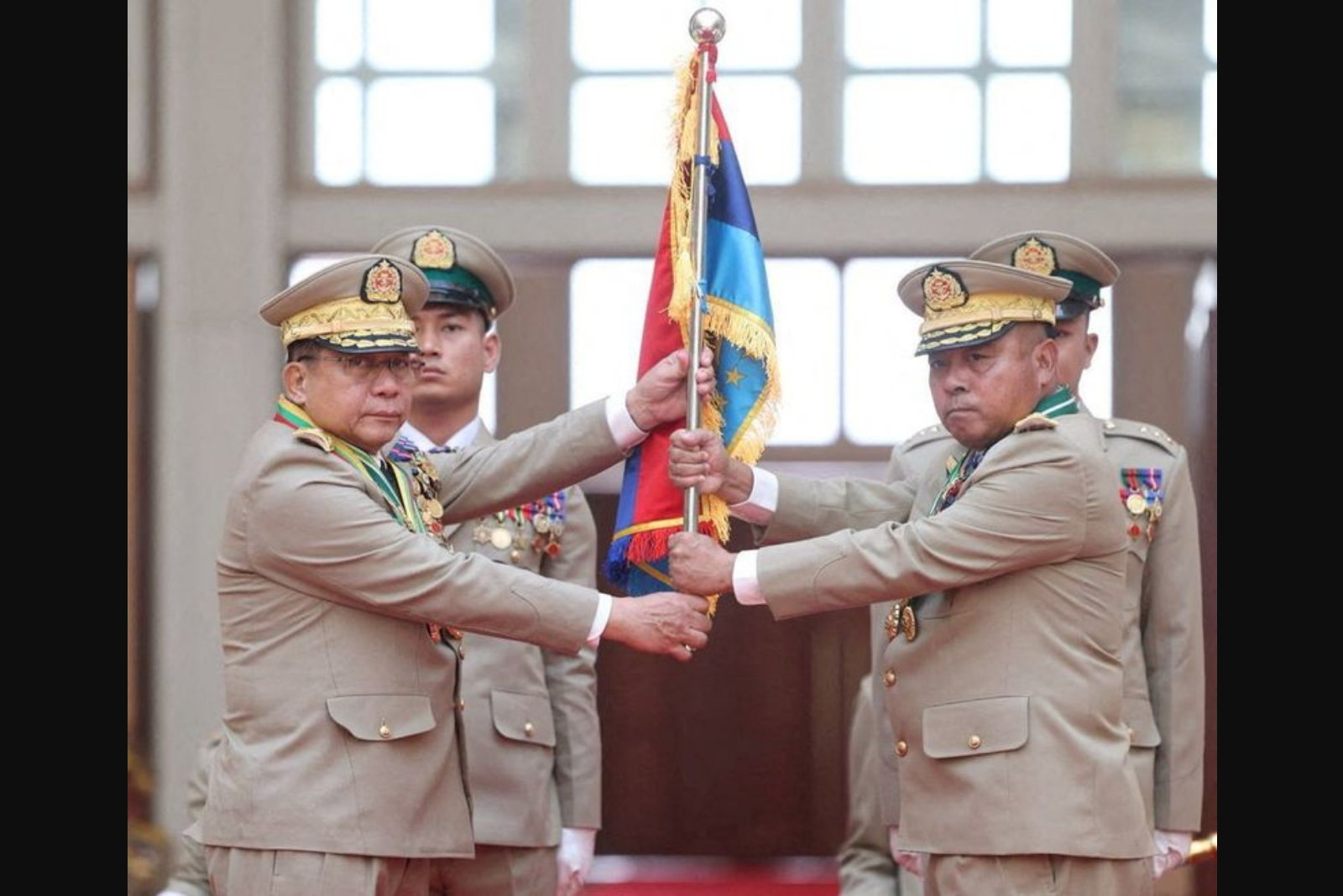
Ye Win Oo, the 60-year-old general who directed the unit that arrested Nobel Peace Prize laureate and then-leader Aung San Suu Kyi at the start of the February 1, 2021 coup, was appointed commander-in-chief of Myanmar's military on Monday. The promotion places the former head of military intelligence into one of the country’s most powerful roles, in a military institution that has long been central to domestic politics.
Multiple sources - including diplomats, analysts and a defector totaling six people - identified his close personal proximity and demonstrated loyalty to outgoing commander Min Aung Hlaing as the crucial factors behind the selection. A spokesperson for the ruling junta did not respond to requests for comment.
Min Aung Hlaing, who has relinquished his uniform, is positioned to become Myanmar's president following a general election held in December and January that was broadly derided as a sham intended to secure continued control for the ruling generals. Observers and a defector who fled the military after the coup say Min has effectively handed the military's highest command to a trusted inner-circle loyalist.
"Min Aung Hlaing has chosen to hand over power to his most trusted inner circle loyalist," said Naung Yoe, a major who defected from the military in 2021 after the coup plunged the country into civil war. Naung Yoe and Naing Min Khant, an analyst at the Institute for Strategy and Policy - Myanmar think tank, both confirmed Ye Win Oo’s direct role in the detention of the 80-year-old politician, who was subsequently tried in secret and imprisoned.
"He appointed Ye Win Oo so that he can maintain influence and authority, and continue to dominate the military through someone who listens to him," Naung Yoe said, referring to Min Aung Hlaing’s likely need for military backing and protection as he shifts into a political role.
Patronage and a steady run of promotions have defined Ye Win Oo’s trajectory within Myanmar’s armed forces. Unlike many senior officers who are alumni of the elite Defence Services Academy, Ye Win Oo trained at the Officer Training School and spent his early career in infantry battalions before assuming higher command responsibilities in central regions.
His rise became more pronounced while serving as a colonel in a regional command based in Yangon, the country's commercial capital. It was there that he entered Min Aung Hlaing’s orbit, a relationship analysts say was strengthened by familial ties between the two men. An analysis by the Institute for Strategy and Policy - Myanmar concluded that those personal links helped propel Ye Win Oo upward.
In 2020 he was appointed Chief of Military Security Affairs, placing him in charge of intelligence gathering and interrogation operations. Two analysts told observers that such a rapid ascent would have been unlikely without Min Aung Hlaing’s backing. "General Ye Win Oo has gained significant power through Min Aung Hlaing’s patronage, serving as a vital pillar for the leader’s grip on power," said Naing Min Khant.
Min Aung Hlaing has tended to reward loyalty with key posts, and has at times detained senior officers as a means of neutralizing potential rivals. That pattern of patronage and internal control has been a recurrent feature within the military hierarchy.
Ye Win Oo made his name while running the military’s intelligence apparatus, particularly through operations that curtailed anti-junta guerrilla activity in major urban settings, according to an analyst who is in contact with military officials. "Under his supervision, the intelligence operations relatively improved," the analyst said, requesting anonymity because of the sensitivity of the subject.
At the same time, independent and international investigators have documented severe abuses linked to Myanmar’s security forces, particularly in detention and interrogation facilities. The Independent Investigative Mechanism for Myanmar reported last year that abuses included beatings, electric shocks, strangulations, and torture by pulling out fingernails with pliers. U.N. investigators have accused security units of systematic torture, killing and other grave violations during interrogations and in detention centers.
Observers now expect the early period of Ye Win Oo’s leadership to closely reflect the priorities of Min Aung Hlaing and his prospective presidency. Analysts suggest the new commander-in-chief will initially act in alignment with the outgoing commander’s strategic goals rather than pursue an independent overhaul of military policy.
"For at least two years, the commander-in-chief will be compliant to the president," the analyst in contact with military officials said, adding that substantial change to the military’s war doctrine is unlikely even as the armed forces continue to fight numerous insurgent groups across broad areas of the country. "We won’t see any radical or critical changes from the status quo."
The appointment marks a notable shift in the profile of Myanmar's top military leadership, elevating an intelligence chief to the institution's premier command. How the change will translate into operational adjustments on the ground, or affect the broader political transition as Min Aung Hlaing moves toward the presidency, remains to be seen within the constraints of the existing military-dominated order.