
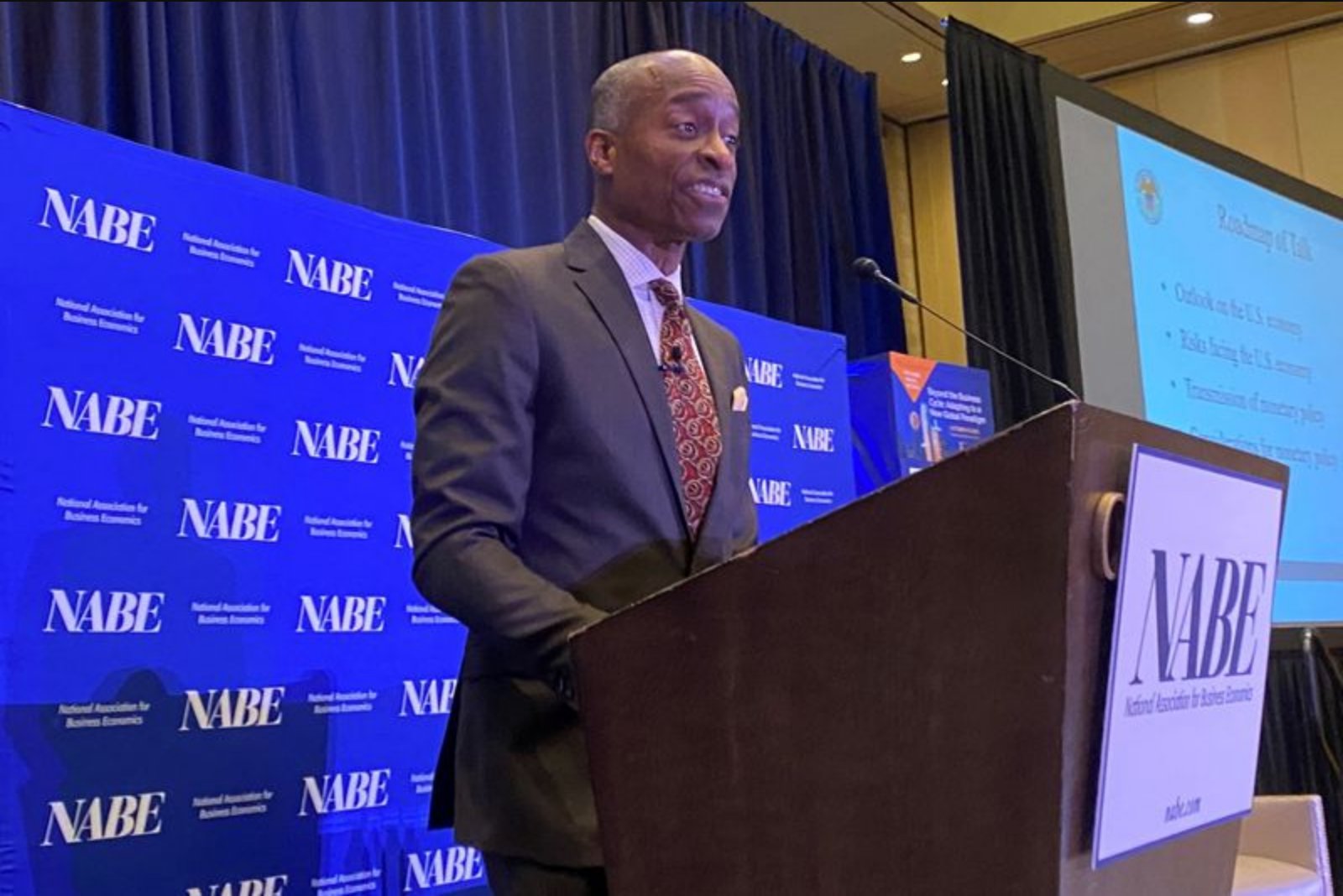
Federal Reserve Vice Chair Philip Jefferson said on Thursday he is closely monitoring rising energy prices, cautioning that if those increases persist they could both elevate inflation and damp household and corporate spending. That combination, he said, would present a hard dilemma for a central bank charged with maintaining price stability and promoting maximum employment.
Delivering prepared remarks to a Dallas Fed event, Jefferson described the current stance of monetary policy as "appropriately positioned." He added that the stance should "continue to support the labor market while allowing inflation to resume its decline toward our 2 percent target as the effects of tariff pass-through are completed."
Jefferson characterized the labor market as roughly in balance and said he expects the unemployment rate to remain near its current 4.4% level for the remainder of the year. He cautioned, however, that despite that balance the labor market is vulnerable to negative shocks because employers are hiring at very low rates. He stressed that risks to his forecast "are skewed to the downside."
On inflation, Jefferson said he had anticipated that recent stalled progress would pick up again as the impact of higher tariffs from the prior year filters through the economy. He pointed to deregulation and productivity gains as additional forces that should help lower inflation over time.
At the same time, Jefferson flagged several upside risks to his inflation outlook, noting that "ongoing trade policy uncertainty and geopolitical tensions, however, pose upside risk to my inflation forecast." He explicitly linked the recent rise in energy costs to conflict in the Middle East and said, "At least in the short term I expect overall inflation to move higher, reflecting a rise in energy prices stemming from the conflict in the Middle East."
Jefferson differentiated between a transitory uptick and a more persistent shock. He said a short-term rise in energy prices would likely be limited to "only a quarter or two," but added that sustained higher oil prices could produce "a more material effect."
Earlier this month the Fed left its policy rate unchanged in the 3.50% to 3.75% range, and Fed Chair Jerome Powell signaled that rate cuts are unlikely without further progress on inflation. Jefferson said he supported that decision.
Looking at broader growth prospects, Jefferson forecast U.S. real GDP to expand at around 2% this year or a touch faster. He attributed that outlook in part to investment in artificial intelligence, federal deregulation, and an increase in business formation. He also noted that the conflict in the Middle East introduces additional headwinds and uncertainty for the outlook.
Jefferson's comments underscore the delicate balancing act facing policymakers: maintain conditions that support jobs while guarding against upside inflation surprises tied to energy and geopolitical developments. For markets and sectors sensitive to consumer spending, energy prices, and borrowing costs, the path of inflation and Fed policy will be central to near-term performance.