
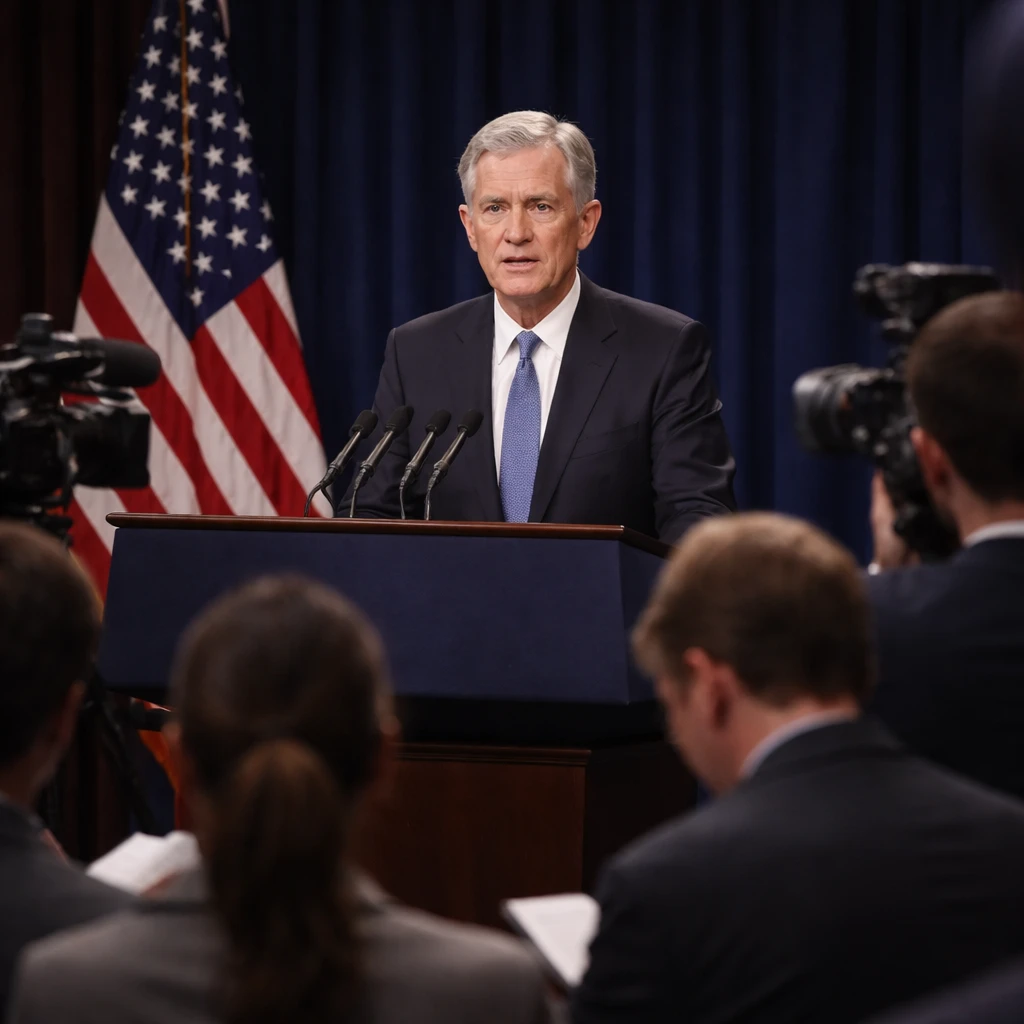
The Federal Reserve opted to keep its benchmark interest rate unchanged on Wednesday, a decision that matched market expectations and left little surprise for investors. Chair Jerome Powell signaled that the central bank is prepared to remain on hold after having implemented a total of 75 basis points in rate cuts at the end of last year.
During the postdecision press briefing, Powell declined to address an inquiry from the Trump administration concerning the renovation of a Fed office building. Instead of answering questions on the probe, Powell pointed reporters to an extraordinary statement he issued earlier this month in which he characterized the investigation as punishment for not setting interest rates to the president's preferences.
With the Federal Open Market Committee decision already priced into markets, Wall Street exhibited a muted reaction. The benchmark S&P 500 index finished the session essentially unchanged, and the blue-chip Dow Jones Industrial Average also ended the day flat. The NASDAQ Composite recorded modest gains.
Below are perspectives from a range of economists, strategists, and market analysts on the Fed decision, Powell's remarks, and what investors should keep in mind going forward.
Market calm and a focus on data
Gabriel Shahin, founder and principal at Falcon Wealth, said the central bank's lack of surprises was constructive for markets. Shahin noted that when the chair does not deviate from expectations it reduces market anxiety, even if rates remain elevated for a longer period. He emphasized that the Fed is focused on data rather than headlines and suggested investors should avoid overreacting to each press conference. Shahin recommended constructing portfolios that are resilient to a high-rate environment and maintaining discipline instead of trying to time policy moves.
Voting behavior and internal dynamics
Richard de Chazal, an analyst at William Blair, described the meeting as unsurprising given the Fed's decision-making pattern since December. He noted that the main source of potential surprise would have been the makeup of dissenting votes. De Chazal observed that it was expected for Governor Miran to vote for an additional cut, consistent with his stance since joining the Board in September. He added that Governor Waller's vote in favor of a further cut was somewhat unexpected and has prompted speculation that the vote could be aimed at bolstering Waller's prospects for the Fed chair role.
Economic outlook and the path of cuts
Matthew Luzzetti, chief U.S. economist at Deutsche Bank, interpreted the statement and press conference as reflecting an improved growth outlook relative to December. Luzzetti quoted Powell's observation that the growth outlook had "clearly improved" since the previous meeting and argued that this reduced the near-term need for rate cuts. Deutsche Bank views the December move as likely the final reduction in this easing cycle under Powell's leadership. Luzzetti said that while risks remain - including the possibility of weaker labor market outcomes triggering earlier cuts - new information suggests policy is near neutral and may not require further easing in the near term. He characterized expectations for a single rate cut this year in September as more balanced following the meeting.
Independence and political tensions
Diane Swonk, chief economist at KPMG, commented on Powell's stance toward institutional independence. Swonk suggested that Powell would remain at the Fed if he believed political interference posed a serious threat, highlighting his bipartisan support in Congress which has, in her view, limited the confirmation of overtly political nominees. She said Powell refused to engage with questions about tensions with the White House during the presser. Swonk assessed that the Fed is likely to remain on hold on rates through at least mid-year. She rated the probability of a June rate cut as less than a coin toss and noted that a new Fed chair might choose to wait an extra meeting before cutting to reassure markets. Swonk added an observation about trust in institutions being slow to accumulate and quick to erode.
Powell's public posture
Justin Wolfers, a professor of economics at the University of Michigan, described Powell's demeanor in the press conference as direct, clear, apolitical, and focused on economic issues. Wolfers suggested Powell's approach was to let his performance as Federal Reserve chair answer his critics.
Labor market signals
Samuel Tombs, chief U.S. economist at Pantheon Macroeconomics, expressed concern that the Fed's rhetoric about the labor market had shifted prematurely and become complacent. Tombs highlighted a deterioration in the three-month average of private payroll growth, noting it stands at 29,000, down from 57,000 at the time of the December meeting. His view implies greater downside risk to the labor market than reflected in the FOMC's recent tone.
Market pricing and the timing of easing
Renaissance Macro Research suggested that market participants should view any Fed easing before June as an indication that something materially negative has occurred in the economy. The group observed that little was priced into markets ahead of June, reinforcing the view that the Fed was unlikely to ease prior to that point absent a notable deterioration in economic conditions.
Overall, the Fed's decision to pause and Powell's avoidance of political commentary left investors with limited new policy signals. Analysts differed on how to read the committee's posture, with some seeing a reduced near-term need for cuts and others warning that labor market softness could change the calculus. For market participants, the prevailing message from the meeting was stability - the Fed has signaled a readiness to remain on hold while continuing to monitor incoming data.