
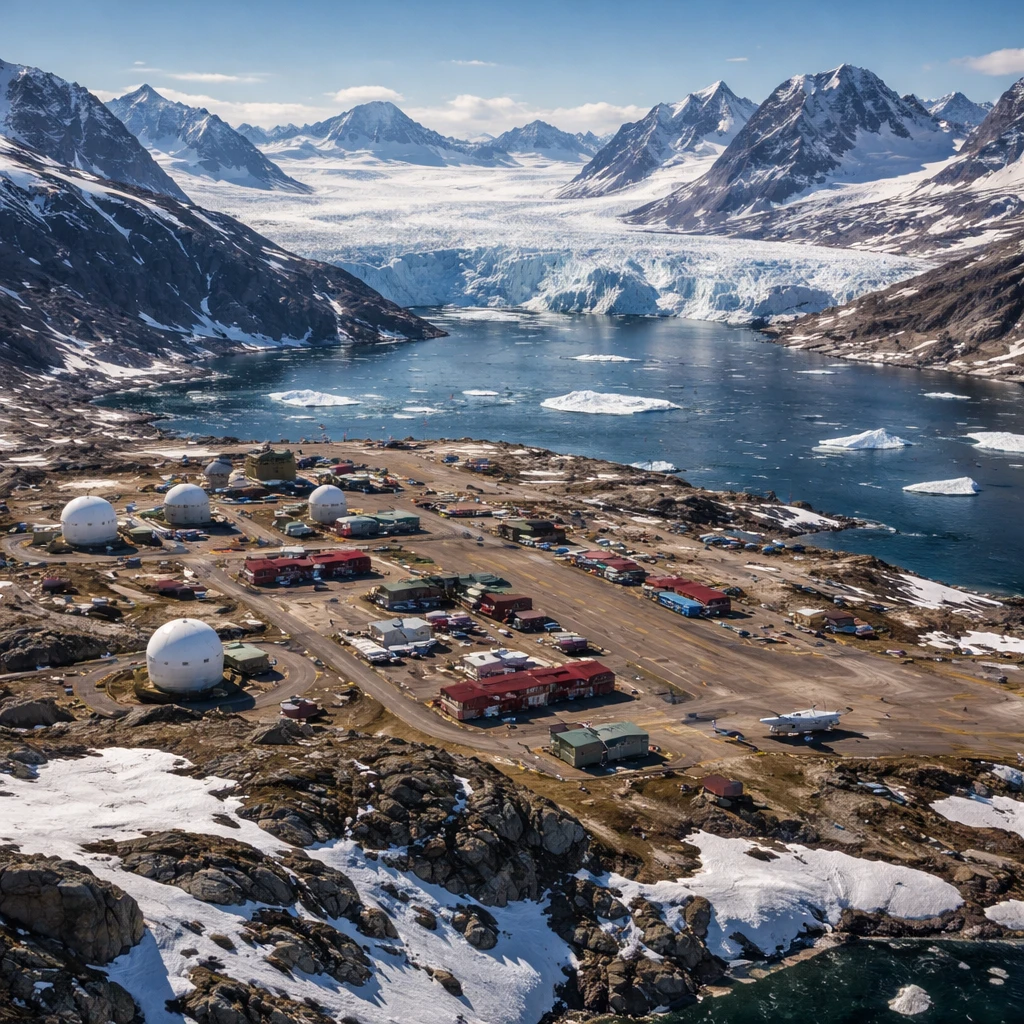
President Donald Trump has periodically reiterated his intent to acquire Greenland, an expansive Arctic island currently governed by Denmark. Despite Denmark's consistent rejection of any sale, Trump suggested on Wednesday that military action to obtain Greenland was off the table, citing a NATO agreement to secure U.S. access to the territory. Nevertheless, comprehensive details about this agreement remain scarce.
The absence of an existing market for territories makes determining Greenland's value speculative. Nevertheless, Otto Svendsen, an Arctic expert at the Center for Strategic and International Studies, indicated that acquiring Greenland could cost nearly $1 trillion. This estimation encompasses payment for the land itself, compensations to Greenland’s inhabitants, and the substantial expenditures needed to support its social infrastructure, defense, and upkeep.
The prospect of allocating such an immense sum has triggered criticism from investors and political opponents alike, especially given the United States' substantial national debt of $38 trillion. Some critics argue funds might be more judiciously used to address pressing domestic concerns, such as healthcare, as expressed by Democratic Representative Brendan Boyle from Pennsylvania.
Any territorial addition to the United States must clear significant constitutional hurdles. The expansion of U.S. territory traditionally requires a treaty, ratified by a two-thirds Senate majority—equivalent to 67 senators. This process means President Trump would need bipartisan support, including from at least 14 Democrats, assuming unanimous Republican backing. However, skepticism about purchasing Greenland transcends party lines; for instance, Senator Lisa Murkowski of Alaska emphasized respecting Greenland's sovereignty as a non-negotiable principle.
Given Greenland’s modest population of roughly 57,000, statehood appears improbable. Alternatives such as establishing a “compact of free association,” which ties financial aid to a U.S. security presence, or a territorial status akin to Guam or Puerto Rico, could be considered. Yet, federal lands fall under congressional jurisdiction, further complicating unilateral executive action.
The U.S. Constitution entrusts Congress with control over federal expenditures. Although the current Republican majority has shown support for President Trump's executive spending initiatives—sometimes bypassing congressional approval—allocating hundreds of billions of dollars, comparable to the entire defense budget, would be challenging without legislative endorsement.
Strategically, proponents of the Greenland acquisition argue it is essential to counter emerging Russian and Chinese interests in the Arctic and to compensate for Denmark's perceived inability to guarantee the island’s security. However, the United States maintains an existing base on Greenland with potential for expansion. Additionally, Greenland possesses abundant rare-earth and critical minerals, though extraction of oil and gas is currently prohibited due to environmental restrictions. Mining activities face bureaucratic obstacles and opposition from indigenous groups.
Senator Mitch McConnell underscored the robustness of NATO alliances and U.S.-Danish military cooperation, noting that the administration had not identified any essential necessity for Greenland that Denmark’s sovereign people would not accommodate. This statement highlights the strong existing relationships and strategic partnerships that complicate unilateral U.S. acquisition efforts.