
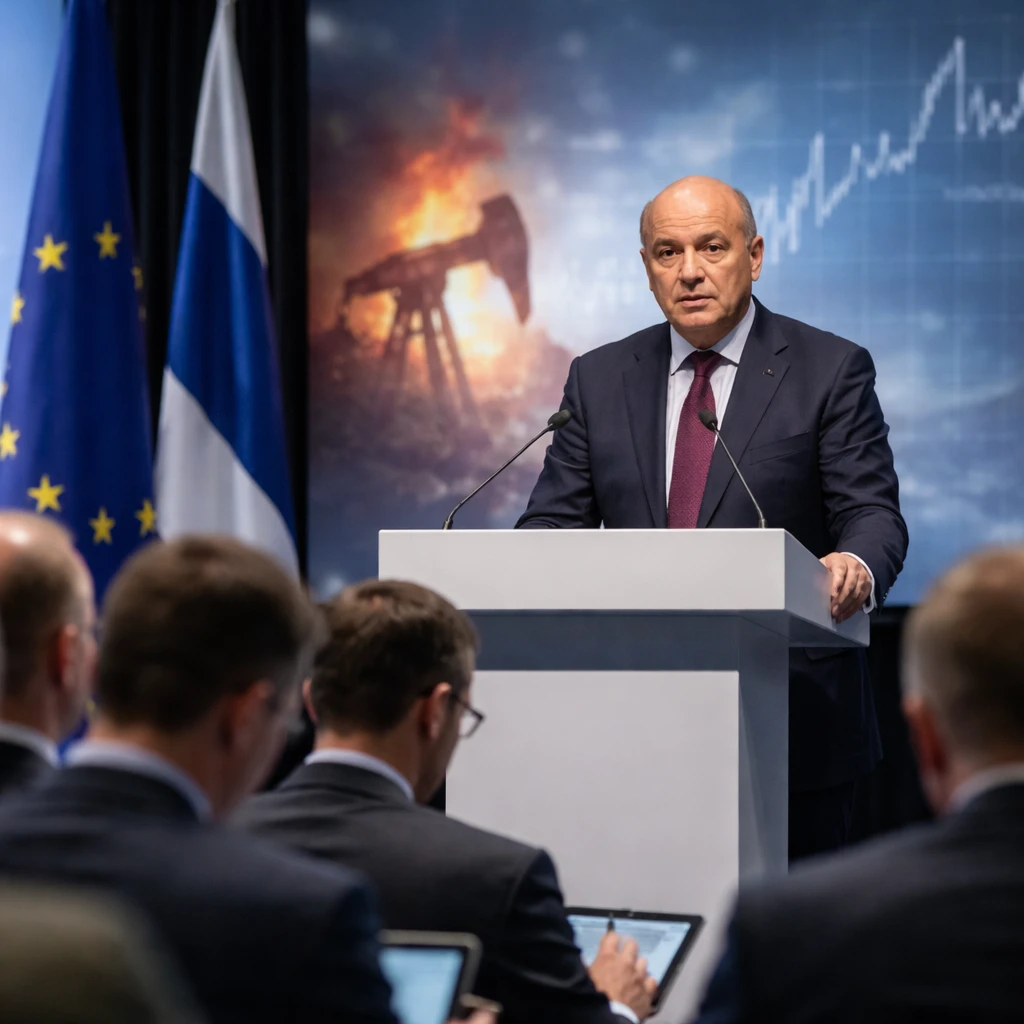
European Central Bank Vice President Luis de Guindos told an audience in Estonia that the near-term financial impact of the U.S.-Israeli military campaign against Iran has, to date, been contained, but that significant uncertainties remain.
De Guindos said the initial assessment shows direct bank exposures to the region are limited and that the euro-area banking system is "well positioned" thanks to solid profitability together with robust capital and liquidity buffers. He also highlighted that European Union markets, including central counterparties focused on energy, have managed margin requirements "effectively" despite recent spikes in oil volatility.
While markets broadly expect the conflict to be "relatively short-lived," de Guindos cautioned against complacency. He flagged the possibility that the fighting could precipitate the "unravelling of interconnected vulnerabilities" and generate broader systemic stress.
"It threatens to derail market sentiment at a time when asset valuations are high, potentially leading to a sharp repricing of risk for leveraged borrowers and sovereigns and amplifying stress in the non-bank financial sector," de Guindos said.
The vice president's comments came against a backdrop of diplomatic developments and military movements. Iran is reportedly examining a 15-point peace proposal from the U.S., while President Donald Trump has been urging aides to secure a rapid end to the fighting. Despite those reported efforts, the parties remain far apart on terms to halt hostilities, and the Pentagon has been moving to deploy additional ground troops to the Middle East.
Energy markets have responded to the conflict. Oil climbed back above $100 a barrel on Thursday and has stayed well above pre-war levels of around $70 a barrel. That jump has rekindled concerns that energy-driven price shocks could re-ignite inflationary pressures across economies globally, including within the Eurozone.
ECB President Christine Lagarde has indicated that policymakers could consider raising interest rates even if price increases are "not-too-persistent." The ECB left its key policy rate unchanged at 2% last week but noted an uptick in inflationary pressures.
De Guindos said the war is expected to push energy prices higher and to lift inflation above the ECB's 2% target in the near term, though he stressed the central bank is "well positioned" to operate through an uncertain monetary policy environment. He added a caveat: if the energy shock endures longer than currently expected, Europe could face both higher inflation and weaker growth.
On the medium-term outlook, de Guindos made clear that much depends on three main factors: how far the conflict spreads, how long it lasts, and the intensity and duration of the resulting energy shock. He also noted that outcomes will hinge on how the energy shock propagates into consumer prices and the wider economy through indirect and second-round effects.
Summary
ECB Vice President Luis de Guindos said the immediate financial spillovers from the U.S.-Israeli conflict with Iran have been contained so far, pointing to limited direct bank exposure and resilient banking-sector buffers. He warned that a broader or prolonged conflict and a sustained energy shock could push inflation above the ECB's target, depress growth, and trigger systemic stress across leveraged borrowers, sovereigns and non-bank financial institutions.
Key points
- Direct bank exposures to the conflict region are limited; euro-area banks have strong profitability and robust capital and liquidity positions.
- European markets and central counterparties dealing with energy have met margin demands "effectively" despite oil-price volatility.
- Higher energy prices are expected to lift inflation above the ECB's 2% target in the near term, with potential consequences for monetary policy.
Risks and uncertainties
- Escalation or prolonged duration of the conflict could cause an "unravelling of interconnected vulnerabilities," increasing systemic stress - affecting banks, non-bank financial institutions, leveraged borrowers and sovereign borrowers.
- A persistent energy-price shock could mean higher inflation and lower growth in Europe, complicating the ECB's policy response and raising risks for markets sensitive to interest-rate expectations.