
European Central Bank economists report that recent increases in U.S. tariff rates have been borne largely by American businesses and consumers, with foreign exporters shouldering a minimal share of the added costs. The study, released Monday, traces the movement of tariff-related costs along the supply chain for goods shipped to the United States between January and November 2025.
The report covers a period in which the statutory effective tariff rate applied to imports into the United States rose from 3% to over 18% between January and November 2025. Using a pricing-chain framework, the researchers followed how those higher statutory tariffs affected foreign exporters, U.S.-based distributors, producers and retailers, and finally consumers.
Their core finding is that exporters deliver almost all of the tariff increases forward in the form of higher export prices. The study estimates that exporters are passing through about 95% of the cost of tariffs. In concrete terms, a 10% increase in tariffs has corresponded to roughly a 9.5% rise in the prices of affected imports, leaving foreign firms to absorb only about 5% of the extra cost.
The economists estimate the immediate burden on U.S. consumers at around one-third of the tariff increase. Survey responses from American firms, however, point to a potentially larger share falling on consumers over time: companies indicate that the consumer portion could climb to more than half once firms have exhausted their internal capacity to absorb higher input costs.
Should foreign exporters continue to limit their absorption of higher tariffs, the central-bank analysis projects that U.S. firms - including distributors, producers and retailers - would end up covering roughly 40% of the tariff increases in the longer run.
The study also documents notable declines in both import prices and volumes after the tariff hikes. Measured unit values of imported goods net of tariffs have shown slightly negative year-on-year changes since April 2025. Import volumes have fallen sharply overall, with the report estimating an aggregate elasticity of -3.7. That elasticity implies that a 10% tariff increase is associated with a 37% decline in import volumes.
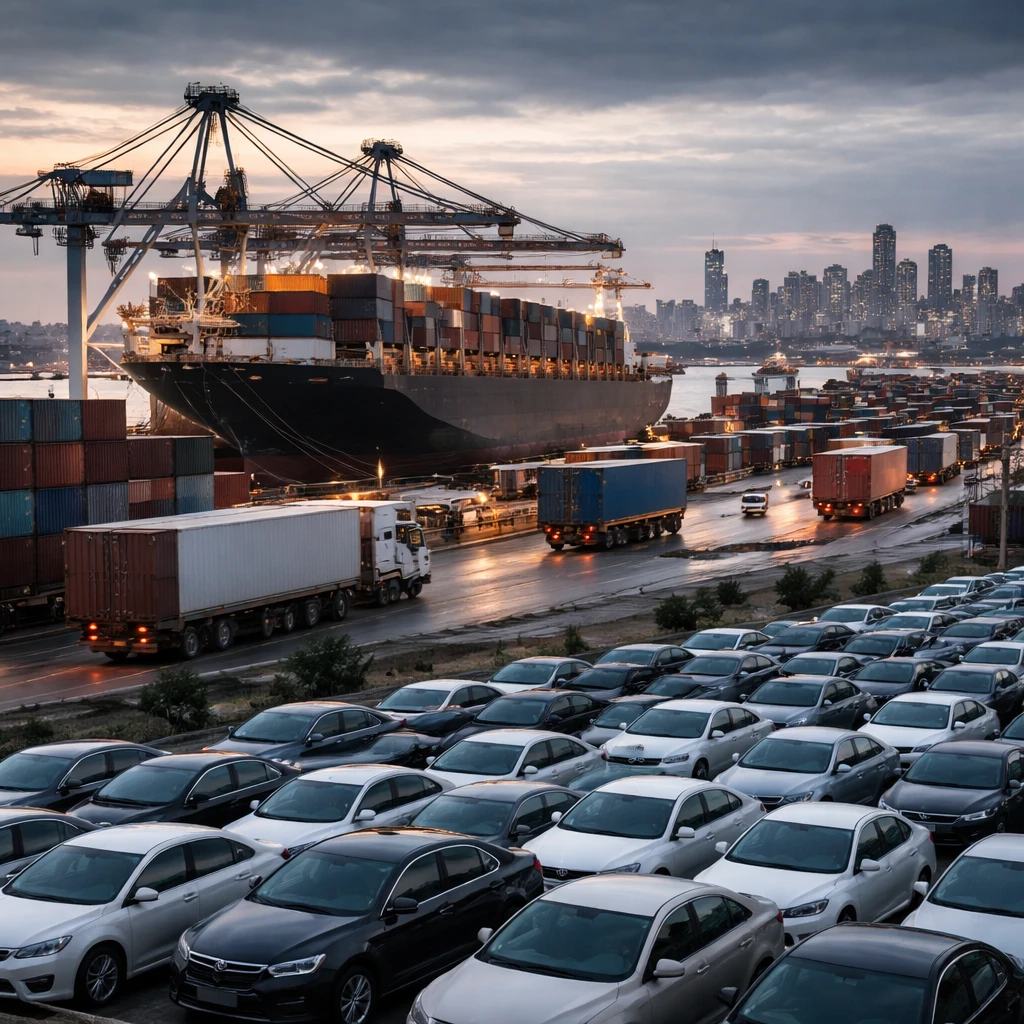
Trade in the automotive sector displayed particularly pronounced adjustments. The analysis finds clear signs of a reorientation of U.S. auto sourcing away from China and the European Union and toward regional partners Canada and Mexico. Car imports from Canada and Mexico increased markedly, while exports to the United States from the EU and Japan experienced both lower unit values and steep volume decreases.
For the subset of goods that continue to be traded under tariffs, the volume response is smaller but still material: the researchers estimate that a 10% tariff rise corresponds to a 4.3% reduction in import volumes for products that remain traded under the tariff regime.
The World Trade Organization's figures cited in the analysis show that the statutory effective tariff rate on U.S. goods reached 18.2% in November 2025, though the WTO's calculation based on customs data indicates a lower actual effective rate of 9.8%.
The ECB economists' calculations underscore two linked developments in the wake of tariff increases - near-complete pass-through of higher statutory tariffs into import prices, and substantial contractions in the volume of imports. The distribution of the burden is evolving: while consumers now bear a significant share, survey evidence and the study's projections suggest a shifting balance toward larger costs for U.S. firms if foreign exporters do not increase their absorption of tariff rises.