
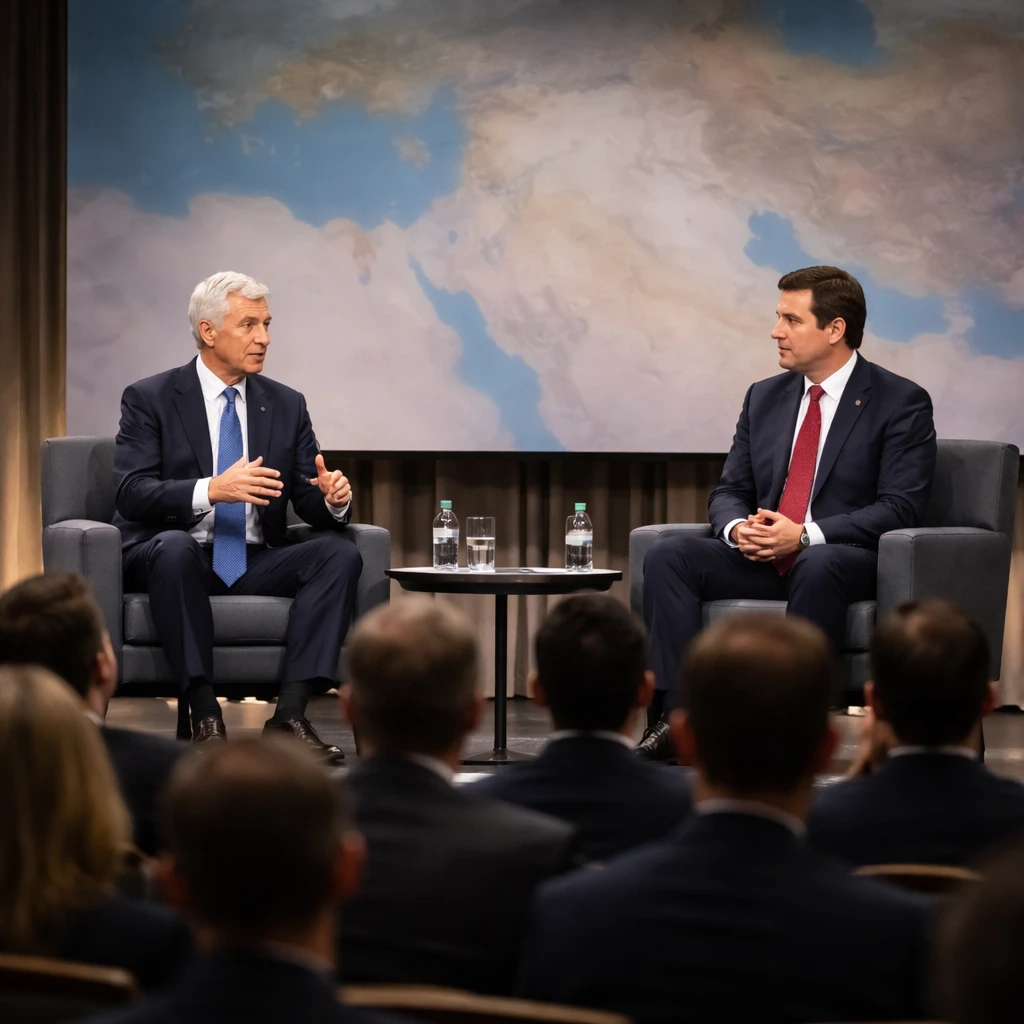
JPMorgan Chase chief executive Jamie Dimon said Tuesday that the ongoing war involving Iran creates immediate uncertainties but may ultimately strengthen the prospects for lasting peace across the Middle East.
In a conversation with Palantir executive and former Congressman Mike Gallagher at a conference in Washington, D.C., Dimon described the present dynamics as more conducive to a long-term settlement than those of two decades ago. "I think the Iran war makes it a better chance in the long run - it's probably riskier in the short run, because we don't know the outcome of it," he said.
Dimon pointed to what he described as a convergence of interests among several regional actors. He listed Saudi Arabia, the United Arab Emirates, Qatar, the U.S. and Israel as parties that now desire permanent peace, and he highlighted that Persian Gulf states have demonstrated a particular willingness to pursue that goal. "The attitude is not what the attitude was 20 years ago," he said. "They all want it."
The CEO tied these geopolitical observations directly to economic consequences. Dimon warned that foreign direct investment, which had been moving into the region for years, would evaporate if stability were undermined. "They can't have neighbors lobbing ballistic missiles into their data centers," he said, underlining the connection between security and capital flows.
Dimon also used the forum to critique U.S. industrial policy and preparedness. He said the country needed to "get our act together" on industries tied to national security, and he cited the inability to produce sufficient munitions as an example that motivated his $1.5 trillion initiative launched last year. "I am deeply frustrated about our own policies in America which set us back," he said. "We've become like Europe, we're unable to move and change, change budgeting, change procurement."
On trade and strategic dependency, Dimon said the U.S. government and the corporate sector "made a huge mistake" in their dealings with China over recent decades by becoming reliant on key components from that country. He said there had been an assumption that China would liberalize politically and economically, and he added, "There was this general assumption they'd become more Democratic and free, and it didn't really happen that way."
The conflict escalated last month after the U.S. and Israel carried out hundreds of strikes on Iran, including one that killed the country's supreme leader. The war has had market consequences: oil prices surged amid supply disruptions.
Dimon framed the situation as one with two time horizons - an elevated near-term risk profile for markets and security, and a potential for a more stable regional order if current pressures prompt lasting political realignment. His remarks connected geopolitics to capital allocation and industrial resilience, and they underscored his focus on policy and manufacturing capabilities he views as critical to national security.
Key takeaways:
- Dimon sees higher near-term risk from the Iran war but a possible improvement in long-term prospects for Middle East peace.
- He warned that instability would deter foreign direct investment, linking security to economic flows.
- Dimon urged U.S. policy changes to shore up industries tied to national security and criticized past dependence on China for critical components.