
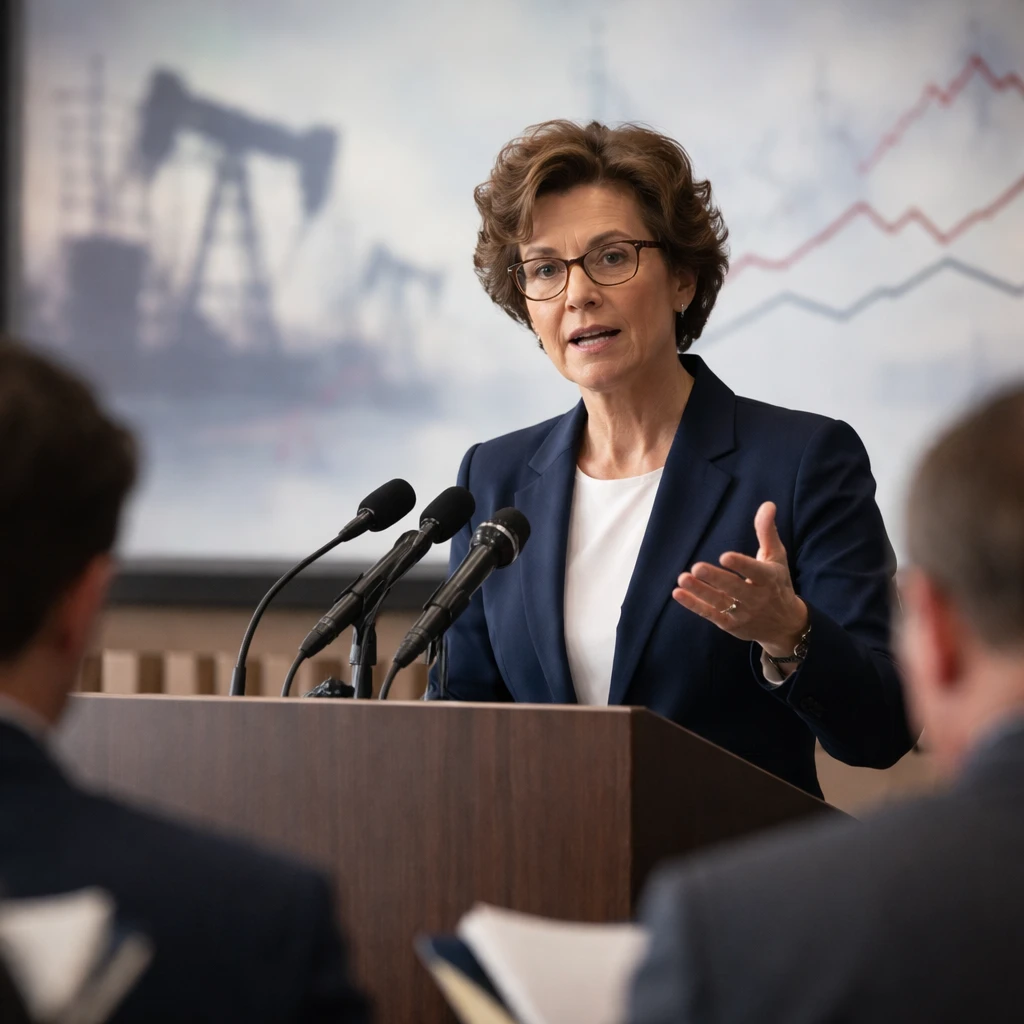
Federal Reserve Bank of San Francisco President Mary Daly said Monday that elevated uncertainty calls for a scenario-driven analysis rather than adhering to a single modal outlook.
Daly sketched two distinct potential trajectories for the economy linked to developments in the Middle East and their effects on energy markets.
In the first scenario, the conflict is resolved quickly, allowing oil and other energy prices to decline. Under that outcome, Daly said the economic impact would be short-lived and relatively muted. In that environment, it would likely be reasonable to look through a temporary uptick in energy costs, provided that inflation expectations remain well anchored.
The alternate scenario is one in which the conflict extends over a longer period. In that case, disruptions to energy supply and the attendant cost pressures could persist. Daly warned that such a development would increase the risk of higher inflation, slower economic growth, and a weaker labor market. Those conditions, she said, would intensify the tradeoffs facing monetary policy and make it more difficult to balance the risks to both sides of the Fed's dual mandate.
On the outlook for monetary policy more broadly, Daly rejected the notion of a single most-likely path. With policy currently in a good place, she argued that the Federal Reserve needs to retain flexibility and the capacity to respond rapidly as risks evolve.
Daly acknowledged that this emphasis on scenarios and flexibility can appear vague. She explained that providing too much forward guidance in an environment of heightened uncertainty risks creating a false sense of certainty. That, she warned, could reduce rather than enhance transparency and complicate the public's ability to anticipate how the Federal Open Market Committee would respond.
She concluded that the appropriate approach is to recognize the underlying uncertainty, examine plausible scenarios, and remain committed to restoring price stability while supporting full employment regardless of which path the economy follows.
Summary
Mary Daly recommended scenario analysis in the face of elevated uncertainty, outlined two possible outcomes tied to the duration of conflict in the Middle East and its effect on energy prices, and urged the Fed to remain flexible while avoiding overconfident forward guidance.
Sectors potentially impacted
- Energy - through movements in oil and broader energy prices.
- Financial markets - via changing inflation and growth expectations that affect monetary policy prospects.
- Labor - through risks to employment should slower growth materialize.