
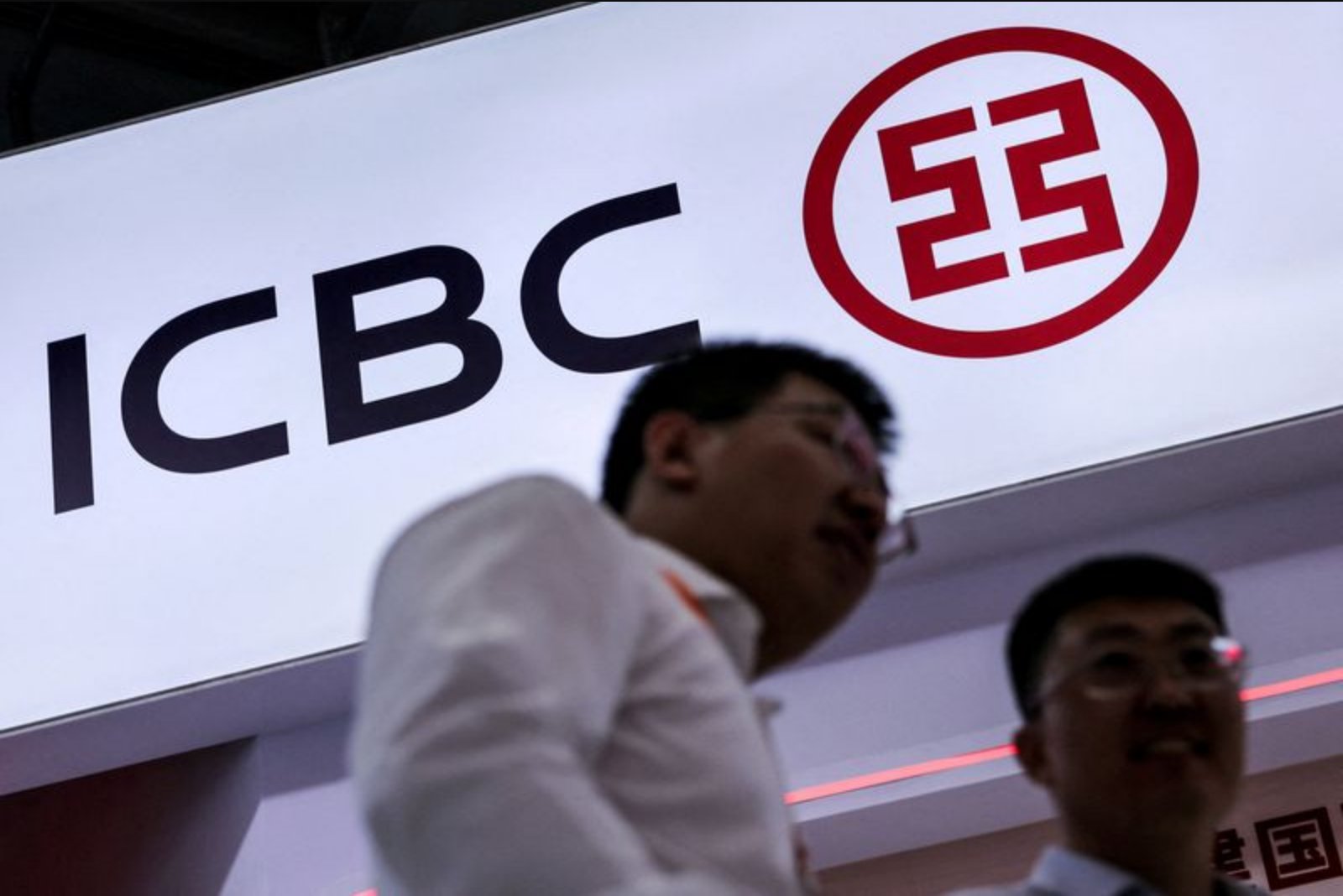
China's leading state-owned lenders may see a rebound in profitability in 2026 as a wave of maturing, high-cost time deposits is expected to roll over at substantially lower rates, easing pressure on banks' funding costs.
Analysts point to nearly 54 trillion yuan of time deposits at listed banks slated to mature next year. Zhang Yiwei, an analyst at China Galaxy Securities, estimated that rolling over maturing three-year deposits at current rates would cut banks' funding costs by roughly 135 basis points versus 2023 levels. Zhang calculated that this repricing would lift aggregate net interest margins by about 12 basis points - a meaningful improvement for an industry that has seen margins squeezed to record lows.
The top-five state banks - among the world's largest lenders - enter this period after a difficult 2025. Those lenders weathered a deepening property sector debt crisis and a slowing economy, effects that showed up in their annual results released this week. LSEG data indicate mixed outcomes for 2025 profits: Industrial and Commercial Bank of China (ICBC) is estimated to report a 2% decline in net profit, China Construction Bank a 0.4% decline, while Agricultural Bank of China is forecast to post 2.3% growth but at a slower pace than the prior year. Bank of China and Bank of Communications are each projected to record growth below 1%.
Looking to 2026, the same data set suggests an improvement for most of the top-five. Three of the five banks are expected to report year-on-year net profit growth in the range of 2.3% to 3.3%, with Bank of China and Bank of Communications forecast at 0.9% and 1.5% growth, respectively.
Why deposit repricing matters
Deposit rates in China have been tightly controlled and progressively lowered by the regulator over the past four years, a policy stance designed in part to protect lenders' profit margins. That control, combined with repeated cuts to benchmark lending rates amid weak credit demand, compressed net interest margins and pushed banks to hunt for alternative income sources.
Huatai Securities has put the amount of maturing time deposits at a record 50 trillion yuan for 2026, underscoring the scale of the potential repricing event. Some large banks have already adjusted their funding mix; since late last year, several have removed five-year certificates of deposit from their product lines, products that typically carried higher yields.
Market pricing on new three-year time deposits reflects the change: interest rates on newly issued three-year deposits offered by multiple banks fell to around 1.5% in early 2026, roughly half the levels seen in 2023. That drop in offered deposit yields is central to analysts' expectations that net interest margins will stabilise and begin to recover.
Analyst views and timeframe for recovery
Zhang framed deposit repricing as the principal engine for a rebound in bank earnings in 2026 and a stabiliser of margins. S&P Global Ratings' Ming Tan echoed that expectation, saying: "We expect margin pressure to alleviate for Chinese banks and stabilise in 2027, driven primarily by deposit repricing."
Analysts also note banks are directing more capital toward technology and innovation-oriented firms, aligning with Beijing's stated push to expand artificial intelligence and other strategic industries. While that redeployment could reshape loan books over time, the immediate margin relief is tied to lower funding costs as deposits mature and are reissued at reduced yields.
Risks and macro headwinds
Despite the potential for margin improvement, the outlook is subject to notable uncertainties. The ongoing conflict in the Middle East could lift global oil prices and introduce cost-push inflation, complicating the economic picture for China and increasing pressure on corporate margins, employment and wages. Analysts at CITIC Futures warned that sustained high oil prices from the conflict would increase the likelihood of further rate cuts in China as policymakers respond to growth shocks.
Domestically, weak credit demand and structural strains - including the property sector's debt challenges and trade frictions - continue to cloud the medium-term growth outlook. China met its roughly 5% growth target for 2025 supported by an export surge, but a Reuters forecast referenced in market commentary suggested growth could slow to about 4.5% in 2026. Slower growth and continued asset quality concerns would limit banks' ability to translate margin improvement into robust profit expansion.
What markets will watch
Investors will be watching commentary from major Chinese banks closely for signals on credit growth, margin trajectories and asset quality through 2026. The stabilisation of net interest margins could give policymakers wider room to consider cuts to benchmark lending rates. That potential for policy easing, combined with deposit repricing, creates a dynamic that will influence lending conditions, bank profitability and broader financial-market expectations.
Exchange-rate context used in market reporting for dollar-denominated comparisons listed $1 = 6.8857 Chinese yuan renminbi.
For now, analysts' forecasts point to modest profit recovery for the largest state banks next year, driven largely by the technical effect of lower deposit costs as a large stock of time deposits reprices at considerably lower rates than during the 2023 peak in deposit yields.