
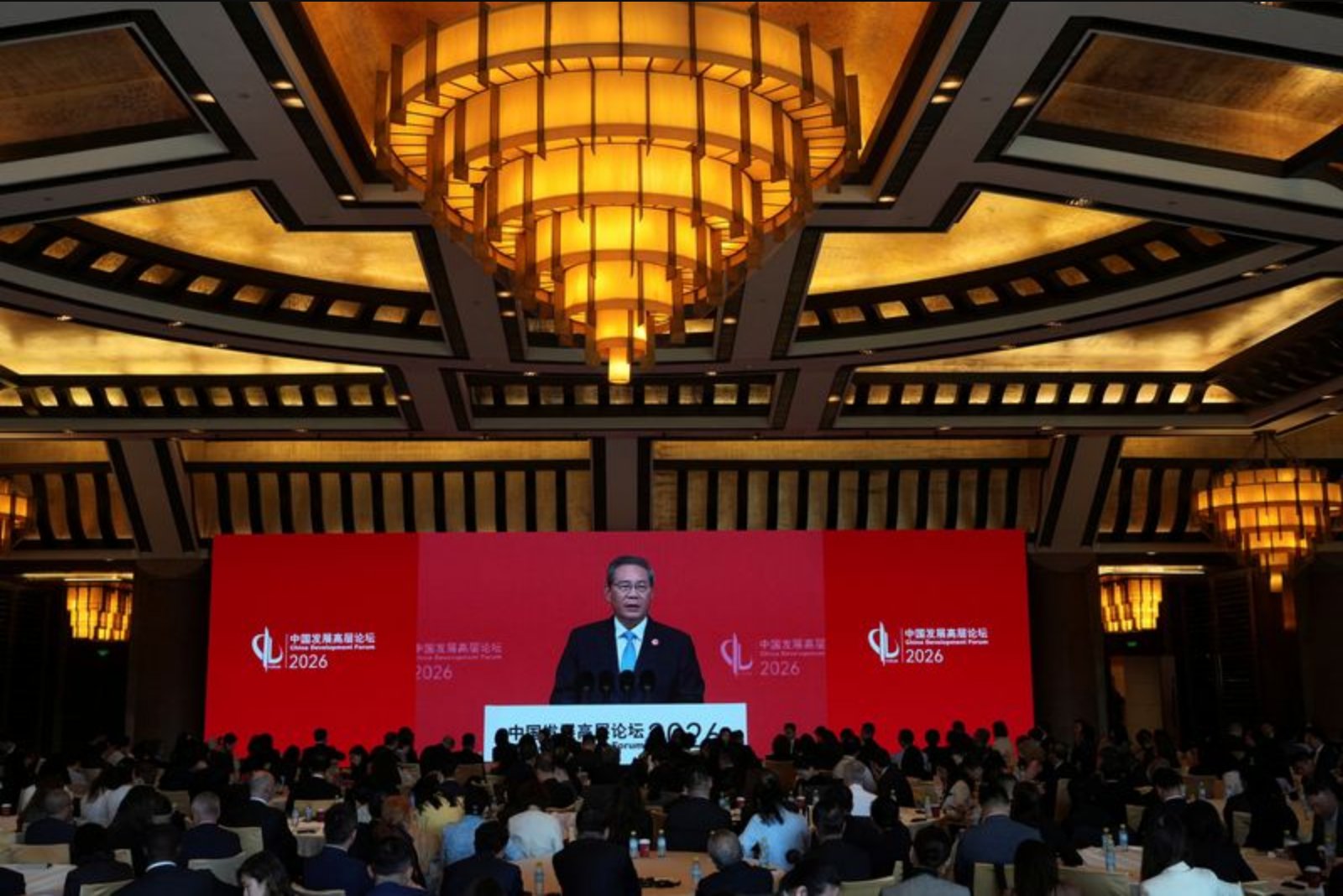
BEIJING - Chinese Premier Li Qiang used the platform of the China Development Forum to reiterate Beijing's intention to open markets further to foreign firms and to pursue a more balanced pattern of trade with global partners. Speaking at the annual two-day forum in Beijing, Li said China would "import more high-quality foreign goods" and would cooperate with other parties to "promote optimised and balanced trade development and expand the global trade pie," according to state media.
The China Development Forum, which runs for two days and concludes on Monday, is a regular venue for Chinese authorities to set out their economic strategy and highlight investment openings to foreign business leaders, officials, academics and economists.
Li's remarks arrive against the backdrop of a record trade surplus for China - the world’s second-largest economy reported a $1.2 trillion trade surplus for 2025 - and at a time when trade tensions and tariff disputes with the United States and the European Union have been prominent.
Officials acknowledged the diplomatic sensitivity of large imbalances. While Li did not explicitly reference the surplus in his remarks, his commitments to boosting imports and balancing trade signal an awareness that such imbalances could affect international relations, particularly as China and the United States have reached a temporary truce on trade.
Last week, U.S. President Donald Trump postponed a planned trip to Beijing to meet Chinese President Xi Jinping because of the Iran war. The postponement delayed an effort to ease tensions between the two largest economies by deferring a high-profile visit.
In a separate address at the forum, People's Bank of China Governor Pan Gongsheng sought to contextualise concerns about imbalances. "Analysing global economic imbalances requires looking not only at trade in goods but also services, and not only at the current account but also the financial account," Pan said, according to a transcript of his speech published by the central bank. He added that China is the country with the largest goods surplus but also the largest services deficit.
Pan also addressed currency-related concerns directly, stating that China "has no need and no intention to gain trade competitive advantage through currency depreciation," a comment aimed at calming international unease over exchange-rate-driven competitiveness.
Efforts to revive foreign investment
Chinese leaders are also pursuing measures to reverse a recent drop in foreign direct investment. FDI fell 5.7% year-on-year to just over 92 billion yuan ($13.36 billion) in January, following a 9.5% decline over the course of 2025.
To attract foreign capital, Beijing expanded the list of sectors eligible for foreign investment incentives in December, adding 200 sectors that now qualify for measures such as tax breaks and preferential land use. The additions target advanced manufacturing, modern services and green and high-tech industries.
Li emphasised parity of treatment, saying foreign firms would be treated the same as domestic enterprises, and that companies from all countries should be able to operate in China with confidence and realise their ambitions.
In meetings on the sidelines of the forum, Commerce Minister Wang Wentao told representatives of a U.S. pharmaceutical trade group and executives from five major multinational drugmakers that China would strengthen intellectual property protection and improve policy transparency.
Corporate participation and attendee list
Senior executives from a range of multinational firms attended the forum, reflecting corporate interest in China despite geopolitical friction. Apple Chief Executive Tim Cook delivered a keynote in which he said the company would continue to work with Chinese suppliers to further advance the industry, state media reported.
Executives from Samsung Electronics, Volkswagen, Broadcom Inc, Siemens, BASF and Novartis were among those present, while major financial institutions including HSBC Holdings, UBS Group and Standard Chartered also sent representatives.
Exchange-rate data cited at the forum equated $1 to 6.8857 Chinese yuan renminbi.
The statements by top government and central bank officials at the forum outline Beijing's immediate policy messaging: reaffirm openness to foreign companies, address trade imbalance concerns by pointing to broader accounts and services, and take steps to stabilise and attract foreign investment in targeted sectors. Officials and visiting executives left the forum with reiterated commitments but also with clear signals that China recognises the international sensitivities around its trade position.