
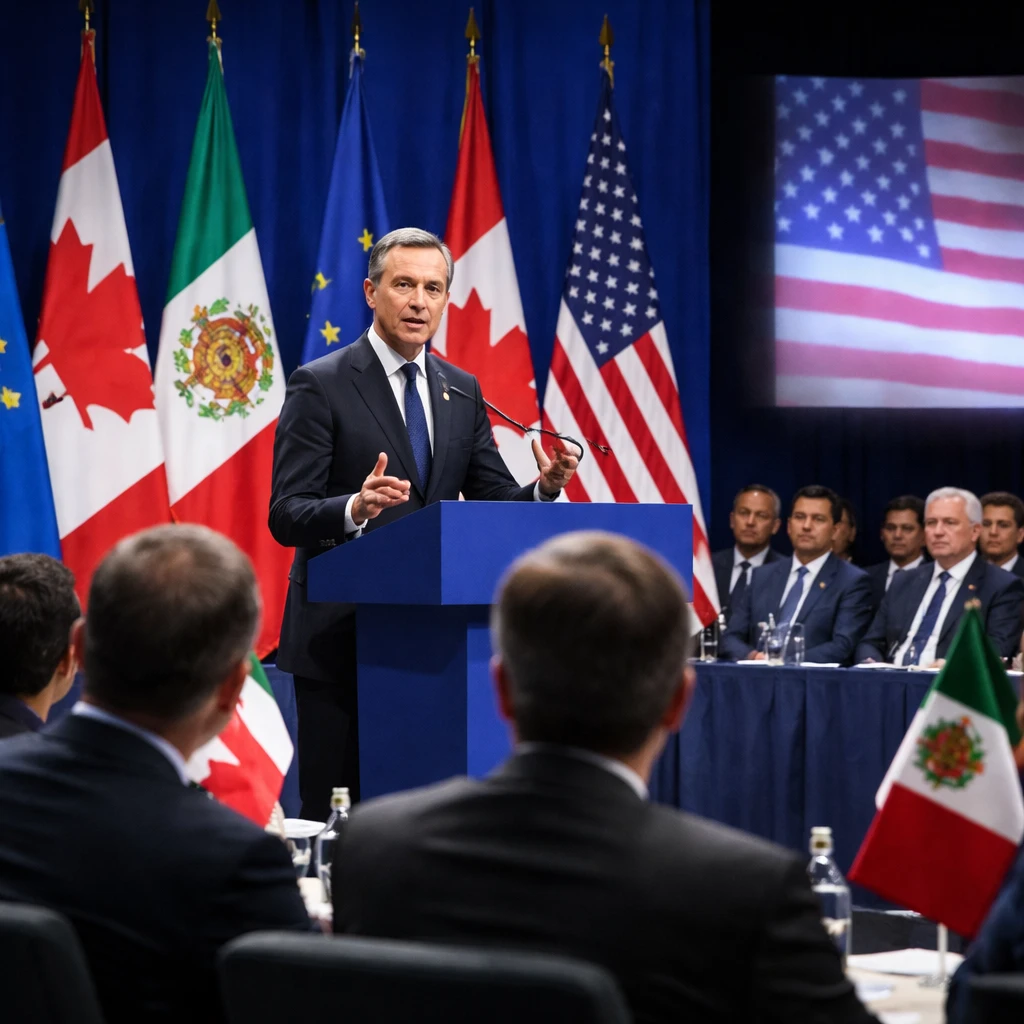
At the World Economic Forum held recently in Davos, Canadian Prime Minister Mark Carney delivered a significant address that has resonated strongly with political leaders in Mexico, fostering an unprecedented diplomatic alignment between the two North American nations. This emerging partnership comes as both Canada and Mexico confront escalating trade and territorial challenges originating from the United States.
Carney cautioned global audiences about the need for middle-ranking powers to dispense with the "pleasant fiction" of a reliably stable rules-based international order. Instead, he highlighted the necessity to prepare for a new reality where major powers actively exploit economic interdependencies as tools of dominance. He stated, "You cannot live within the lie of mutual benefit through integration, when integration becomes the source of your subordination," emphasizing the shifting dynamics in global economic relations.
Mexican President Claudia Sheinbaum publicly endorsed Carney's viewpoint during a press briefing, describing his analysis as well aligned with the contemporary global landscape. Her endorsement underscores a shared concern between Canada and Mexico regarding the diminishing certainty and enforcement of conventional rules governing international trade.
Further underlining this emerging unity, Mexican Federal Deputy Dolores Padierna Luna advocated for a coordinated approach between the two countries, particularly in preparation for the upcoming renegotiations of the Canada-United States-Mexico Agreement (CUSMA). She remarked, "I believe that Canada and Mexico need to speak more, always more deeply, and provide mutual support," highlighting the strategic imperative of synchronized policy positions.
Echoing this sentiment, opposition members in the Mexican legislature also recognized the value of Carney's address. Deputy Juan Ignacio Zavala Gutiérrez commended the Prime Minister’s speech as a "powerful, clear and intelligent" guidebook for nations seeking to protect their autonomy in the face of competing hegemonic powers.
The context for this evolving stance includes a series of provocative acts originating from Washington, such as social media posts depicting the U.S. flag superimposed over Canadian territory. Such displays have been met with strong condemnation; Padierna Luna described the imagery as "insulting" and "offensive," urging Canada and Mexico to unite in defense of their sovereignty.
Contrasting with the conciliatory tone of the Canadian and Mexican leaders, the speech by Carney drew a pointed rebuttal from U.S. President Donald Trump. Speaking from his own position at Davos, Trump asserted the primacy of the United States in continental security, stating, "Canada lives because of the United States." He further cautioned Carney directly, "Remember that, Mark, next time you make your statements," underscoring the tensions underpinning the trilateral relations.
The exchanges at Davos highlight deepening geopolitical rifts within North America that could influence trade dynamics, security arrangements, and diplomatic relations as leaders from Canada and Mexico seek common ground against an increasingly assertive United States.