
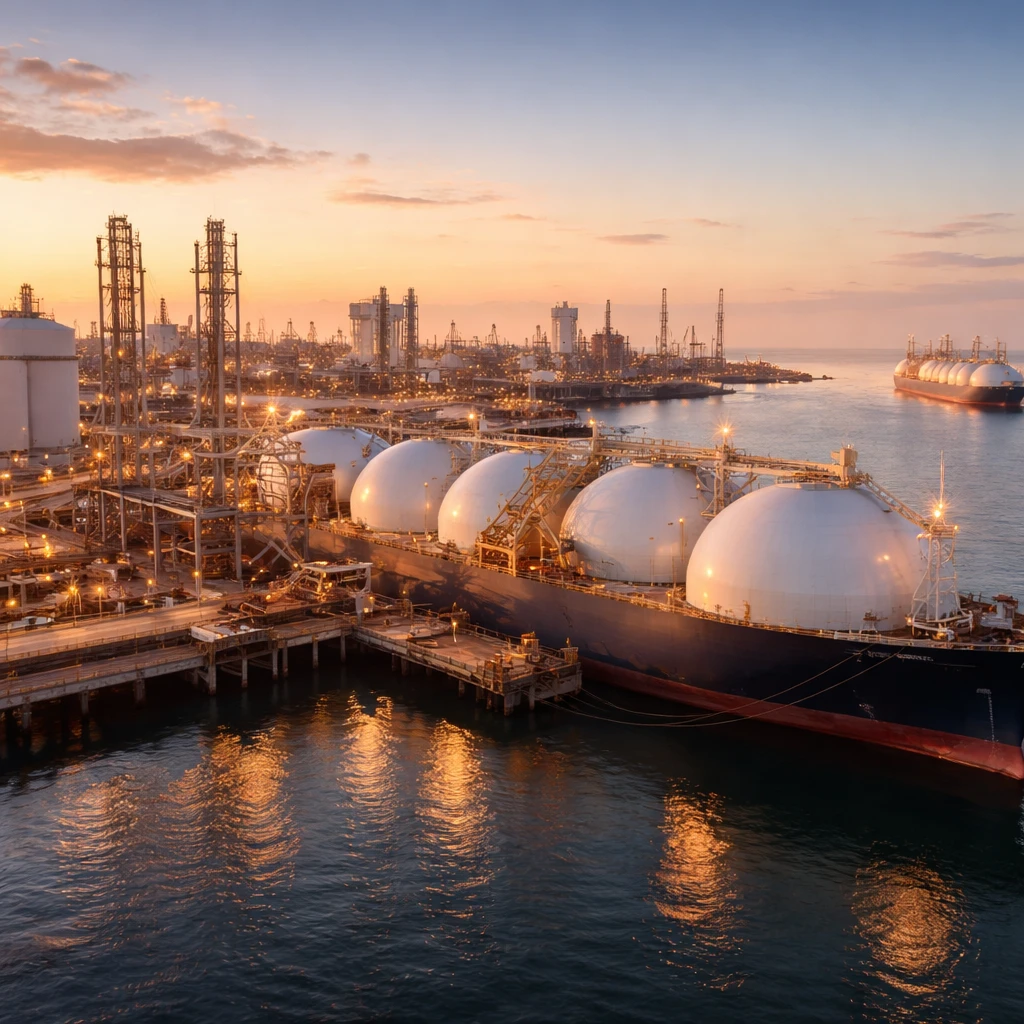
The global gas market is under strain after a combination of the Iran war and the shutdown of important Qatari liquefied natural gas facilities. The resulting supply shock has elevated prices and raised urgent questions about whether U.S. LNG can stabilize Europe’s energy supply as the continent seeks alternatives to pipeline gas and reduced reliance on Russian energy.
Europe has shifted toward the global LNG market to make up for diminished pipeline deliveries. That dependence exposes the region to tighter worldwide inventories and greater price volatility as buyers compete on the open market.
The United States has emerged as a significant source of LNG amid this reorientation. Robust shale gas output and the commissioning of new export capacity along the Gulf Coast have enabled higher U.S. shipments to global buyers, including those in Europe.
According to a note from Bernstein, the stoppage of Qatari LNG flows and disturbances around the Strait of Hormuz have driven up global gas prices. Europe’s benchmark TTF has risen to about $16 per mmbtu, while prices in Asia have climbed even further, intensifying competition for cargoes.
Despite the heightened demand, analysts caution that the United States has limited room to expand physical LNG supply to Europe on short notice. Bernstein reports that U.S. export terminals are already operating near their maximum sustainable rates, with recent export volumes running at roughly 94% of peak capacity. Key facilities such as Sabine Pass, Corpus Christi, and Freeport are producing close to their top output, leaving little spare production to be squeezed out.
That constraint means U.S. assistance would likely come through rerouting existing cargoes rather than lifting overall volumes. U.S. LNG contracts are generally sold on a free on board basis without destination restrictions, which allows shippers to redirect shipments initially bound for other regions to Europe if market conditions warrant.
However, market prices are currently steering cargoes away from Europe. Asian LNG prices have surged, creating a price gap that makes shipments more lucrative if diverted eastward rather than toward European ports. Bernstein estimates that European gas prices would need to rise an additional 40 percent to 50 percent to attract sufficient U.S. cargoes away from Asia should the Qatari export disruption persist for several months.
Direct European dependence on Qatari LNG is relatively modest in percentage terms - about 8 percent of Europe’s LNG imports in 2025 - yet the closure of Qatari facilities has broader consequences. Around 20 percent of global LNG supply normally transits the Strait of Hormuz, and interruptions there propagate throughout the market.
Compounding these pressures, Europe’s gas storage levels remain below historical norms after a cold winter, reducing the region’s buffer and increasing urgency to secure supplies ahead of the upcoming heating season.
Analysts say the episode underscores how vulnerable Europe remains to global energy shocks even as it has reduced direct reliance on Russian pipeline gas in recent years. With U.S. export capacity largely utilized and global prices favoring Asia, Europe faces a difficult balancing act between securing near-term volumes and managing price signals that drive cargo flows.
Summary
The halt to Qatari LNG shipments and disruptions around the Strait of Hormuz have tightened global gas markets, pushing European benchmark prices to about $16 per mmbtu and lifting Asian prices even higher. While the U.S. is a major LNG supplier, its terminals are near full capacity and can mainly redirect existing cargoes. Analysts estimate Europe would need a 40 percent to 50 percent price increase to attract enough U.S. cargoes away from Asia if the disruption lasts several months. Europe’s gas stores are below average after a cold winter, leaving the region exposed to ongoing supply volatility.
Key points
- U.S. export capacity is a critical source of global LNG but is operating near full utilization - recent volumes are about 94 percent of peak capacity. Impacted sectors: Energy production, export infrastructure, commodities markets.
- Price dynamics currently favor deliveries to Asia over Europe, with Europe’s TTF near $16 per mmbtu and Asian prices higher, creating a significant eastward pull on cargoes. Impacted sectors: Utilities, energy trading, shipping.
- Europe’s storage and import profile increase vulnerability - Qatari LNG accounted for roughly 8 percent of Europe’s LNG imports in 2025 and about 20 percent of global LNG normally moves through the Strait of Hormuz. Impacted sectors: Energy security, industrial energy consumers, power generation.
Risks and uncertainties
- Prolonged shutdown of Qatari facilities or continued Strait of Hormuz disruption could sustain elevated global gas prices and keep cargo competition intense. Impacted sectors: Energy, utilities, industrial users.
- Limited spare export capacity in the U.S. constrains the ability to raise physical LNG deliveries to Europe quickly; relief would likely come from redirecting existing shipments, which depends on price incentives. Impacted sectors: LNG shipping, terminal operations, commodity traders.
- Below-average European gas storage after a cold winter increases exposure to future supply interruptions and price spikes ahead of the next heating season. Impacted sectors: Residential heating, power generation, broader economic activity reliant on stable energy supply.