
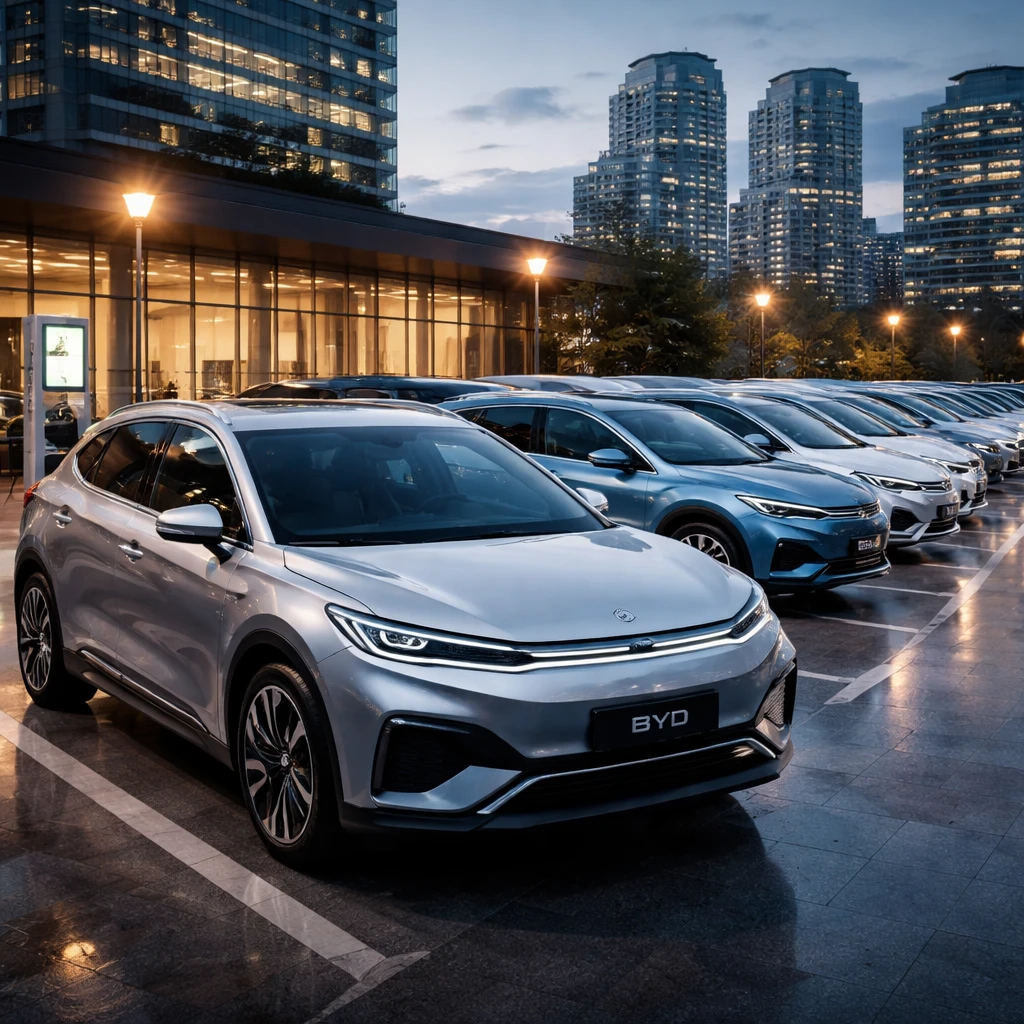
Chinese automaker BYD more than tripled its European Union registrations in the first two months of 2026, ACEA data show. The company recorded 29,291 registrations in January-February, up 179.2% from 10,491 a year earlier, making BYD a clear standout in an otherwise soft market.
Overall new car registrations across the EU declined 1.2% year-on-year to 1,664,680 units in the two-month period.
Electric vehicle trends
Battery-electric vehicles (BEVs) continued to expand their footprint. BEVs accounted for 312,369 registrations, a 22.3% increase from 255,463 in the same period of 2025, and represented 18.8% of the market compared with 15.2% a year earlier.
Hybrid-electric vehicles remained the most-registered powertrain, totaling 643,898 units and representing 38.7% of new-car registrations.
Plug-in hybrid vehicles (PHEVs) also increased their share, reaching 162,751 units or 9.8% of registrations, up from 7.4% a year earlier. Growth in PHEV volumes was particularly pronounced in several markets: Italy saw volumes more than double at 116.1%, Spain rose 71.5%, and Germany increased 23.8%.
Fossil fuel vehicle share and country-level movements
The combined share of petrol and diesel vehicles fell to 30.6% from 38.7% a year earlier. Petrol registrations dropped 23.3% to 374,774 units, while diesel registrations declined 17.7%, together accounting for 8.1% of new registrations.
Among the four largest EU markets for BEVs, which together represent 61% of BEV registrations, performance varied. France recorded a 38.5% rise, Germany a 26.3% increase, while the Netherlands declined 34.9% and Belgium fell 11%.
Petrol registrations contracted sharply in several major markets. France posted the steepest decline at 48.5%, followed by Germany at 22.8%, Spain at 20.8% and Italy at 18.6%.
Manufacturer performance
Among major manufacturer groups, Stellantis delivered the strongest growth, rising 9.5% to 304,251 units. Volkswagen Group remained the market leader with a 27% share but slipped 0.7% to 449,294 units. Renault Group fell 16.1% to 161,262 units, with Dacia down 30.9%.
Tesla increased registrations by 16.7% to 20,941 units. SAIC Motor rose 6.6% to 32,214 units. Jaguar recorded zero registrations in January-February 2026, compared with 446 a year earlier, reflecting the British brand's model transition.
The ACEA data portray a market where electrified powertrains continue to gain ground even as total registrations slightly retreat, and where individual manufacturers and national markets display divergent trajectories.