
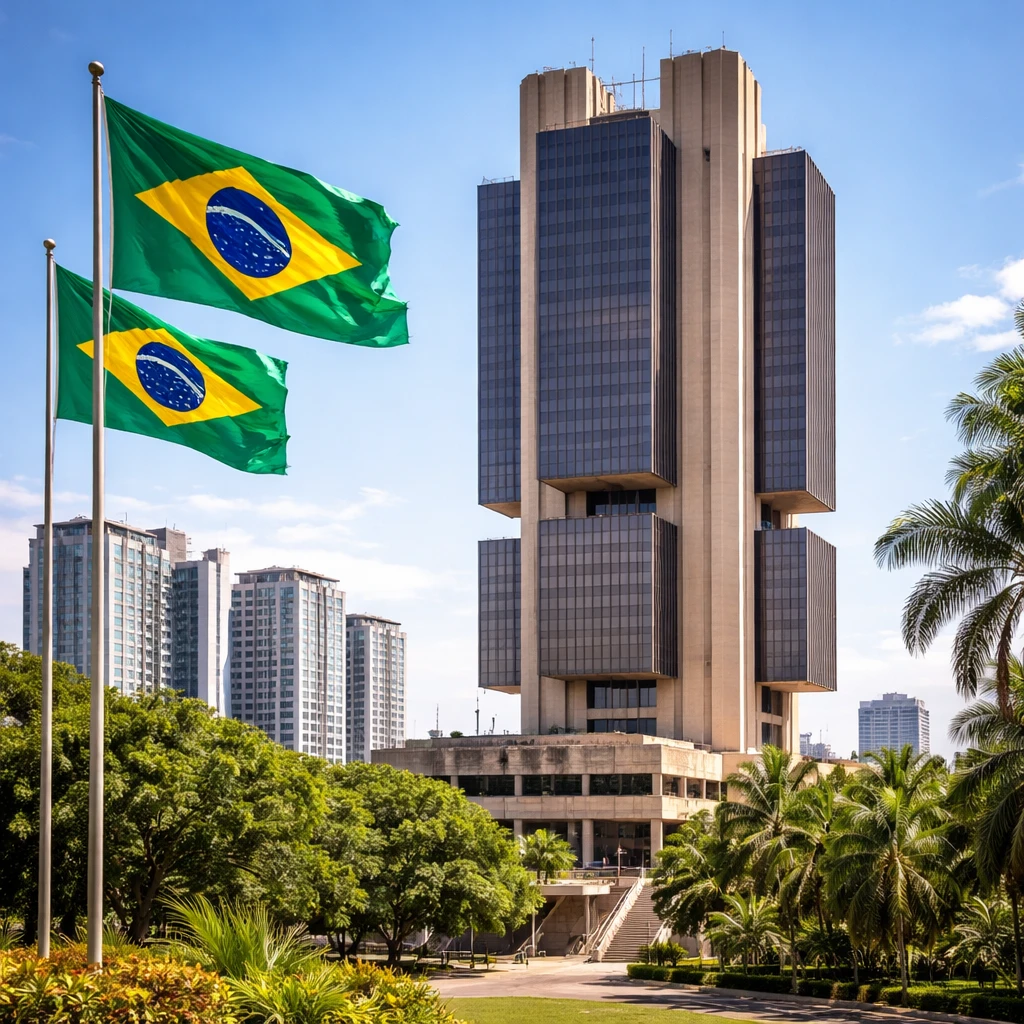
Brazil's central bank appears poised to commence a cycle of interest rate reductions in March after holding rates steady for nearly two years, driven by the need to rejuvenate a sluggish economy, according to a recent Reuters poll of economists.
Currently, the benchmark Selic interest rate stands at a high 15%, a figure that has been unchanged through five consecutive meetings, including the one scheduled for January 28. In the latest survey conducted between January 19 and 22 among 35 economists, 32 anticipate the rate will remain static at the January meeting. However, a small minority predict early movements with two forecasting a modest 0.25 percentage point cut to 14.75% and one expecting a more substantial 0.5 percentage point decrease to 14.5%.
Looking ahead, the consensus strongly leans towards an initial rate cut occurring in March. Of the 34 economists who addressed this question, 28 believe the monetary policy committee, Copom, will take this step then. Among these, 15 expect a half-point reduction, while 13 foresee a quarter-point cut followed by gradual easing.
This potential shift follows a prolonged period in which the bank maintained a hawkish stance to counter inflationary pressures, involving rate hikes and stabilizations at elevated levels. The last rate reduction occurred in May 2024, preceding this tight monetary phase.
Analysts emphasize that declining inflation trends underpin this anticipated policy change. Citi economists highlight that the reduction in inflation expectations and a slowdown in current inflation rates support the viability of initiating a rate-cutting cycle by March.
Inflation data reflects this trend, with annual inflation finishing the previous year at 4.26%, dipping below the 4.5% upper limit of the central bank's target range of 3% plus or minus 1.5 percentage points. This improvement might be signaled through subtle amendments in the central bank’s next policy statement, suggesting a shift in outlook. EQI Asset's chief economist, Stephan Kautz, notes the potential removal of language hinting at possible future rate hikes, and the inclusion of terms like "gradual," "parsimony," and "lagged effects" to convey the imminence of easing.
Economic growth in Brazil is forecast to slow during the first half of the year, with consumer prices expected to decelerate further before accelerating again towards the end of 2026, as indicated by a separate Reuters poll. Median forecasts from 47 economists estimate GDP growth of 1.8% for the current year, somewhat down from 2.3% projected for 2025. Official GDP statistics for the previous year will be published in March.
Regarding economic risks, among 18 economists responding to an auxiliary question about GDP forecast uncertainties, 12 believe growth could surpass expectations, while six anticipate a slower expansion than projected.
Stimulus measures are expected to play a significant role in driving growth, particularly through increased household consumption. BNP Paribas economist Laiz Carvalho points out that initiatives implemented during late 2025 and early 2026 are forecasted to boost household spending.
One notable government action includes permitting 14 million terminated workers to withdraw a combined 7.8 billion reais (approximately $1.45 billion) from a public insurance fund. This disbursement is intended to provide immediate financial relief and stimulate consumption.