
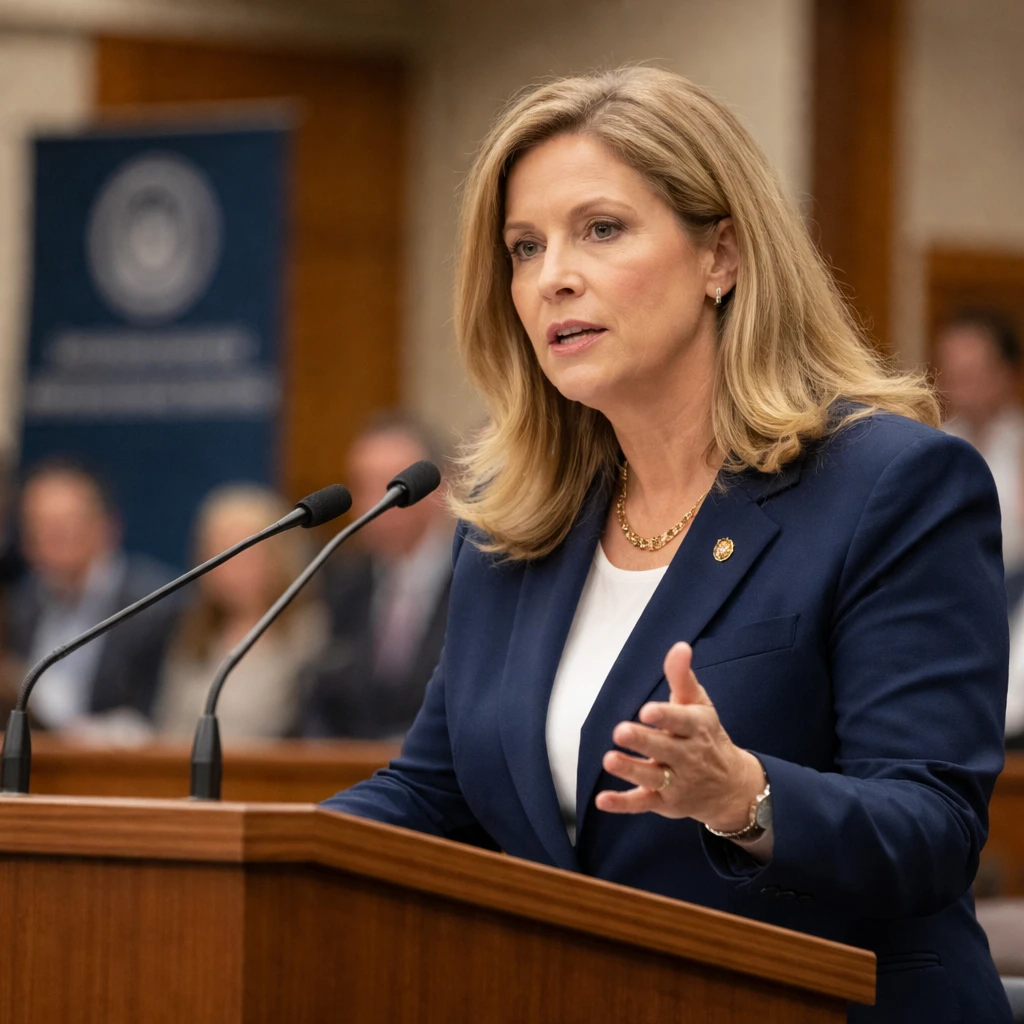
Federal Reserve Vice Chair for Supervision Michelle W. Bowman said on Friday that her policy emphasis is shifting toward guarding workers against a sudden deterioration in employment, even as the central bank maintained its current interest rate stance.
Speaking at the Southwestern Graduate School of Banking, Bowman highlighted a marked slowdown in private payroll gains, noting that private payroll growth averaged just 30,000 per month in the final quarter of last year. She characterized the present employment dynamic as a "low-hiring, low-firing" environment that could quickly tip into sizable layoffs if broader economic activity weakens.
On the outlook for monetary policy, Bowman set out a clear path for easing over the coming year. "Looking ahead to 2026, my Summary of Economic Projections includes three cuts for this year," she said, signaling an expectation for multiple reductions in borrowing costs next year.
Bowman acknowledged that the Fed's most recent decision to pause rate moves was a "close call." She said the pause reflected a balance between guarding against labor-market risks and waiting for clearer data. Citing prior easing, she noted that after 75 basis points of cuts last year, the central bank can afford to "keep policy powder dry" while the Fed awaits more accurate signals following the government shutdown.
Despite the decision to hold rates this month, Bowman stressed that the labor market remains fragile and that policy makers should be prepared to shift course if employment conditions deteriorate. She pointed out that inflation remains somewhat elevated because of tariff-related effects, but expressed confidence that inflation will decline to 2 percent as those one-off shocks fade.
Bowman framed the Fed's posture as conditional and ready to act if necessary. She warned that the current apparent stability in jobs could give way abruptly. "History tells us that the labor market can appear to be stable right up until it isn't," she said, underscoring the risk that a "jobless expansion" could eventually stall overall economic activity and prompt policy response.
Clear takeaways
- Bowman is redirecting focus to defend employment following a sharp slowdown in private payrolls late last year.
- Her personal projections include three rate cuts in 2026, even as the Fed paused recently.
- The Fed is maintaining readiness to adjust policy should job conditions worsen, and views recent inflation pressures as partly driven by tariffs that should subside.