
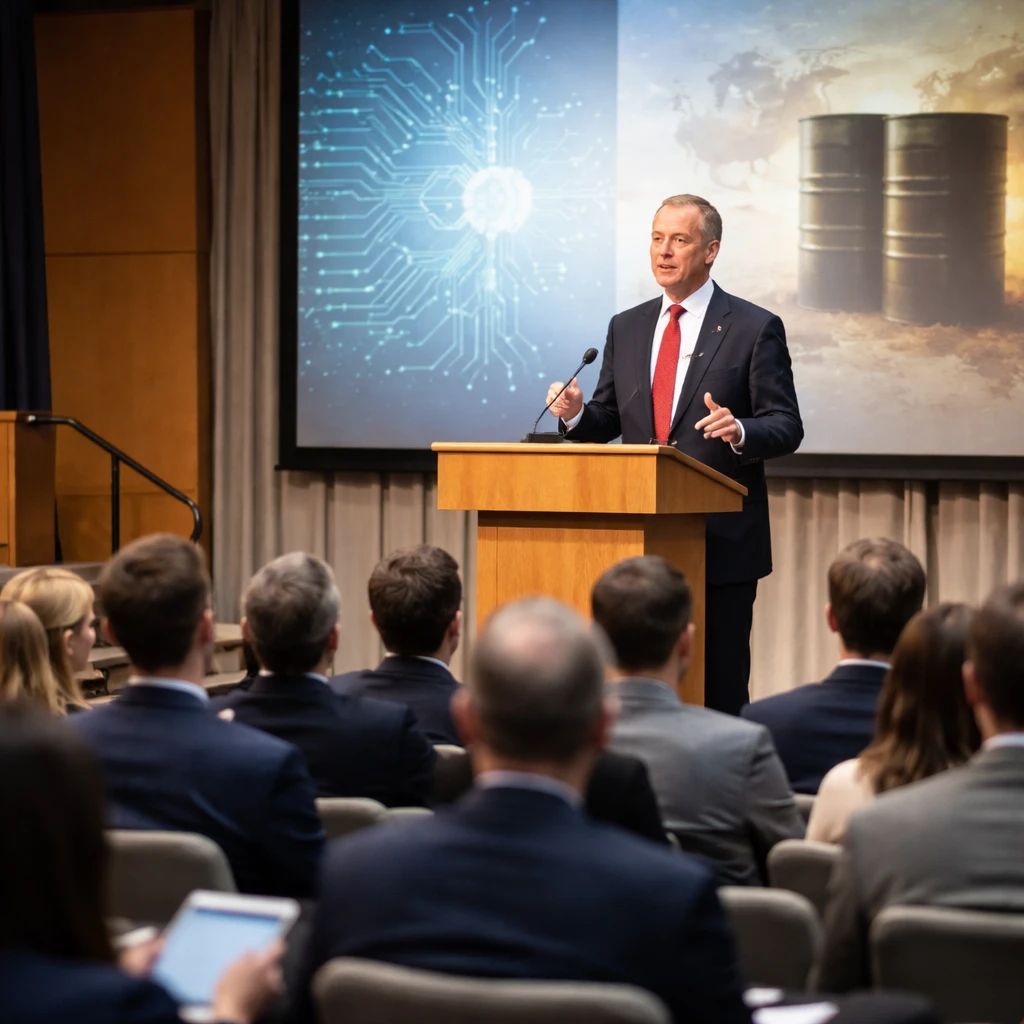
Tom Barkin, president of the Federal Reserve Bank of Richmond, said Friday that uncertainty enveloping the U.S. economy has increased over the past year, driven in large part by developments in artificial intelligence and the conflict in Iran. Barkin delivered his remarks at the Appalachian Highlands Economic Forum hosted at East Tennessee State University in Johnson City, Tennessee.
Barkin said many policy questions that were outstanding last year have been settled, yet fresh uncertainties have emerged. He highlighted the speed of AI developments, citing an announcement by Block that it plans to replace 40% of its workforce with AI and pointing to nearly $700 billion in AI investments announced within a single week. Those developments, Barkin said, have added a new and powerful dimension to the economic outlook for businesses and policymakers.
At the same time, Barkin argued the Iran conflict has injected additional ambiguity into the global economic picture. He said the dispute has prompted spikes in oil prices and disruptions to supply chains. Barkin referenced historical episodes in which oil price shocks coincided with recessions, noting the years 1974, 1979, and 1990 as previous instances.
Despite those sources of uncertainty, Barkin noted that the U.S. economy expanded by 2% last year. He said consumer spending has continued, a pattern visible in recent credit card data, and attributed the resilience to low unemployment, gains in real wages, and elevated asset values. Business earnings, he added, rose by double digits in the fourth quarter.
On labor markets, Barkin described a mixed picture. The unemployment rate has averaged roughly 4.4% over the past six months, a rate he said has been seen only three times in recent decades. Yet employment growth is nearly flat, and younger workers are encountering difficulty finding jobs. Barkin explained that low levels of hiring are being balanced by lower net migration and retirees from the baby-boom generation leaving the workforce.
Inflation remains above the Federal Reserve's 2% goal by about one percentage point, Barkin said, although it has come down from rates above 7% in 2022. He pointed to slowing shelter price growth and easing wage pressures as signs of progress, but warned that recent personal consumption expenditures inflation data indicate that disinflationary progress may be losing momentum.
Turning to firms' hiring behavior, Barkin said employers report that labor is readily available and that many have multiple applicants for each opening, with little upward pressure on wages. He noted low turnover and widespread reluctance among employers to add staff, a stance he attributed to a combination of strong productivity, elevated uncertainty, and the potential labor-market effects of AI.
On the subject of AI and employment, Barkin cautioned that much of the current conversation focuses on potential job losses. He also signaled a possible countervailing force: AI could enable revenue and employment growth through improved sales targeting and business expansion, so long as skills mismatches can be resolved.
Regarding monetary policy, Barkin recalled that the Federal Reserve has cut interest rates by 175 basis points over the prior 18 months, leaving the federal funds rate at the higher end of what he characterized as the neutral range. At the Fed's most recent meeting, with risks present for both employment and inflation, Barkin said policymakers opted to hold rates steady in order to await clearer signals.
Context and implications
Barkin framed the current environment as one in which previously unresolved policy questions have largely been addressed, but new and distinct sources of uncertainty have arisen. His comments emphasized the dual nature of recent developments: persistent macroeconomic resilience on measures such as growth and consumer spending, alongside fresh geopolitical and technological risks that complicate near-term forecasting.