
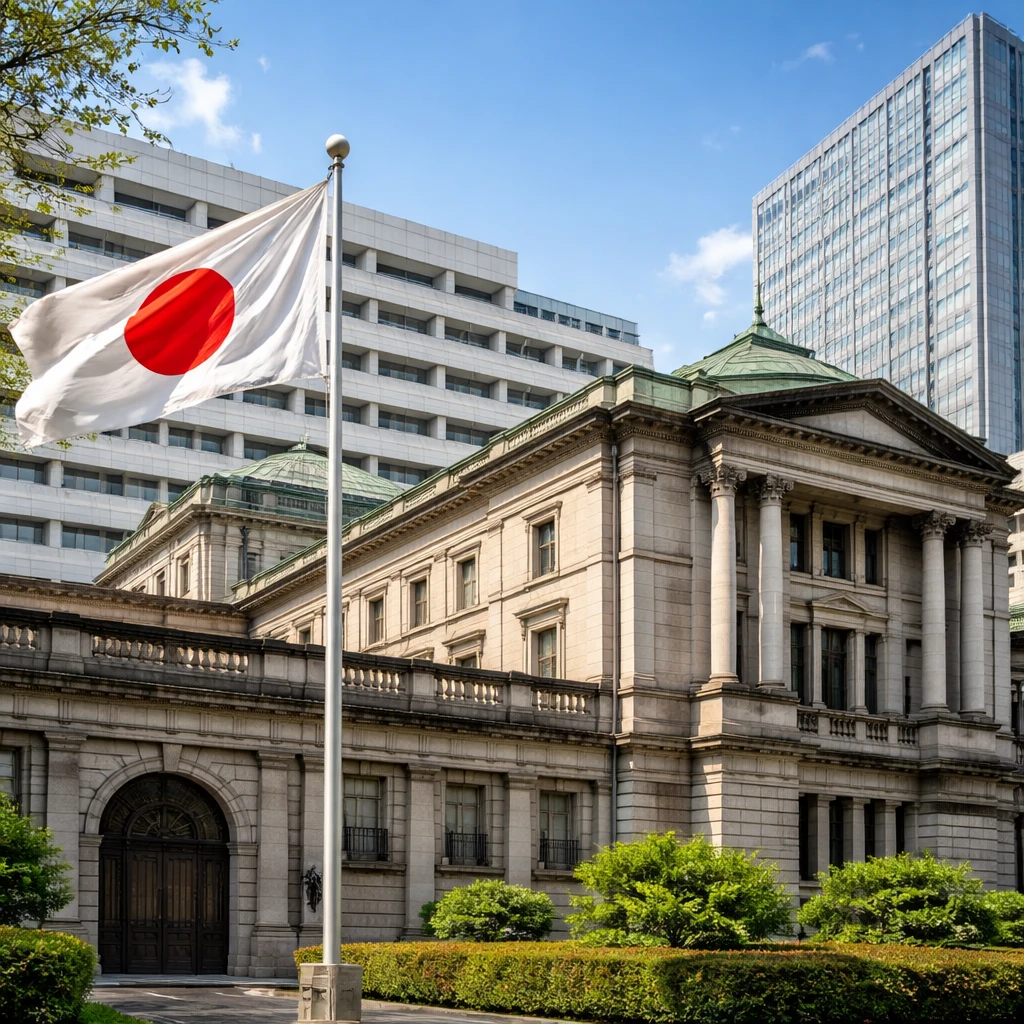
On Friday, the Bank of Japan (BOJ) decided to keep its benchmark overnight call rate unchanged at 0.75%, a move anticipated by market participants following last December's 25 basis point interest rate hike. The decision garnered strong backing from the BOJ's monetary policy board, with eight of nine members supporting the hold, and only board member Hajime Takata dissenting in favor of an additional 25 basis point increase.
The central bank further updated its macroeconomic outlook, raising growth and inflation projections for the fiscal years 2025 and 2026. Specifically, the BOJ now projects real GDP growth to range between 0.8% and 0.9% in fiscal 2025, an upward revision from the previous 0.6% to 0.8% estimate. For fiscal 2026, GDP growth is forecast to be between 0.8% and 1.0%, also reflecting an increase from prior estimates of 0.6% to 0.8%.
Regarding inflation, the central bank slightly lowered its core consumer price index (CPI) inflation projection for fiscal 2025, while elevating the fiscal 2026 core CPI forecast to a band of 1.9% to 2.0%, up from an earlier range of 1.6% to 2.0%. This revision underscores expectations of a gradually accelerating inflationary environment beyond next year.
The BOJ's decision aligns with its policy framework, which anticipates that interest rates will continue to rise as the economy expands and price levels increase, aiming to sustain inflation near the 2% target. The bank highlighted expected boosts to private consumption and household spending stemming from forthcoming government initiatives, including measures to reduce energy costs and enact tax reforms in 2026.
These forecasts and policy stances were released shortly after data indicated a marked slowdown in Japanese CPI inflation during December, although the underlying inflation rate remains above the 2% annual target. The central bank signaled expectations for inflation to moderate during the first half of 2026 before achieving steady growth later in the year.
In addition, the BOJ forecasted continued labor market tightness, aligned with anticipated economic acceleration. This positive outlook supports the central bank’s ongoing strategy to adjust rates in accordance with inflation and wage dynamics.
The economic outlook improvement coincides with Prime Minister Sanae Takaichi's preparations for increased fiscal spending and potential consumer tax cuts. However, concerns have emerged regarding the funding of these fiscal measures given Japan's already high government debt, leading to significant selling pressure on Japanese government bonds throughout January. This uncertainty exerted downward pressure on the yen, which weakened modestly following Friday's BOJ announcement.
The BOJ’s measured pause reflects a cautious approach as it awaits further clarity on the trajectory of economic growth and wage developments in the context of expanding fiscal policy support.
Key Points:
- The BOJ retained its benchmark interest rate at 0.75%, with a majority board consensus, signaling a temporary pause after last month's hike.
- Updated forecasts show stronger economic growth and slightly higher inflation outlook for 2025 and 2026, reflecting expectations of enhanced government fiscal stimulus.
- The central bank anticipates labor market tightness and increasing private consumption driven by government measures targeting energy costs and tax reform.
Risks and Uncertainties:
- Potential challenges in funding expanded fiscal spending amid high government debt levels, which have contributed to volatility in Japanese bond markets.
- Downward pressure on the yen following monetary policy decisions may affect import costs and inflation dynamics.
- Uncertainty remains regarding the pace and sustainability of wage growth, a key factor influencing future interest rate adjustments.
Disclosure: This analysis is based on publicly available information and does not constitute financial advice.
Tags: Japan, BOJ, InterestRates, Inflation, GDP