
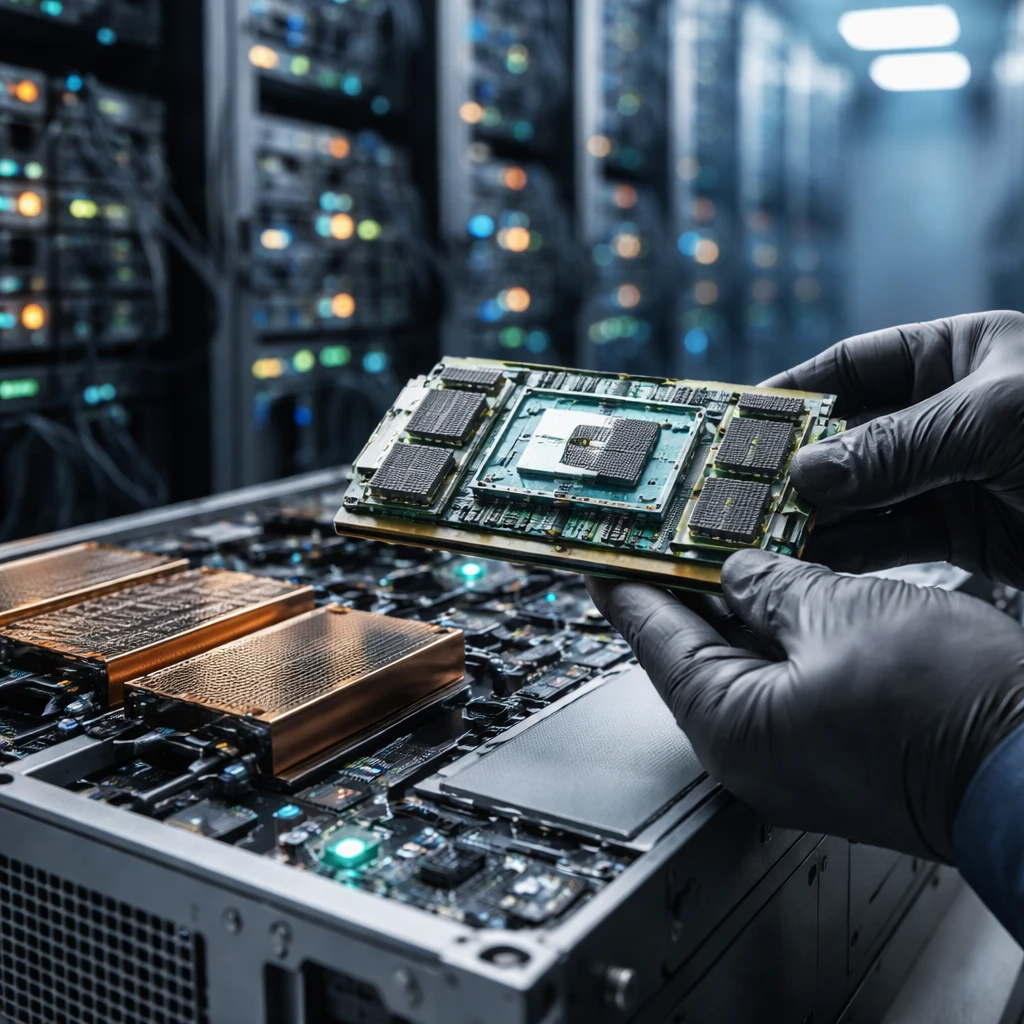
A Barclays note concludes that South Korea's largest memory manufacturers stand to gain from a marked increase in AI-related demand, but warns that capitalizing on the trend will require strategic adaptation.
The research emphasizes that artificial intelligence is driving a rapid increase in demand for high-performance memory, particularly high-bandwidth memory (HBM). HBM is identified as a crucial component for AI servers and data centers, and Barclays highlights HBM and other specialized memory products as central to the evolving market dynamics.
Barclays points to improving pricing power in the memory sector as AI-related demand tightens supply for advanced products. That shift is supporting rising average selling prices (ASPs), which the note says should underpin near-term earnings momentum at Samsung Electronics Co Ltd DRC (LON:0593xq) and SK Hynix Inc (KS:000660), two of the world's largest memory manufacturers.
Despite the favorable pricing backdrop, the report stresses that cyclical price gains alone will not secure sustained outperformance. Rather, Barclays argues both companies must transition to a more AI-centric product portfolio, increasing emphasis on HBM and other memory types tailored to AI workloads.
The note places this company-level shift within a broader market context. It states that large technology firms are substantially increasing investment in AI infrastructure, producing a surge in demand for advanced semiconductors. Memory, previously viewed as a highly cyclical and commoditized segment, is now being described as more structurally linked to long-term AI spending patterns.
Industry-wide supply discipline is also cited as a factor reinforcing tighter market conditions. After an extended downturn, memory suppliers have been cautious about adding capacity. Barclays notes that this restraint in capacity expansion is amplifying the price impact of rising AI-driven demand.
On positioning, the bank suggests SK Hynix appears to have an edge in the near term because of its leadership in HBM. Samsung, by contrast, is portrayed as needing to hasten its transition toward advanced, AI-focused memory products to close that gap. Barclays underscores that successful scaling of advanced memory production and ongoing improvements in manufacturing yields will be critical differentiators between the two firms going forward.
In summary, Barclays frames the ongoing AI adoption as reshaping the memory industry from a historically cyclical business into one with structural growth potential - but only for companies that can realign product mix and execution capabilities quickly enough to meet evolving AI demands.