
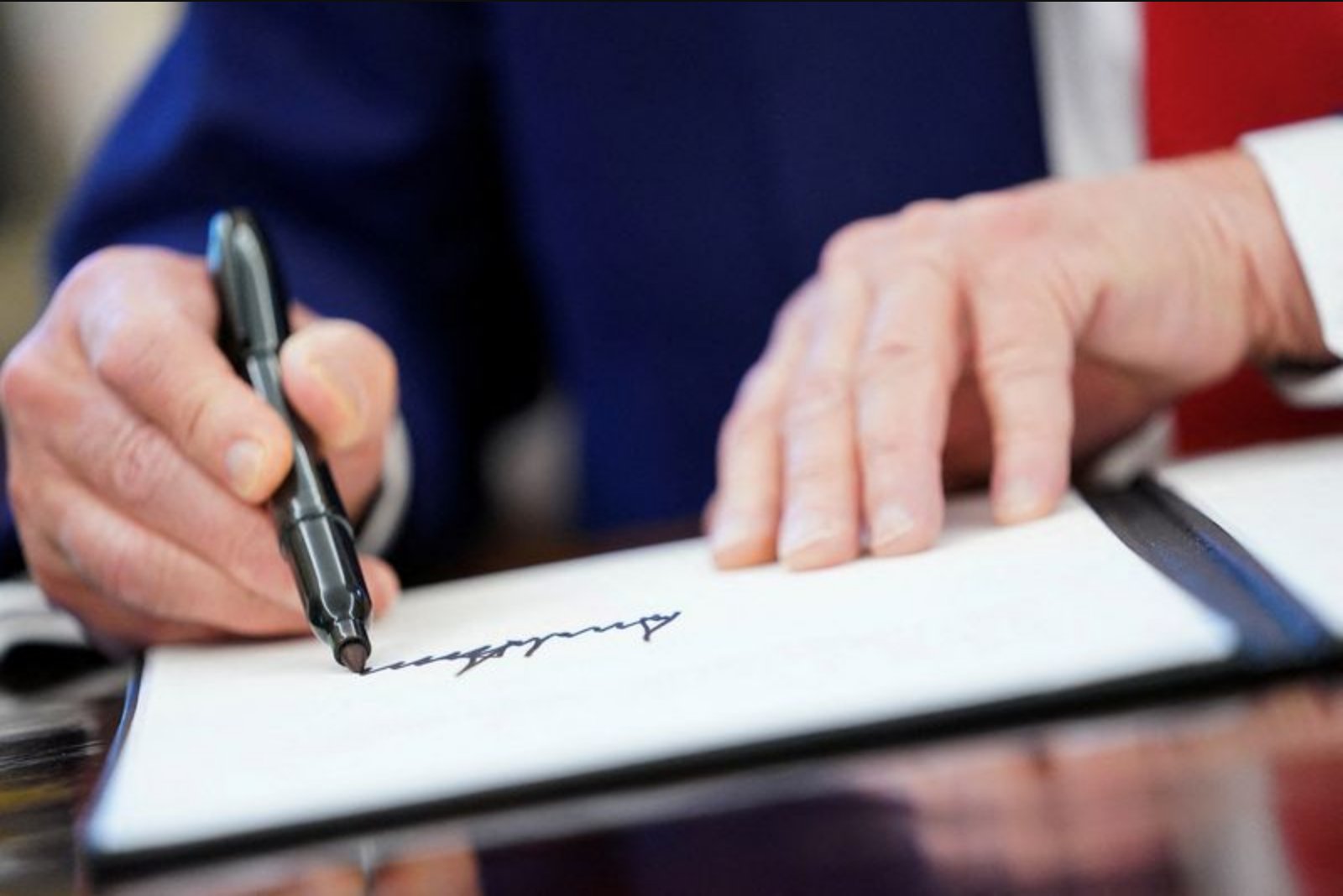
March 28 - The Treasury Department said on Thursday that President Donald Trump’s signature will be printed on $100 bills starting in June, a change tied to commemorations of the 250th anniversary of the United States. The move will end a practice that has placed the U.S. Treasurer’s signature on banknotes since 1861 and will make the sitting president one of relatively few current heads of state whose autograph or image appears on circulating currency.
The adjustment will substitute the president’s signature for the U.S. Treasurer’s name on the $100 note. The signature of the U.S. Treasury secretary, which was added roughly a century ago, will remain on the bills alongside the president’s autograph.
Across the globe, banknotes frequently display the signature of an official connected with the issuance of money - such as the head of a central bank, a finance minister or another senior fiscal official. Euro banknotes carry the signature of the president of the European Central Bank, and United Kingdom pound notes bear the signature of the Bank of England’s chief cashier. At times in the past, Soviet roubles displayed the signature of a finance minister or central banker.
The U.S. Treasury’s announcement follows an earlier plan to issue a commemorative coin that would feature the president’s likeness as part of Semiquincentennial celebrations. However, an 1866 law bars paper currency from displaying images of living current or former presidents, a restriction that limits the options for placing a presidential portrait on U.S. banknotes.
The addition of a sitting president’s signature to circulating banknotes is rare on the global stage, but it is not without precedent. The Treasury provided a set of historical and international examples of leaders who have been represented on their nations’ currency while holding office. Those examples include situations in which photographs, portraits or signatures of incumbents were used on banknotes during their terms.
Notable cases cited by the Treasury include:
- Congo / Zaire - Banknotes issued after the country’s name was changed to Zaire in 1971 featured the then-leader Mobutu Sese Seko in his characteristic leopard hat or military attire. His image appeared on notes during his rule, which lasted until 1997; after he was deposed, the government removed his face from some notes until replacement notes were issued.
- Uganda - Idi Amin Dada, who governed following a 1971 coup and remained in power through 1979, appeared on Ugandan banknotes during his time in office. Apollo Milton Obote, a rival who had been ousted by Amin and later returned to power in 1980, also appeared on the country’s notes.
- Kenya - The portraits of President Daniel Arap Moi, who served from 1978 to 2002, and of Jomo Kenyatta, Kenya’s first president, were once featured on Kenyan banknotes. Both portraits were phased out gradually after constitutional changes prompted a redesign of the notes.
- Indonesia - The country’s first two presidents, Sukarno and Suharto, were depicted on banknotes while serving in office. Notes bearing Suharto’s image were withdrawn following his 1998 resignation amid an Asian financial crisis and subsequent political upheaval; those notes were pulled from circulation in 2000.
- Philippines - During his 1965-1986 presidency, including nearly a decade under martial law, Ferdinand Marcos Sr. appeared on numerous Philippine banknotes and coins. Philippine peso notes currently carry the signature of his son, President Ferdinand Marcos Jr., though the featured imagery of recent notes emphasizes native birds and animals rather than portraits.
- Tanzania - Julius Nyerere, the country’s first president who served from independence in 1961 until 1985, was pictured on banknotes released after the central bank was established; the first banknotes featuring his image were issued in 1966, according to central bank records.
These examples illustrate a range of approaches taken by governments toward the depiction of serving leaders on currency, from signatures to portraits, and in some cases the later removal or redesign of notes following political transitions.
The Treasury’s plan to add the president’s signature to the $100 bill is explicitly framed as part of national anniversary activities and does not include an image of the president on the note itself, consistent with the 1866 prohibition on likenesses of living presidents on paper currency. The secretary of the Treasury’s signature will remain on the bill, maintaining a practice that dates back about a century.
Summary: The Treasury has said President Trump’s signature will be added to $100 bills in June as part of the United States’ 250th anniversary commemorations. This will replace the long-standing placement of the U.S. Treasurer’s signature on notes while keeping the Treasury secretary’s signature intact. International examples show a variety of practices where serving leaders’ autographs or portraits have appeared on currency, and in some cases images were later removed after political change.