
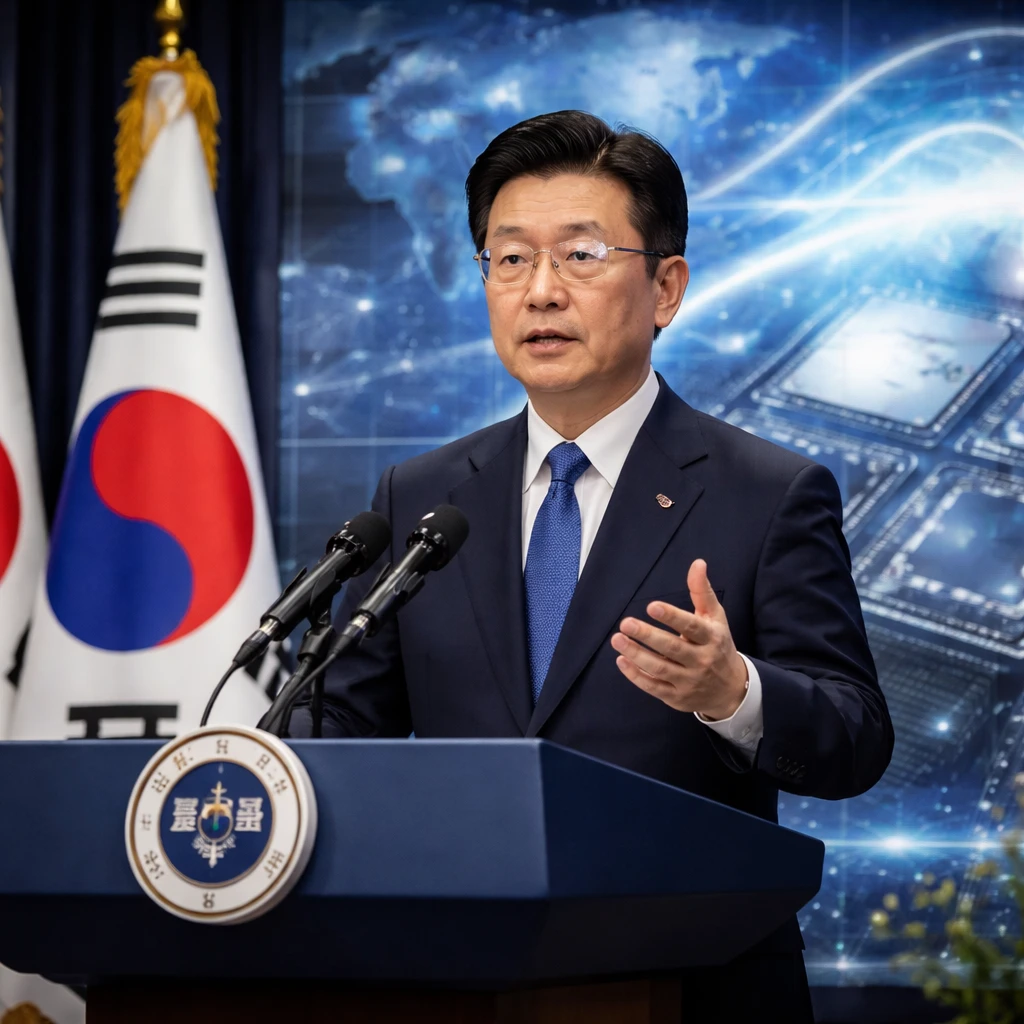
South Korean President Lee Jae Myung commented on Wednesday about the prospective United States tariffs on semiconductor imports, suggesting that while the introduction of higher tariffs may not drastically affect South Korea's chipmakers, it would likely result in elevated prices for semiconductor products within the US market.
US Commerce Secretary Howard Lutnick indicated that chip manufacturers from South Korea and Taiwan might be subject to tariffs reaching up to 100% if they do not increase production on American soil. Reflecting on this, President Lee underscored the significant market share held by companies from both countries, noting their near monopoly in the semiconductor industry.
“They control approximately 80 to 90% of the market share, therefore, it is probable that the majority of any additional tariffs would be transferred to the pricing of chips in the United States,” Lee stated during a press conference.
South Korea's prominent semiconductor firms, including Samsung Electronics and SK Hynix, along with Taiwanese giant TSMC, dominate sectors such as memory chips and contract manufacturing. President Lee also highlighted that South Korea has established safeguards through existing trade agreements with the US, aimed at protecting its chipmakers from competitive disadvantages relative to Taiwanese or other global competitors.
In 2025, South Korea recorded exports of $709.4 billion, marking a 3.8% increase from the previous year. This growth was buoyed by a 22% expansion in semiconductor shipments, driven in part by robust demand linked to artificial intelligence investments. Chip exports directed to the US accounted for 8% of the total $173.4 billion in semiconductor exports, while China remained South Korea's largest market for these products, followed by Taiwan and Vietnam.
Addressing currency matters, President Lee discussed the recent depreciation of the South Korean won, mentioning that government authorities expect a recovery to approximately 1,400 won per US dollar within one to two months. He cautioned that domestic policy efforts alone would be insufficient to stabilize the foreign exchange market given its correlation with the weakening of the Japanese yen, but noted that the won has performed relatively better in comparison.
Regarding the domestic stock market, which surged by 76% last year to become the best performer globally, Lee opined that valuations remain below their true worth.
On the diplomatic front, President Lee conveyed that he is actively pursuing efforts to resume dialogue between North Korea and the United States, emphasizing the need for a pragmatic approach in dealing with Pyongyang. He acknowledged the difficulties inherent in expecting North Korea to fully relinquish its nuclear weapons program but stressed the benefits of persuading the regime to halt nuclear material production, nuclear exports, and the development of intercontinental ballistic missiles.
Lee revealed that North Korea is currently producing sufficient nuclear material to assemble 10 to 20 nuclear weapons annually. So far, North Korea has not responded to outreach attempts from Lee and US President Donald Trump to rekindle communications, with discussions having stalled since 2019 due to disagreements over sanction relief and nuclear disarmament.
Furthermore, President Lee drew attention to the necessity of maintaining a clear separation between religion and politics. He asserted, “The principle of separation of church and state should never be violated and must be strictly enforced.”
South Korea's legislative body is presently considering a bill to establish a special prosecutor tasked with investigating potential involvement of religious organizations in politics, including scrutiny of the Unification Church and deliberations over extending probes to the Shincheonji Church of Jesus. Han Hak-ja, head of the Unification Church (also known as the Family Federation for World Peace and Unification), is currently on trial over allegations of attempting to bribe associates of former President Yoon Suk Yeol, accusations which Han has denied.