
Currencies March 27, 2026

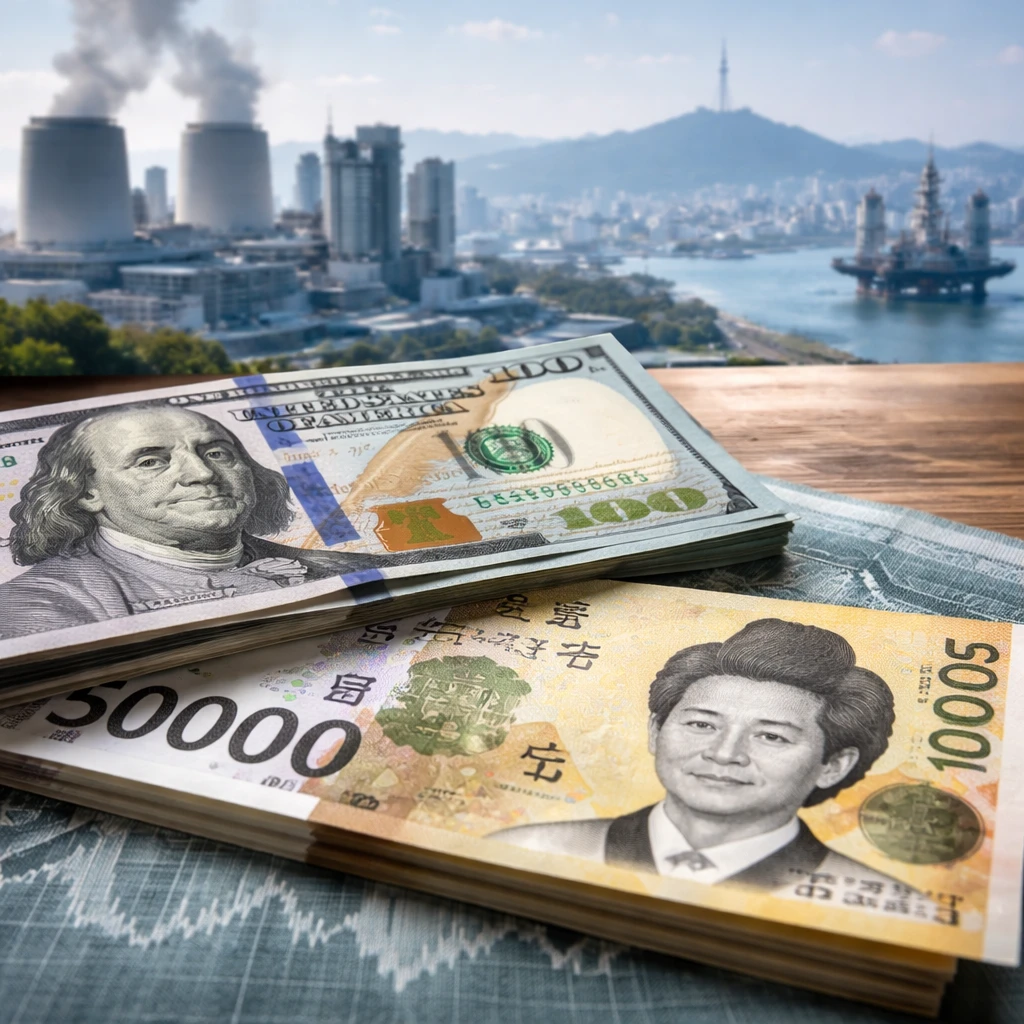
BofA Sees USD/KRW Holding Within Range While Middle East Tensions Persist

Bank of America says South Korean won's sensitivity to energy costs and risk appetite will keep USD/KRW capped near term, with a later decline expected as chip exports and portfolio flows normalize

By Ajmal Hussain
BofA Sees USD/KRW Holding Within Range While Middle East Tensions Persist

Bank of America expects the U.S. dollar to South Korean won rate to remain constrained in the near term amid ongoing Middle East tensions, citing South Korea's vulnerability to energy-price swings and shifts in investor risk sentiment. The bank warns that sharp upward moves in USD/KRW could trigger policy responses, and projects the pair to move lower over time as semiconductor exports and more balanced portfolio flows support the won.

Key Points

  • Bank of America expects USD/KRW to remain rangebound near term due to the ongoing Middle East crisis and Korea's sensitivity to energy-price swings - impacting currency markets and trade-exposed sectors.
  • The bank warns that rapid upward moves in USD/KRW could be seen as excessive divergence from fundamentals and may trigger policy actions aimed at preserving financial stability - relevant to financial markets and regulators.
  • Over the longer term, strong semiconductor chip exports and more balanced portfolio flows are projected to push USD/KRW lower, supporting exporters and capital flow dynamics.

Bank of America has signaled that the USD/KRW exchange rate is likely to stay confined to its recent trading band until the current Middle East crisis eases. The bank points to South Korea's heightened exposure to energy price movements and to changes in global risk sentiment as the primary factors that will keep the pair rangebound in the near term.

According to the bank's assessment, any abrupt rise in USD/KRW that pushes the pair well beyond where fundamentals justify could be seen as excessive divergence. In that scenario, the bank warns that authorities may implement policy measures intended to shore up financial stability, implying a potential for intervention if market moves threaten orderly functioning.

Looking past the immediate period of elevated geopolitical risk, Bank of America expects USD/KRW to trend lower. The bank cites strong chip exports as a supporting force for the South Korean won, suggesting that demand for semiconductors will help underpin the currency. In addition, the bank anticipates a shift toward more balanced portfolio flows, which it says will further contribute to a reduction in USD/KRW over time.

This view separates a near-term phase dominated by external risk factors - notably the Middle East crisis and energy-price sensitivity - from a later phase where trade performance and capital flows exert downward pressure on the dollar relative to the won.

The bank's guidance emphasizes two themes: first, the outsized role of external energy prices and risk appetite in determining short-term currency moves for South Korea; second, the capacity for export strength and improved portfolio flows to reassert influence over the exchange rate beyond the near term.

Market participants should note the dual implications: elevated geopolitical risk can constrain currency appreciation for the won in the short run, while sector-specific strength in chip exports and normalization of investment flows can support a stronger won later on. The potential for policy response to rapid, disorderly moves in USD/KRW also highlights a channel through which authorities may seek to limit deviations from fundamentals.

Risks

  • Prolonged Middle East tensions could sustain risk-off sentiment, keeping USD/KRW constrained - affecting currency traders and export sectors tied to global demand.
  • Volatility in energy prices may amplify South Korea's currency sensitivity and influence short-term exchange-rate moves - impacting import-dependent industries and inflation dynamics.
  • Rapid, disorderly appreciation of USD/KRW could prompt policy interventions to protect financial stability, creating uncertainty for markets and financial institutions.

More from Currencies

Asian FX stalls as markets digest Iran diplomacy; Indian rupee sets fresh record low Mar 27, 2026 Treasury Confirms President's Signature Will Appear on U.S. Banknotes; Treasurer's Name Omitted After 165 Years Mar 26, 2026 Bank of America Sees U.S. Dollar Strength Extending Into Second Quarter Mar 26, 2026 Asian FX Quiet as Dollar Holds Ground; Rupee Hovers Near Record Low Mar 26, 2026 Asia FX Rangebound as Tehran Strike Reports Clash with Diplomatic Signals; AUD Slips After Softer CPI Mar 25, 2026