
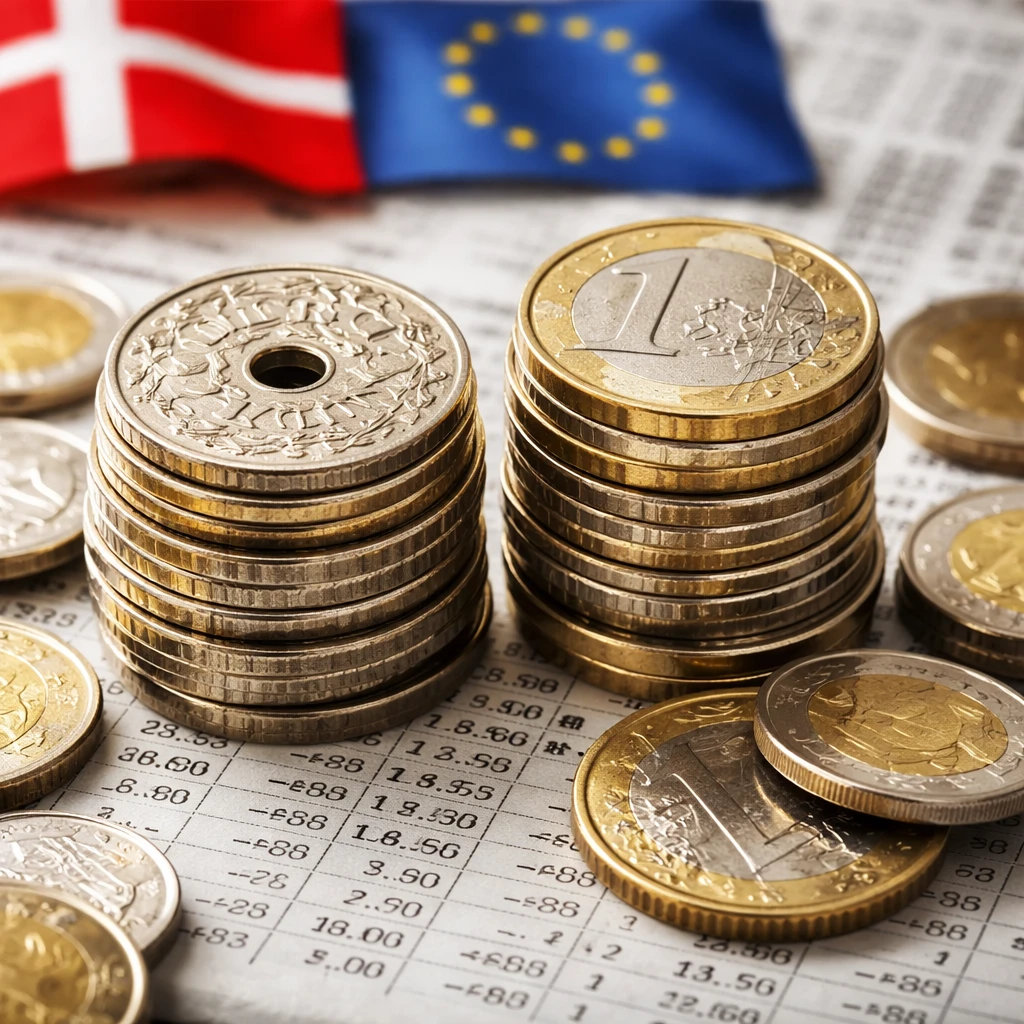
Geopolitical dynamics have shaped currency trading as 2024 commenced, with attention on various global flashpoints including Venezuela and Greenland. Such developments have increasingly influenced Danish financial markets, with notable currency fluctuations observed.
Since the start of the year, the Danish krone has demonstrated relative weakness versus the U.S. dollar. Concurrently, the EUR/DKK exchange rate has approached levels not seen since the onset of the global pandemic, as reported by Bank of America Securities analysts on January 20. The Danish krone’s performance amidst these conditions underscores the complex interplay of geopolitical factors and market sentiment.
Denmark is unique within Europe as the sole participant in the Exchange Rate Mechanism II (ERM II), adhering to a fluctuation allowance of plus or minus 2.25% from a fixed central rate of 7.46038 for the EUR/DKK pair. This framework is designed to maintain relative currency stability inside the European system.
Bank of America Securities notes that the most critical aspect for Denmark’s central bank is both the magnitude and the velocity at which the EUR/DKK exchange rate deviates from its central parity. The recent movement marks only the fourth occasion since ERM II's inception that the EUR/DKK rate has approached its maximal permissible variation. This rare occurrence highlights a moment of potential stress for the currency peg.
Historical context provides insight into how the Danish central bank might respond. Past episodes, including Denmark’s 2000 referendum decision rejecting full Eurozone membership, the Swiss National Bank's 2015 decision to abandon its Swiss franc peg resulting in regional currency pressures, and liquidity divergences between Denmark's central bank and the European Central Bank (ECB) during 2019-2020, serve as precedents. Each of these instances led to the DKK approaching the limits of tolerance within the ERM II framework.
Drawing on these precedents, Bank of America Securities predicts that the Danish central bank is likely to prioritize foreign exchange interventions to uphold the peg. This approach is made feasible by Denmark’s robust FX reserves, which are near a record high, representing about 22% of GDP. Adjusting policy rates to narrow the spread, currently favoring the ECB by 25 basis points, remains an alternative but would probably only be considered after utilizing intervention strategies.
Furthermore, given Denmark’s stewardship role within the ERM II mechanism, aid from the ECB is not out of the question should circumstances require such coordinated support. Despite current market pressures, Bank of America Securities maintains confidence that the EUR/DKK peg will remain intact through these challenging conditions.
For investors and participants in foreign exchange markets, vigilance on the EUR/DKK peg remains essential as evolving geopolitical risks and market dynamics unfold. Market watchers will likely focus on the Danish central bank's intervention activities and policy decisions in the weeks ahead.