
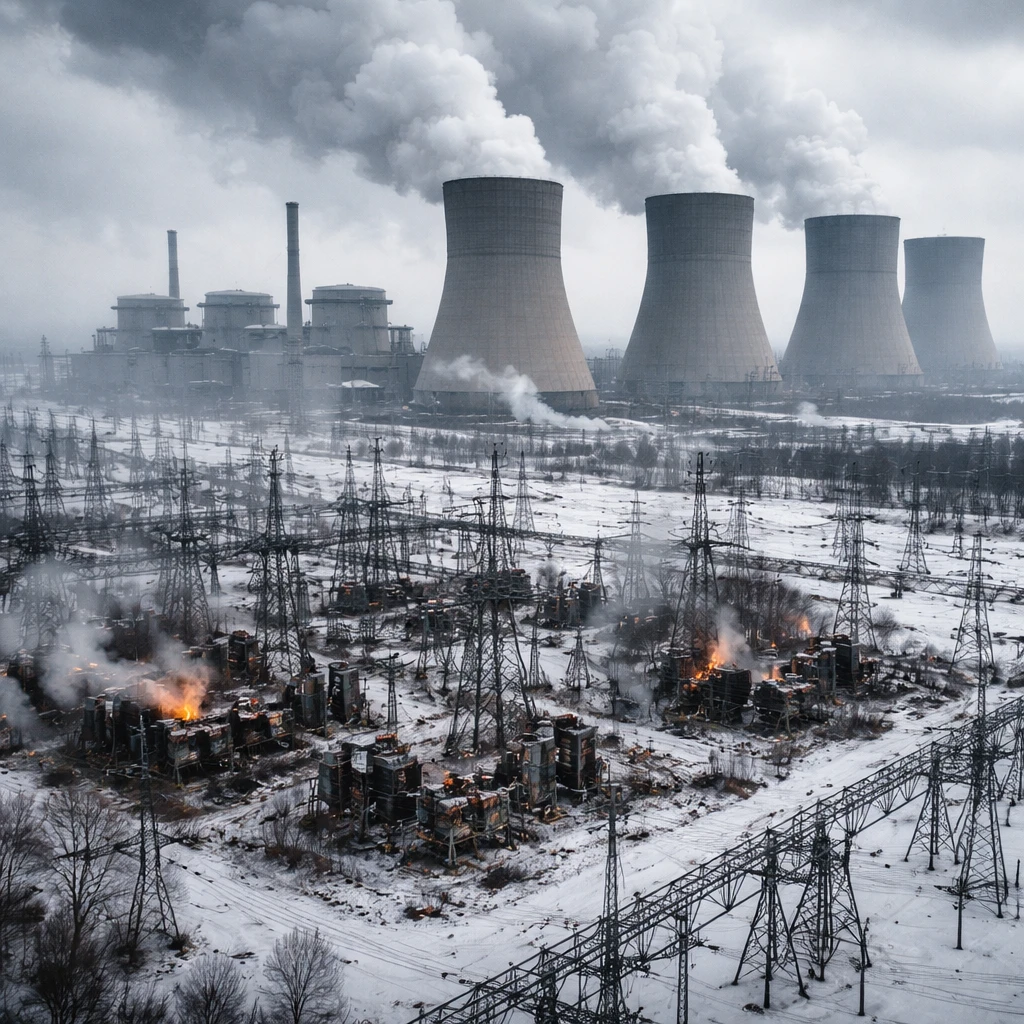
Amidst harsh winter conditions, military assaults have intensified on Ukraine’s energy framework, heavily dependent on nuclear generation which now accounts for the bulk of the nation’s electricity supply. Nearly half of Ukraine’s generating capacity has already been incapacitated due to these ongoing attacks.
President Volodymyr Zelenskiy has highlighted the strategic aim behind these actions: Russian forces intend to shut off Ukraine’s electrical power by disrupting the substations that transmit nuclear energy to consumers, threatening to plunge the country into a comprehensive blackout. Ukraine operates three nuclear power plants with a combined capacity of 7.7 gigawatts. Its fourth, the Zaporizhzhia Nuclear Power Plant, which is the largest in Europe, remains under Russian occupation and is currently non-operational.
The energy shortfall presently stands at approximately 10 gigawatts, where imports partially cover the gap, yet authorities must rely on extensive rolling blackouts lasting several hours and impacting entire regions. An industry source, wishing to remain anonymous due to the sensitivity surrounding the situation, reported that nuclear power now generates up to 80% of Ukraine's consumed electricity, with almost all alternative generating capacities severely damaged.
Disruption of thermal plants from ongoing air strikes has left nuclear power as the critical backbone of electricity production. Removal or reduction of nuclear generation capacity would risk systemic collapse in vital urban infrastructure.
President Zelenskiy noted that combined domestic energy production and imports currently satisfy only 60% of the nation's demand. Concurrently, Economy Minister Oleksiy Sobolev, speaking at the World Economic Forum in Davos, revealed that since October 2025 Russian shelling has damaged 8.5 gigawatts of Ukraine's energy generating units including thermal and hydroelectric facilities.
Key Role of Substations
Nuclear power plants rely not only on reactors but also depend heavily on sophisticated substations that transform and distribute generated high-voltage electricity into the grid and ultimately to consumers. Oleksandr Kharchenko, director of Kyiv’s independent Energy Research Centre, indicated that ten critical substations facilitate over half of Ukraine’s nuclear-generated electricity consumption. Some are co-located with the nuclear plants, while others are situated tens or even hundreds of kilometers away.
Damage to Infrastructure
International Atomic Energy Agency (IAEA) Director Rafael Grossi recently confirmed the impact of Russian missile barrages on essential Ukrainian substations. According to Kharchenko, attacks have occurred more than 60 times during the nearly four-year conflict, primarily targeting substations far removed from the plants themselves. Despite aiming for rare, powerful transformers, damage has predominantly been limited to auxiliary components protected by defensive measures. Consequently, repair and restoration often take only days.
Nevertheless, these attacks have forced repeated reductions in output from nuclear reactors, adding further stress to Ukraine’s energy supply.
Potential Consequences of Attacks Near Nuclear Facilities
Experts caution that strikes against substations proximal to nuclear reactors carry unpredictable and grave risks. Explosions, even without direct reactor hits, could compromise critical systems such as radioactive water pipelines and other nuclear equipment essential for plant safety and operation. Some substations exist just a few hundred meters from reactor buildings, and damage could cascade into broader plant failures.
The physical reactor structures themselves boast thick concrete shielding that might withstand drone attacks and smaller munitions; however, missile strikes from ballistic weapons pose a severe threat capable of breaching containment or igniting fires jeopardizing sensitive equipment.
Ukraine’s historical nuclear tragedy at the Chornobyl plant, approximately 80 kilometers from Kyiv, underscores the catastrophic potential of nuclear incidents. Kharchenko reiterated that Russian missile strikes aimed at substations could inadvertently strike reactors or critical infrastructure, damaging extensive pipelines transporting radioactive water, turbines, or control systems, thereby endangering nuclear safety at these facilities.