
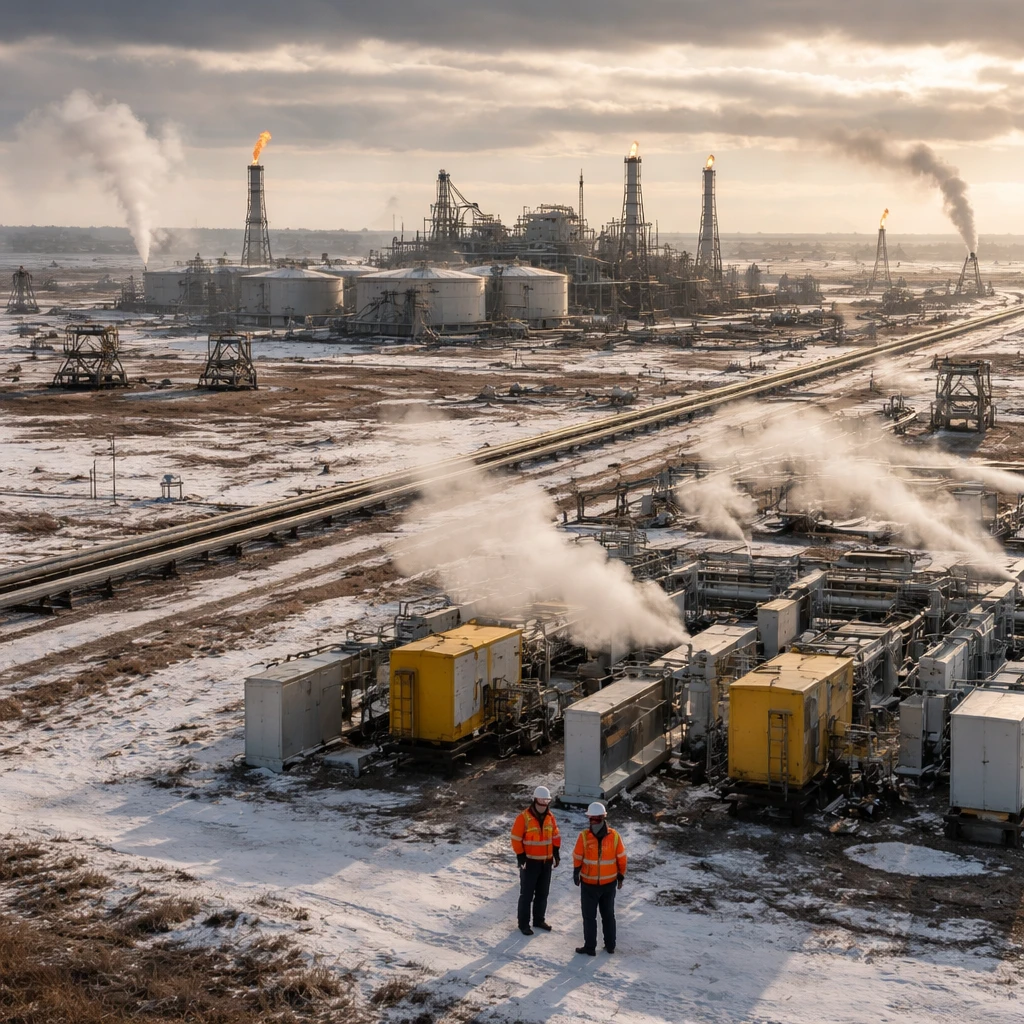
MOSCOW, Jan 27 - Kazakhstan’s Tengiz oilfield, the country’s largest, is in the process of restoring production after a shutdown triggered by a fire at a generator and the consequent power outage, but two sources familiar with the situation told Reuters they expect output to remain below half the field’s typical level by February 7.
The outage at Tengiz - which, along with the Korolev field, had its production temporarily halted on January 18 by operator Tengizchevroil (TCO) after the generator fire - represents another disruption for Kazakhstan’s oil sector. The country has already faced limits to its main export route in recent months following an attack by Ukrainian naval drones.
It remains unclear what caused the generator fire. Chevron, the lead partner in the consortium operating Tengiz, said on Monday that oil production had been restarted, but did not specify which field that referred to. Kazakhstan’s energy ministry reported on Monday that Tengiz was preparing to resume output soon and that Korolev was already operating again. Despite these statements, TCO has not yet rescinded a force majeure declaration it issued on CPC Blend crude supplies after the shutdown.
One source who spoke on condition of anonymity because they were not authorised to speak to the media provided estimates for the near-term recovery path. The source said the fields were expected to produce 33,000 metric tons per day by February 5, which corresponds to about 260,000 barrels per day or roughly 26% of usual volumes. By February 7, that source projected daily production would rise to 57,000 metric tons - about 46% of typical levels - but emphasized that the extent of further recovery remained uncertain.
Another source described restoring Tengiz to its normal operational profile as a difficult task and said the pace of recovery was hard to estimate. "Oil output has been restarted and will reach a decent level in a week or so but it’s hard to say what’s next," the source said, adding that Tengiz would likely struggle to meet its planned export schedule.
A third source offered a different near-term view, suggesting Tengiz output could approach 670,000 barrels per day by mid-February, a level comparable to output seen in autumn but still below the roughly 900,000 barrels per day the field reached earlier last year.
Tengiz, located in western Kazakhstan, is identified by Chevron as the world’s deepest producing supergiant oilfield, and extraction there involves substantial technical challenge. The bulk of Tengiz’s crude moves to markets through the Caspian Pipeline Consortium (CPC), which transports about 80% of Kazakhstan’s oil exports. TCO’s decision to maintain force majeure on CPC Blend shipments means export flows tied to that grade remain constrained.
Financial markets and industry analysts have also weighed in on the probable national impact. JPMorgan estimated on Friday that Tengiz might remain offline through the end of the month and projected Kazakhstan’s January crude output would average between 1 million and 1.1 million barrels per day, compared with the roughly 1.8 million barrels per day the country typically produces.
At the government level, Kazakhstan said Prime Minister Olzhas Bektenov met with ExxonMobil Vice President Peter Larden on Monday and urged the U.S. energy company to accelerate work to address the outage and to take steps aimed at preventing similar incidents in future. Within the TCO consortium, Chevron holds a 50% stake, ExxonMobil owns 25%, Kazakhstan’s KazMunayGaz controls 20% and Russia’s Lukoil has 5%.
As Tengiz works through the phased restart and authorities and partners assess the condition of production infrastructure, both the timeline for a full recovery and the impact on Kazakhstan’s export schedules remain subject to significant uncertainty.