
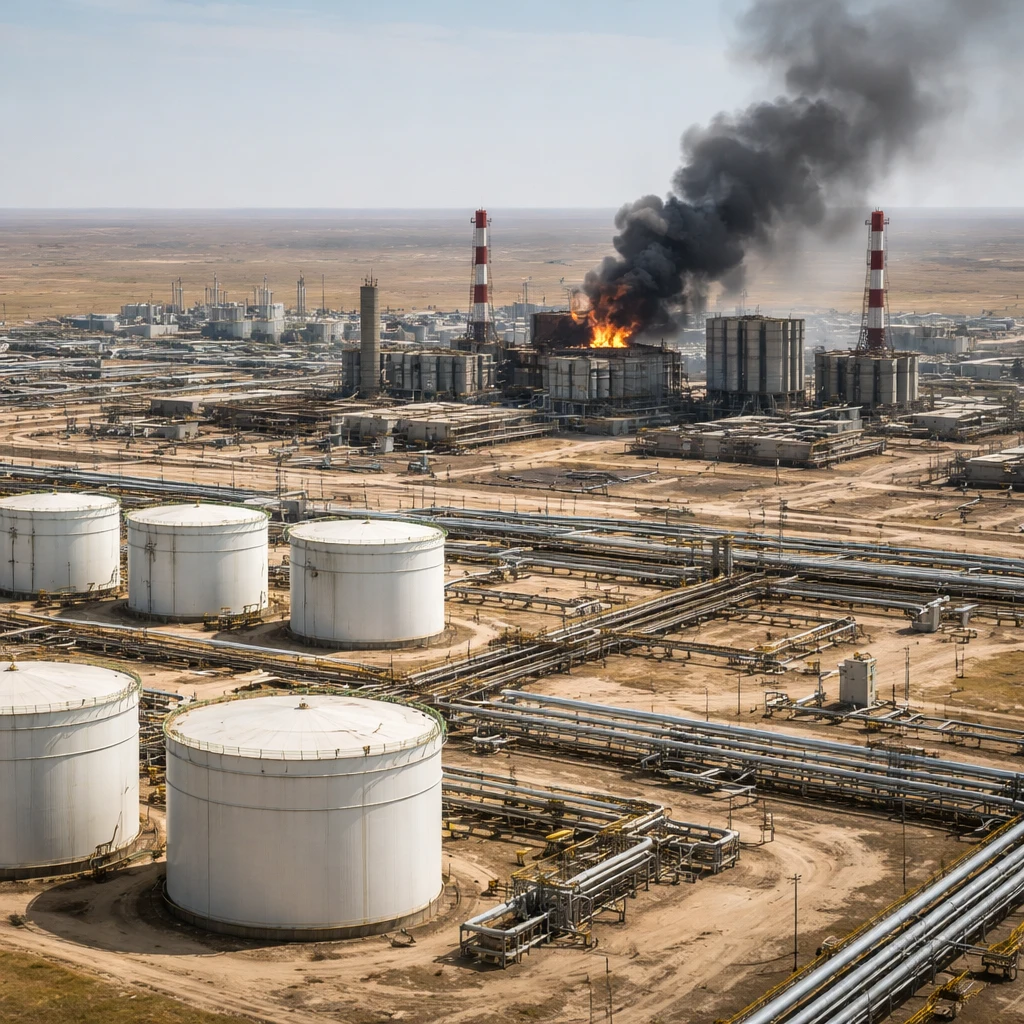
The Tengiz oilfield in Kazakhstan, a major contributor to global crude supplies, remains shut down following a fire at two turbine transformers at its GTES-4 power station on January 18, according to Kazakhstan’s state-owned KazMunayGas. Production at the Tengiz and Korolevskoye fields has been suspended to resolve the ensuing electricity supply challenges, Tengizchevroil (TCO) reported.
Initial announcements from TCO indicated that the halt in production would last until the week's end. However, anonymous industry sources disclosed that the downtime could extend up to 7 to 10 days or potentially into February as repair efforts continue. This operational pause has led to the cancellation of five CPC Blend crude export cargoes, with volumes totaling approximately 600,000 to 700,000 metric tons, originally scheduled for loading at the Caspian Pipeline Consortium's (CPC) Black Sea terminal across January and February.
Chevron, TCO's majority stakeholder holding a 50% share, confirmed the proactive suspension of production at Tengiz and Korolevskoye but declined to provide further specifics regarding operational or financial implications.
While TCO’s production shortfall is significant, Kazakhstan's overall oil output has not yet experienced a net decrease due to compensatory increases from other major Caspian oil fields. Production data reveals that although output in the first half of January was down by 35% compared to December averages, robust growth has occurred at the Kashagan and Karachaganak fields subsequently.
Specifically, Kashagan’s average daily output reached 197,000 barrels between January 1 and 19 — a 28% rise over the first 12 days of January — while Karachaganak's average increased by 21% to 156,000 barrels per day over the same timeframe, according to calculations from a knowledgeable source. Tengiz maintained an average of 360,000 barrels per day during this interval, reflecting a 6% increase compared to the earlier period prior to the shutdown.
The operators of Kashagan and Karachaganak, NCOC and Karachaganak Petroleum Operating respectively, did not respond to requests for comment. Industry sources suggest these producers are partially mitigating the effects of the Tengiz suspension, though expectations are set for the CPC to begin reducing throughput in the near future.
Kazakhstan exports the bulk of its oil through the CPC pipeline, but disruptions to infrastructure at the marine terminal in Yuzhnaya Ozereyevka are prompting partial redirection of crude shipments via the Baku-Tbilisi-Ceyhan (BTC) pipeline and through the Druzhba pipeline to Germany.
The Tengiz project has a consortium ownership structure with Chevron holding 50%, ExxonMobil 25%, KazMunayGas 20%, and Lukoil 5%. The interruption at Tengiz underscores operational vulnerabilities that can impact regional export logistics and global crude supply chains.