
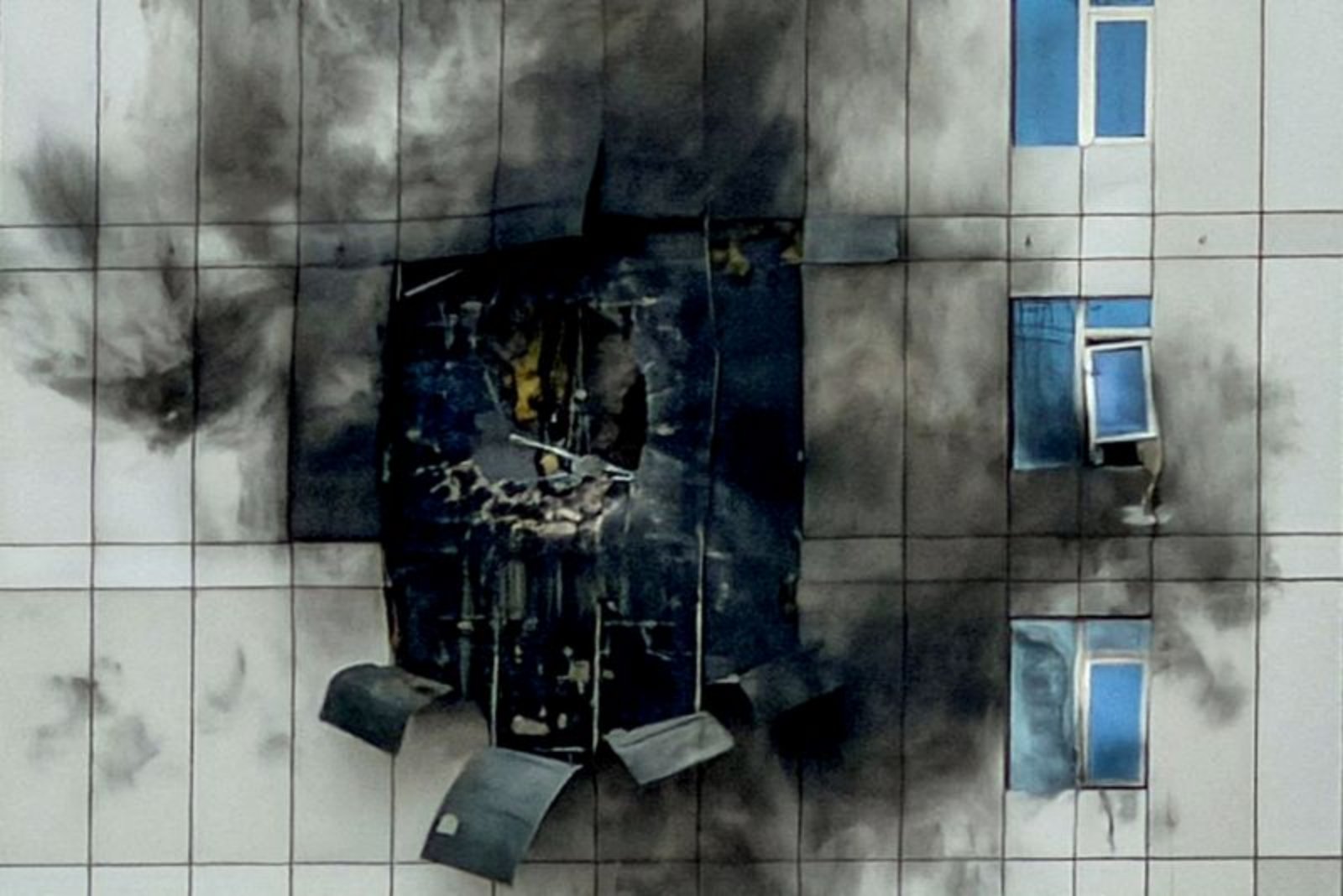
Gulf Arab governments are telling the United States that an outcome with Tehran should go beyond simply halting the current fighting and must instead remove the Iranian capabilities that enable repeated attacks on energy and civilian targets, four Gulf sources said.
Leaders in the region, many of whose countries have been struck repeatedly during the U.S.-Israeli campaign against Iran, want any agreement to lock in enforceable curbs on missiles, drones, and proxy operations - and to guarantee that key maritime arteries such as the Strait of Hormuz will never again be used as instruments of coercion. The strait currently carries about 20% of global oil and liquefied natural gas supplies.
U.S. President Donald Trump has extended a deadline for Iran to reopen the Strait of Hormuz - warning Tehran that energy facilities could be destroyed if the waterway remains closed - and has said negotiations with Iran are progressing. He set a deadline at 0000 GMT on April 7 for reopening the strait. An Iranian official has called a U.S. proposal for ending the war "one-sided and unfair," and Tehran has linked any settlement to the removal of U.S. bases in the Gulf.
But for many Gulf policymakers the crucial question has shifted from how to stop the war to what regional order will be created once hostilities end. "The real challenge is not persuading Iran to stop the war, but ensuring the Gulf is not left exposed to the same dynamics that made it possible in the first place," Ebtessam Al-Kerbi, president of the Emirates Policy Centre, said.
Gulf officials have told Washington in private discussions that Iran has left regional actors with no clear diplomatic off-ramp, the sources said. Those officials argue that a deal must rewrite rules of engagement by providing guarantees that the Strait of Hormuz will not again be used as a tool of war and by formally integrating Gulf states into whatever security architecture follows.
Yousef al-Otaiba, the United Arab Emirates’ ambassador to the United States, framed the conflict not as a crisis to be frozen but as a test of whether Tehran can still hold the global economy hostage after the fighting stops. "A simple ceasefire isn’t enough," he wrote in a column for the Wall Street Journal. "We need a conclusive outcome that addresses Iran’s full range of threats: nuclear capabilities, missiles, drones, terror proxies and blockades of international sea lanes." He warned that an agreement which merely shelves missiles, drones and proxies would simply postpone the next crisis.
Economic exposure is a major driver of Gulf concern. Their economies are highly dependent on energy exports and travel, and the conflict has sent shockwaves through the global economy by driving up energy prices, disrupting supply chains and exacerbating inflation. That exposure informs why some Gulf states are urging stronger, enforceable measures than a ceasefire alone would provide.
U.S. intelligence, according to five people familiar with it, can confirm with certainty that roughly one third of Iran’s large missile inventory has been destroyed. Gulf officials say that assessment underlines the need for continued degradation of Iranian strike capabilities - not simply a pause in hostilities.
Regional scepticism about the durability of a ceasefire is rooted in past experience. Iran’s nuclear enrichment was capped under the 2015 agreement, though Tehran denies seeking nuclear weapons. That deal left Iran able to threaten the region via missiles, drones, proxy groups and maritime pressure, and Gulf states say those remaining vectors of coercion must be removed to achieve lasting stability. In 2018, the United States withdrew from the 2015 nuclear accord, with President Trump calling it a "defective" and "one-sided" agreement that did not serve U.S. interests.
Not all Gulf states are aligned in public posture. Qatar, Oman and Kuwait have been pushing in private for a swift end to the conflict, citing fear of economic fallout and reprisals. By contrast, the UAE, Saudi Arabia and Bahrain say they are prepared to absorb further escalation and have signaled they will not accept a post-war Iran that can again use the Strait of Hormuz as leverage.
UAE presidential adviser Anwar Gargash said Iran’s strikes on Gulf states have had "profound geopolitical repercussions," making Tehran the central threat shaping Gulf strategic thought and pushing the UAE toward deeper security alignment with Washington. "This is the cost of Iran’s misguided calculations," he said.
The Gulf Cooperation Council - the six-state grouping made up of Bahrain, Kuwait, Saudi Arabia, Qatar, Oman and the UAE - has underscored a unified regional stance against any settlement that marginalises Gulf security concerns. GCC Secretary-General Jasem Al-Budaiwi cited 5,000 missile and drone attacks on Gulf energy facilities, civilian infrastructure and maritime traffic and said Iran has "crossed all limits." He said Gulf states have practiced restraint to avoid a broader war but insisted the region would not accept repeated targeting, stressing that while a political resolution is preferred, every state reserves the right to self-defence.
Gulf analysts and officials are urging Washington to continue efforts to degrade Iran’s cruise and ballistic missile capabilities. That capability has long been viewed by Gulf capitals as the principal direct threat against their territories and energy networks.
At the same time, U.S. planning considerations have raised alarm among regional partners. Mr. Trump has weighed whether to deploy ground forces to seize Kharg Island, Iran’s strategic oil hub that handles 90% of Iran’s oil exports, according to a U.S. official and three people familiar with the matter. Analysts say control of the island would give the United States substantial leverage over Iran’s oil economy.
Tehran has warned that any ground seizure would provoke strikes against the "vital infrastructure" of any country that assisted such an operation. Some Gulf allies have cautioned Washington against deploying troops to Kharg Island or establishing extensive ground operations in Iran, arguing that such steps would widen the war, trigger significant Iranian retaliation and likely endanger Gulf energy and civilian infrastructure.
Despite those cautions, Gulf states continue to press Washington to press the military campaign against Iran’s missile and drone networks - a demand rooted in the recurring nature of the threat and the direct impact on their economies and populations.
What Gulf states want
- Permanent, enforceable restrictions on Iran’s missile and drone capabilities that have been used against Gulf energy and civilian targets.
- Assurances and architectural guarantees that the Strait of Hormuz will not again be used as a bargaining chip to disrupt global energy supplies.
- Integration of Gulf states into any post-conflict security framework to prevent the recurrence of maritime blockades, proxy attacks and threats to shipping lanes.
How Gulf states are positioning themselves
Positions vary within the Gulf. Qatar, Oman and Kuwait favour a prompt cessation of hostilities to limit economic damage and the prospect of reprisals. The UAE, Saudi Arabia and Bahrain signal readiness to endure further escalation if it is necessary to ensure that Iran cannot again weaponise the strait or sustain the missile, drone and proxy threats that have targeted Gulf states.
Gulf officials say their message to Washington has shifted from implicit concerns to explicit demands that any agreement directly address and guarantee Gulf security. As Abdulaziz Sager, chairman of the Gulf Research Center, put it, "The United States protects its interests, and Israel’s. Now it is our turn to protect and defend ours."
Implications for energy and markets
Because the Gulf economies are heavily reliant on energy exports and travel, disruptions to the Strait of Hormuz and attacks on infrastructure have immediate and far-reaching market consequences. Past disruptions have driven energy prices higher, strained supply chains and fed inflationary pressures worldwide. For Gulf producers, the stakes are both economic and strategic: the ability to export energy reliably affects fiscal balances, international contracts and investor confidence.
In short, Gulf states are demanding that any settlement not only end the shooting but also eliminate the capabilities and incentives that allowed the crisis to arise. Without such outcomes, regional leaders fear a return to the same precarious balance that enabled repeated cycles of coercion and disruption.