
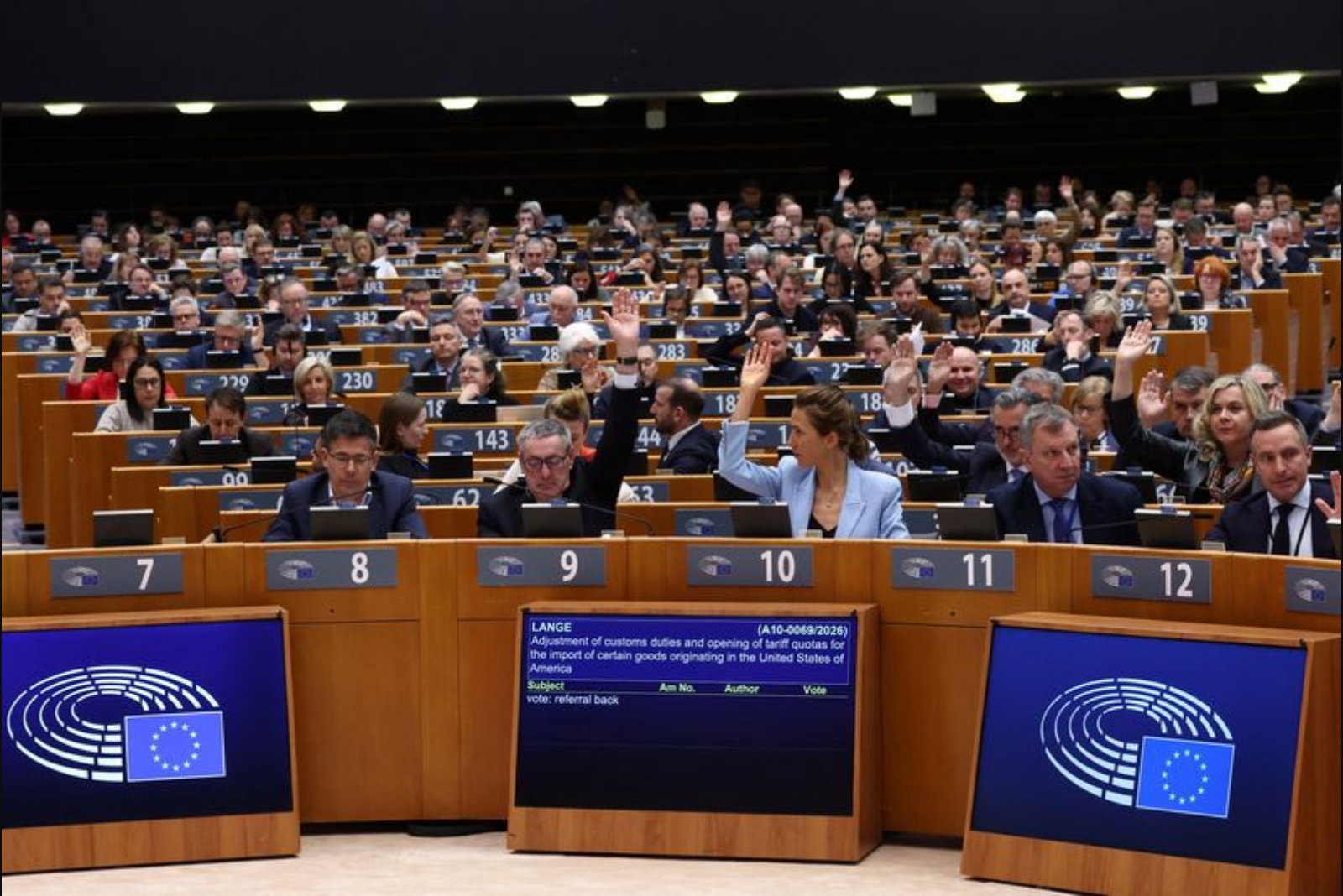
European Union lawmakers advanced legislation on Thursday intended to complete the EU's commitments under the trade agreement reached with the United States, but only after attaching a series of protections that reflect lingering doubts about Washington's reliability.
The European Parliament endorsed the measure by 417 votes in favour, 154 against and 71 abstentions. In addition to approving duty reductions envisioned in the Turnberry agreement, the assembly added a package of safeguards designed to make the concessions conditional and reversible.
Safeguards and demands
Parliamentarians required so-called sunrise, sunset and suspension clauses as part of the legislation. The sunrise clause would make EU reductions of import duties contingent on the United States honouring its side of the bargain. The sunset provision sets an expiration date for the tariff concessions of March 31, 2028. A suspension clause would permit the EU to pause the deal if Washington breaches the agreement or if there is a damaging surge of U.S. imports.
Separately, lawmakers insisted the United States remove 50% duties that were imposed a month after the Turnberry understanding on the steel and aluminium content of products, including items cited specifically such as wind turbines and motorcycles.
European Trade Commissioner Maros Sefcovic described the vote as a "crucial step", saying it provides certainty to EU businesses. The U.S. Mission to the EU said it welcomed the vote.
Scope of the deal and remaining steps
The parliamentary debate addressed several elements of the deal. Proposals under consideration include the elimination of EU import duties on U.S. industrial goods and improved access for U.S. agricultural produce, central planks of the Turnberry arrangement. Lawmakers also discussed maintaining zero duties for U.S. lobsters, a concession that was initially agreed with then-President Trump in 2020.
Thursday's vote is a significant step but not the final one. Representatives of the European Parliament and EU governments will enter negotiations to agree final legal texts, and a conclusive vote by parliamentarians is not expected before April or May.
Parliamentarians voice reservations
In debate ahead of the roll call, many members said the package remained unbalanced. Some argued that the EU was being asked to eliminate most of its import duties while the United States would largely retain a broad 15% rate. Bernd Lange, chair of the parliament's trade committee, said the result was "not really an agreement at all."
Belgian Social Democrat Kathleen Van Brempt criticised the outcome as a bad deal, saying: "It does not bring stability. It does not protect us from tariffs, threats and coercion."
The parliamentary timetable had been interrupted earlier in the year after threats from the U.S. President to impose new tariffs on European allies that did not back his proposed acquisition of Greenland and following the introduction of an import surcharge. That sequence of events contributed to the decision by lawmakers to add conditional clauses to the implementing text.
Economic context cited in debate
Speakers highlighted the importance of U.S.-EU trade ties. The U.S. is the EU's largest trading partner, with EU exports to the United States rising to a record 555 billion euros ($641.47 billion) in 2025. Despite that scale of commerce, members remain cautious about the deal's practical protections against tariff-related disruption.
The approved legislation moves the EU side of the Turnberry pact closer to implementation while formally retaining levers to respond should the United States deviate from the negotiated terms or if trade flows shift in a way deemed damaging by the EU.
Key points
- The European Parliament voted 417-154 with 71 abstentions to advance legislation implementing the EU side of the Turnberry trade deal with the U.S.
- Lawmakers added sunrise, sunset and suspension clauses and demanded removal of 50% duties imposed on steel and aluminium content of certain products; key sectors affected include steel, aluminium, wind turbines, motorcycles, industrial goods and agricultural exports.
- The vote advances the process but final legal texts must be negotiated with EU governments and a final parliamentary vote is not expected before April or May.
Risks and uncertainties
- Uncertainty over U.S. compliance - Parliament included conditional clauses because members fear Washington may not fully honour the Turnberry deal, creating risk for exporters and manufacturers reliant on predictable tariffs (affects steel, aluminium, wind turbines, motorcycle manufacturers).
- Potential for disruptive tariffs or import surges - The legislation includes a suspension mechanism to address either breaches by the U.S. or a damaging surge in U.S. imports, signalling lingering concern about sudden trade shifts (affects industrial goods and agricultural sectors).
- Perception of imbalance - Many lawmakers believe the deal is lopsided, with the EU giving up most import duties while the U.S. retains a broad 15% rate, a political and market uncertainty that could affect negotiations and implementation.