
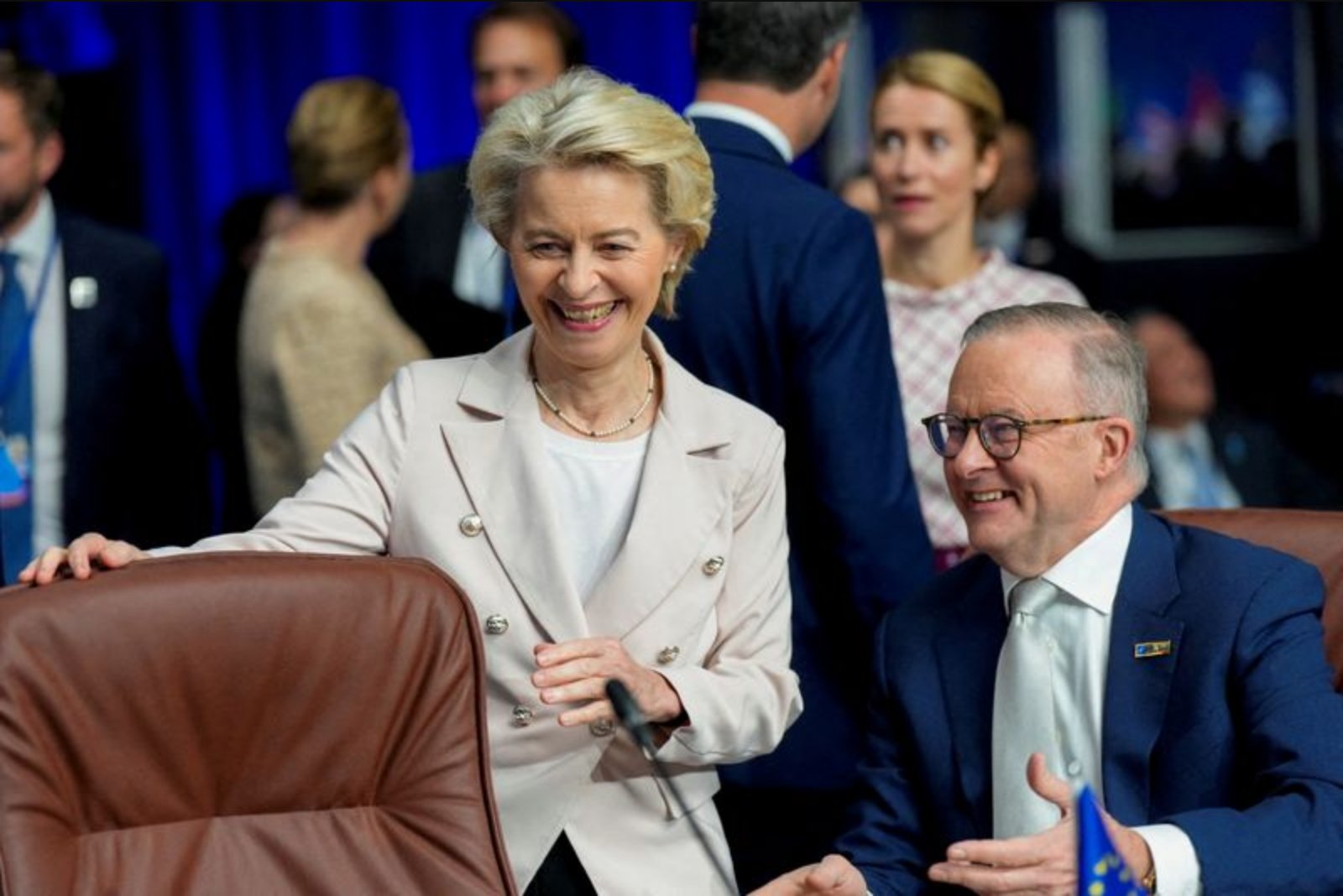
The European Union and Australia formally signed a trade agreement on March 24 in a deal that concludes negotiations begun in 2018 and accelerates collaboration between the bloc and Canberra. The accord comes as both sides pursue alternative export markets and strengthen economic ties against the backdrop of heightened global trade tensions.
Under the terms laid out by the European Commission, the agreement will eliminate more than 99% of tariffs on EU goods shipped to Australia, a move the Commission estimates will reduce duties by roughly one billion euros per year for European companies. The pact also includes lower tariffs on imports of critical minerals into the EU, reflecting specific provisions around those commodities.
European Commission President Ursula von der Leyen, speaking after a meeting with Australian Prime Minister Anthony Albanese in Canberra, framed the deal as part of a broader alignment. "The EU and Australia may be geographically far apart but we couldn’t be closer in terms of how we see the world," she said. "With these dynamic new partnerships on security and defence, as well as trade, we are moving even closer together."
Trade and market access specifics were a focus of the announcement. The Commission expects the arrangement to boost the EU's total exports to Australia by as much as 33% over the next 10 years. In services, the EU will secure expanded entry for telecoms and financial services providers.
Agricultural goods see immediate tariff relief under the deal for a selection of products. Australian tariffs on wine, sparkling wine, fruit, vegetables and chocolates will fall to zero on day one, while tariffs on cheeses will be phased out over three years. For beef, the EU agreed to open two tariff rate quotas totaling 30,600 tons, with approximately 55% of that quota volume to enter duty-free.
Previous discussions between the parties stalled in 2023, largely because of disagreements over EU quotas for meat imports and protections for the agricultural sector. Negotiations originally started in 2018 but gained momentum as geopolitical trade tensions, including U.S. tariff measures, reshaped priorities for both sides.
The pact also fits into a strategic European push to lessen dependence on China for certain resources. The Commission highlighted the role of the agreement in part to diversify supply lines for critical minerals, an area where Beijing has at times imposed export controls on key inputs.
These developments further signal the EU’s growing engagement in the Indo-Pacific region. The Commission pointed to recently concluded trade accords with Indonesia in September and with India in January as context for the bloc’s expanded outreach.
Trade volumes between the two partners are significant. EU firms exported 37 billion euros of goods to Australia in 2025 and 28 billion euros of services in 2023. As a collective, the EU ranked as Australia’s third-largest two-way trading partner in 2024 and the sixth-largest export destination; it was the country’s second-largest source of foreign investment in 2024. The announcement included a currency reference of $1 = 0.8611 euros.
While the agreement marks a milestone after years of negotiation, it reflects a series of trade and strategic recalibrations prompted by recent international developments. The deal’s trade liberalization measures are expected to reshape tariff exposure, services access and mineral import regimes between the EU and Australia.