
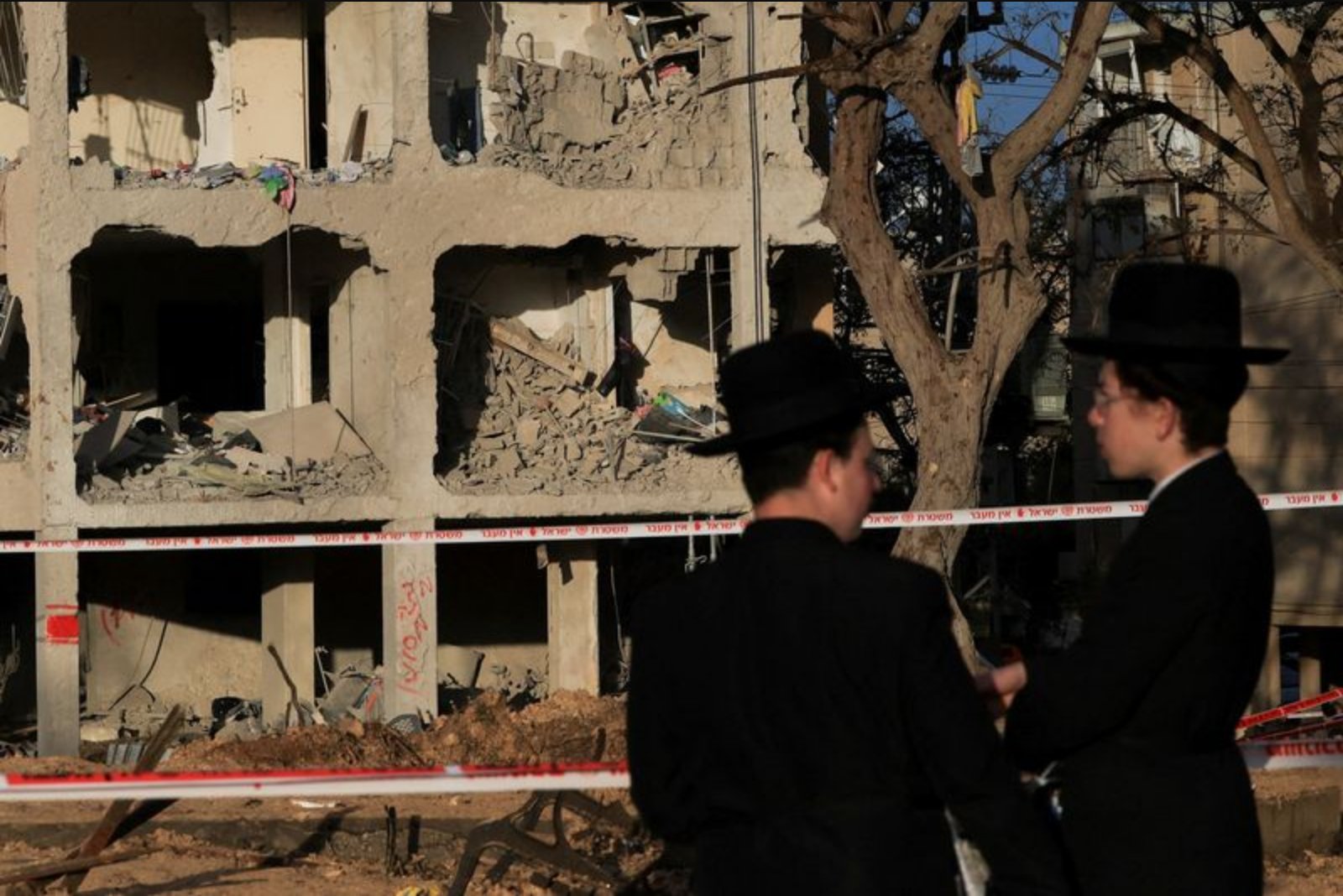
Air raid sirens sounded across Israel from the early hours of Sunday, warning residents of incoming missiles after scores of people were injured overnight in separate attacks in the southern towns of Arad and Dimona. The Israeli military said it struck targets in Tehran just hours after Iran conducted its own attacks on southern Israel.
The confrontation intensified into a direct exchange of threats between the U.S. president and Iran. President Donald Trump issued an ultimatum on Saturday giving Iran 48 hours to "fully open" the Strait of Hormuz, saying in a social media post he would "hit and obliterate" Iranian power plants if the passage was not reopened. Iran responded on Sunday by warning it would hit U.S. infrastructure in the Gulf - explicitly including energy facilities - should Washington carry out the president's threat.
The president's social media post, made at around 7:45 p.m. EDT (2345 GMT) on Saturday, stated: "If Iran doesn’t FULLY OPEN, WITHOUT THREAT, the Strait of Hormuz, within 48 HOURS from this exact point in time, the United States of America will hit and obliterate their various POWER PLANTS, STARTING WITH THE BIGGEST ONE FIRST!"
U.S. Marines and heavy landing craft have been moving to the region as the standoff widened, a deployment that has coincided with the exchange of threats and increased military activity.
Market reaction to the heightened rhetoric has been immediate and sharp. Oil prices jumped on Friday and settled at their highest level in nearly four years after a series of developments including Iraq declaring force majeure on all oilfields developed by foreign firms, an Israeli strike on a major gas field in Iran, and Tehran's retaliatory strikes on neighbouring states. The effect on shipping has been severe: Iranian actions have effectively closed the Strait of Hormuz at times, a narrow but critical choke point which carries around a fifth of global oil and liquefied natural gas supplies. The near-closure sent European gas prices surging as much as 35% last week.
Analysts flagged the president's ultimatum as a clear trigger for renewed volatility. "President Trump's threat has now placed a 48-hour ticking time bomb of elevated uncertainty over markets. If the ultimatum is not walked back, we will likely see a Black Monday reopening of global equity markets in free fall and oil prices spiking significantly higher," said IG market analyst Tony Sycamore.
Iran's officials and military commanders warned that attacks on their fuel and energy infrastructure would prompt a wide-ranging response. The Khatam al-Anbiya military command headquarters said on Sunday that if the U.S. struck Iran's fuel and energy infrastructure, Tehran would launch attacks on all U.S. energy, information technology and desalination infrastructure in the region. The nation's power grid is closely linked to its energy sector; strikes on major plants could trigger blackouts with cascading effects on pumps, refineries, export terminals and military command centres, officials noted.
Iran expanded the geographic scope of its military options on Saturday by firing long-range missiles for the first time in this conflict. Two ballistic missiles with a range of 4,000 km (2,500 miles) were fired at the U.S.-British military base at Diego Garcia in the Indian Ocean, according to comments by Israeli military chief Eyal Zamir. An Iranian strike also landed near Israel's Dimona nuclear reactor, about 13 km (8 miles) southeast of the facility.
The fighting has not been confined to direct Iran-Israel exchanges. Israel said it raided Hezbollah sites in southern Lebanon and killed 10 of the group's fighters. Hezbollah said it attacked several border areas in northern Israel. One person was killed in an Israeli kibbutz, Israeli emergency services said, marking the first fatality in Israel from Lebanese fire since March 2, when Hezbollah entered the war in response to the killing of Iran's Supreme Leader Ali Khamenei.
Israeli authorities said the military had been ordered to speed up demolition of homes in "frontline villages" in Lebanon to remove what it called threats to Israeli communities, and to immediately destroy all bridges over Lebanon's Litani river that were claimed to be used for "terrorist activity."
Maritime traffic through the Strait of Hormuz has been disrupted but not uniformly halted. Iran's representative to the International Maritime Organisation was quoted in Iranian media as saying the strait remained open to all shipping except vessels linked to "Iran's enemies." The representative, Ali Mousavi, had been speaking earlier in the week to the Chinese news agency Xinhua, before President Trump's 48-hour demand. Mousavi said that passage was possible by coordinating security and safety arrangements with Tehran.
Ship-tracking data have shown that some vessels - including Indian-flagged ships and a Pakistani oil tanker - have been able to negotiate safe passage through the strait. Pakistan was noted in reports as maintaining good relations with Iran while also keeping close ties with the U.S. and Saudi Arabia.
The unfolding conflict has carried high human, economic and political costs. Officials said more than 2,000 people have been killed since the military campaign launched on February 28. The war has upended markets, pushed fuel costs higher, fuelled fears of global inflation and strained alliances among Western powers.
Political fallout is also apparent at home in the United States. A Reuters/Ipsos poll carried out last week found that 59% of Americans disapproved of U.S. military strikes against Iran, while 37% approved. The conflict has become a significant political liability for the president ahead of November elections for Congress, observers said.
Allies have given mixed signals on how far they are willing to go in support of U.S. actions. Some NATO partners have expressed reluctance to participate in operations to reopen the Strait of Hormuz, prompting the president to criticise them for what he described as cowardice. Several governments indicated they were cautious about joining a conflict they said was initiated without prior consultation from Washington.
Japan's foreign minister, Toshimitsu Motegi, said on Sunday that Tokyo could consider deploying its military for minesweeping operations in the Strait, but only if a ceasefire were reached.
The possibility of strikes on energy infrastructure has prompted concerns across sectors beyond oil markets. Observers warned that damage to power plants, refineries, pipelines, export terminals and desalination facilities could have immediate and cascading impacts on domestic utilities, regional fuel supplies and critical civilian infrastructure that depend on power and water treatment. The role of information technology infrastructure in command, control and civil services was also highlighted in Tehran's warned targets.
As the 48-hour ultimatum ticked on and militaries repositioned in the region, uncertainty remained elevated. Markets, shipping interests, energy companies and governments were all watching for whether the ultimatum would be carried out, walked back or precipitate further strikes - each path carrying risks spelled out by parties involved and by analysts monitoring the conflict.
For now, the situation was unresolved and volatile: facilities and shipping lanes at the heart of global energy flows were under threat, regional air defences were on alert, and domestic political pressure was mounting for governments involved in and affected by the conflict. The next moves by Washington, Tehran and regional actors will determine whether the crisis escalates further or whether diplomatic and operational steps are taken to stabilise the immediate threats to energy infrastructure and markets.