
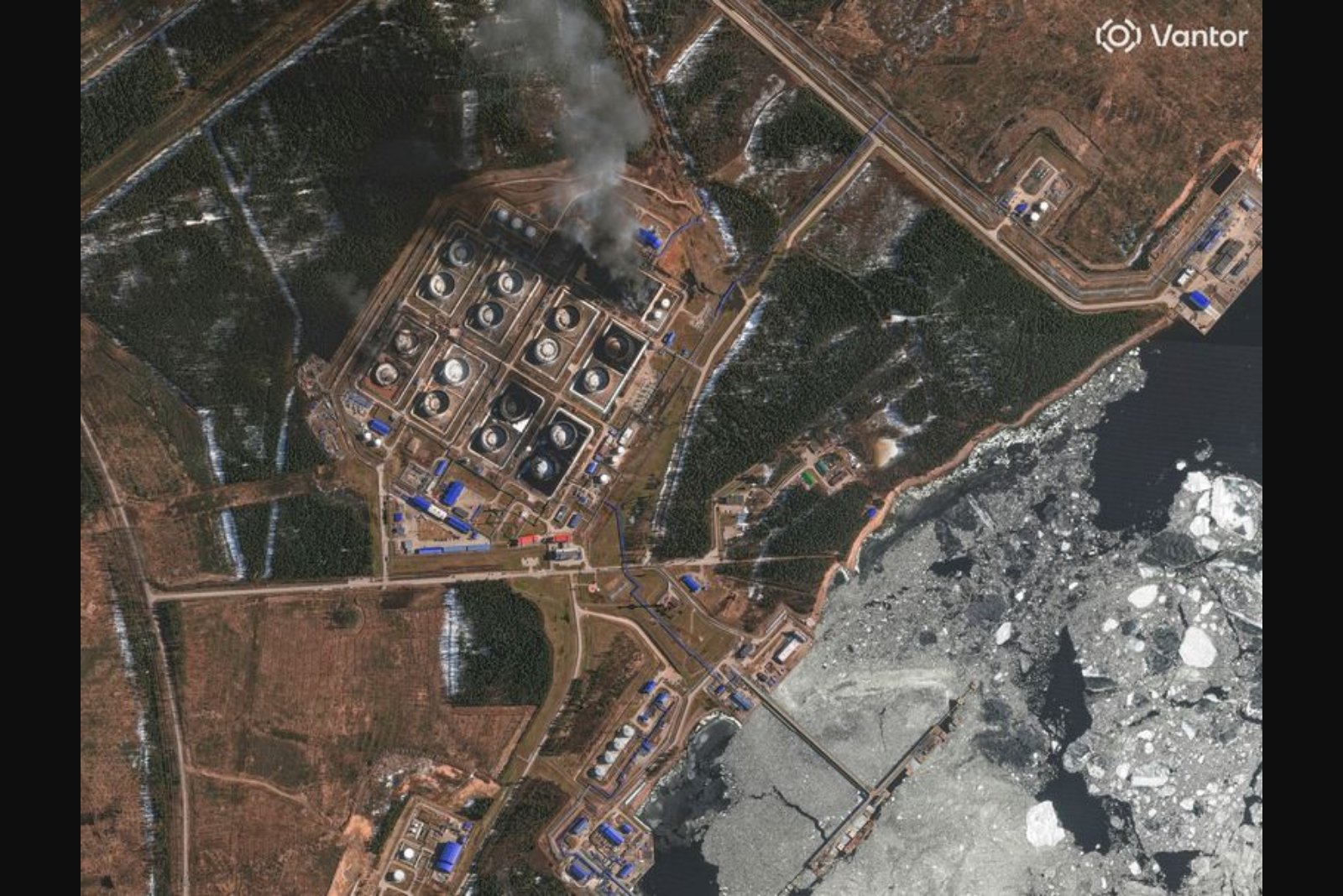
April 2 - New satellite images from the end of March show that Russia’s Baltic Sea export hub at Primorsk sustained heavy damage to its storage infrastructure in recent drone attacks, with at least 40% of the terminal’s storage capacity affected, according to commercially supplied imagery.
The images, provided by U.S. spatial intelligence company Vantor, identify at least eight reservoirs each with a capacity of 50,000 cubic metres that were damaged. Industry sources and traders consulted in the satellite assessment said that level of damage represents at least 40% of the port’s total storage and could force a reduction in throughput at the outlet.
Ukraine has increased attacks on Russian energy infrastructure over the past month, carrying out what have been described as the heaviest drone strikes on Baltic Sea ports since the onset of the more than four-year war. At one point last month, an estimated 40% of Russia’s oil exporting capability was out of operation when taking into account the strikes, the earlier closure of the Druzhba pipeline in Ukraine, and the seizure of Russia-linked tankers.
Storage and handling at Primorsk
Data from Russian oil pipeline operator Transneft indicates that Primorsk can handle 1 million barrels of oil per day, a throughput equivalent to almost 1% of global oil supply. At its principal oil depot the port holds 14 crude oil reservoirs and four facilities used to store diesel. Industry sources said that two of the eight tanks assessed as seriously damaged were used to handle diesel.
Transneft, which also controls the ports, did not reply to a request for comment on the satellite findings.
Additional damage at Ust-Luga
The satellite imagery also shows damage to facilities at another Baltic Sea terminal at Ust-Luga. Local Russian authorities reported that Ust-Luga was hit on March 22, 25, 27, 29 and 31, leading to suspensions of export operations on multiple occasions.
At the Ust-Luga Oil terminal the images indicate eight oil product reservoirs of 30,000 cubic metres each were damaged by fire. That quantity of damaged capacity represents roughly one quarter of the storage at that outlet. The imagery also shows that some berth facilities suffered damage.
Official statements and operational implications
Kremlin spokesman Dmitry Peskov described the strikes as "terrorist attacks," and said Russia was working on measures to protect its critical infrastructure. The combination of damaged storage tanks, strikes on berth facilities and prior disruptions to pipeline and shipping links means a constrained logistical picture for exports originating from the Baltic Sea ports.
Traders and logistics specialists assessing the satellite material warned that availability of reservoirs is an important element of the ports' logistics chains and that reduced storage can directly impact the ability to load and export crude and refined products. Where precise recovery timelines or repair schedules were not provided, the extent and duration of export disruptions remain uncertain based on the available imagery and statements.
As the situation develops, the operational capacity of the affected ports will be a key factor in near-term export volumes from these Baltic Sea gateways.