
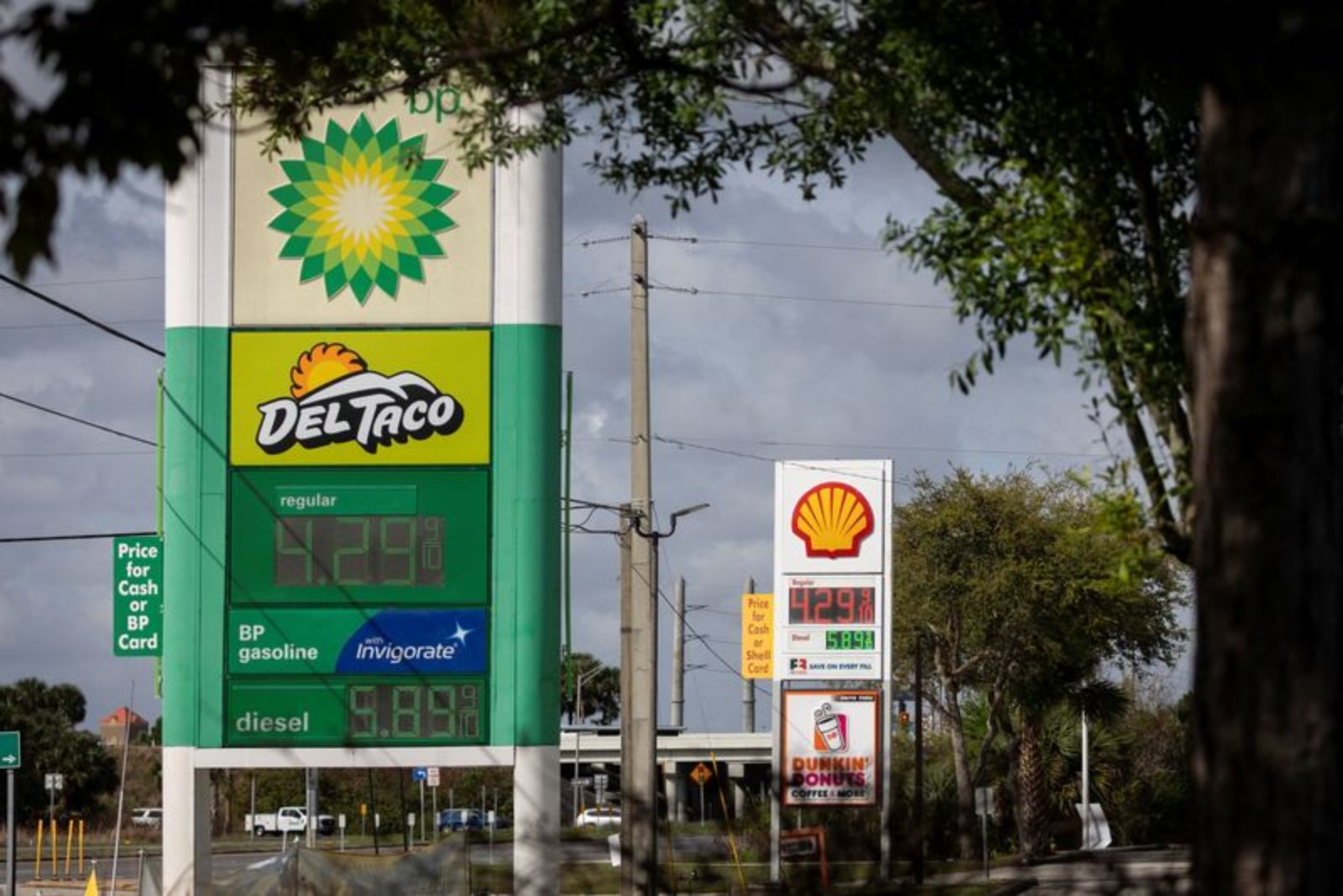
In cities from Boston to Denver and Houston, American motorists are altering their driving behavior and vehicle choices as fuel costs climb amid the Iran war. Some drivers are cutting back on longer trips, others are adding miles to reach less expensive pumps, and a few are switching to electric vehicles to avoid volatile gasoline and diesel bills.
In Boston, Pat Ouedraogo said he has curtailed longer-distance outings. "It’s a situation where you feel powerless about these prices," he told a reporter while adding a few gallons to his Nissan SUV at a Shell station charging $4.99 a gallon.
Across the country, average U.S. gasoline prices were $4.16 a gallon on Friday, while diesel averaged $5.67, the most that consumers have paid at the pumps ahead of the peak summer travel season since Russia’s February 2022 invasion of Ukraine roiled global energy markets, data from GasBuddy showed.
GasBuddy analyst Patrick De Haan estimated those prices translate into an additional $10.4 billion in U.S. gasoline and diesel spending this year compared with the same March 1-April 10 period last year, a measure GasBuddy uses to track the impact on consumer outlays since the war began.
Individual drivers are responding in varied ways. In Boston, one driver is trimming long trips. In Denver, Kari DyLong, who spends about 40 minutes commuting each way to work as a sales manager for craft brewer Oskar Blues, says she is minimizing weekend excursions and keeping activities closer to home because gas now consumes a larger share of her paycheck. "I’m doing things way more at home and not venturing out because I’m having to spend a bigger portion of my paycheck now towards gas to get me to work," she said.
In contrast, aspiring law student Skyler Burke has been driving extra miles to reach cheaper stations farther from home. And in Houston, auto broker David Wright has replaced a fuel-hungry race car with an all-electric vehicle.
Truckers facing steep cost increases
The spike in diesel prices is hitting truck operators particularly hard. Houston-based trucker Eddie Esquivel said his weekly fuel costs have nearly doubled, rising to roughly $1,600-$1,700 from $800-$900 before the conflict escalated. "These prices are hitting real hard. Diesel was $2-something a gallon. Now, it could hit $6," Esquivel said while filling up at a QuikTrip in South Houston. "You got truck payments, you got to buy tires, you got to do oil changes, and you got a family. This is killing us."
Global supply disruptions and market response
Energy market participants describe the six-week-old Iran war as an acute shock to oil supply. Major production facilities have been damaged and the effective closure of a key shipping passage has tightened flows of crude and refined products. Analysts point to about 2 million barrels per day of Middle Eastern refining capacity knocked out of service because of damage related to the conflict, according to Macquarie analysts.
Those disruptions have helped push pump prices higher in the United States, the world’s largest fuel consumer, where the cost of gasoline carries particular political weight.
Political reverberations and consumer sentiment
High fuel costs are creating political strain as voters weigh campaign promises of lower energy prices against the reality of rising consumer costs. Americans’ approval of the president has fallen in polls amid comparisons between prior promises and the sharp increase in consumer prices in March, driven in part by record fuel prices. While some voters say fuel prices are influencing their political choices, others report cutting discretionary travel or seeking alternatives to manage household budgets.
One voter at a Denver station said, "I definitely won’t be voting for (the Republican) party or anyone affiliated with this president right now who is in office at all," while filling up a pickup truck, reflecting the intensity of economic frustration among some motorists.
Outlook for prices and diplomatic efforts
U.S. officials have cautioned that even if military involvement ends and the Strait of Hormuz reopens, fuel prices are unlikely to return quickly to pre-war levels. Delegations from the United States and Iran were scheduled to hold talks in Pakistan aimed at reaching a permanent ceasefire following a fragile two-week truce announced earlier in the week. Analysts say that a lingering geopolitical risk premium is likely to remain in markets; rather than a rapid recovery to pre-war benchmarks, prices may soften gradually and stay elevated relative to earlier levels.
"We still expect a lingering geopolitical risk premium to remain in the market," said Wei Ren Gan, an analyst at consultancy Rystad. "Rather than a rapid recovery to pre-war levels, prices are likely to soften gradually and could remain relatively higher than pre-war benchmarks."
The U.S. government has also indicated that pump prices could remain elevated for some time even after any reopening of key shipping lanes.
Signs of demand destruction
Higher pump prices are already showing up in government data. U.S. gasoline demand in the week before Easter was 8.6 million barrels a day, down 9% from demand at the same point last year. Other indicators point to consumer strain: pawn loan transactions rose 9% as gas surpassed $4 a gallon, according to Tim Jugmans, financial chief at pawn loan provider EZCORP.
Those patterns—reduced discretionary driving, shifts in where people buy fuel, and increased use of alternative financing by cash-strapped consumers—are tangible signs of demand destruction that can ripple through retail, leisure, and logistics sectors if prices persist at elevated levels.
What this means for households and markets
For motorists and commercial drivers alike, the immediate impact is clear: tighter household budgets and higher operating costs for fleets. For markets, the loss of refining capacity and a sustained geopolitical risk premium could keep fuel prices higher for longer, influencing consumer spending and transport costs as the country heads into the peak travel months.
The situation remains fluid. Diplomatic talks and any further developments in the Iran war will shape the outlook for supply and prices, but analysts and U.S. government advisers emphasize that a return to pre-war price levels would not be immediate.