
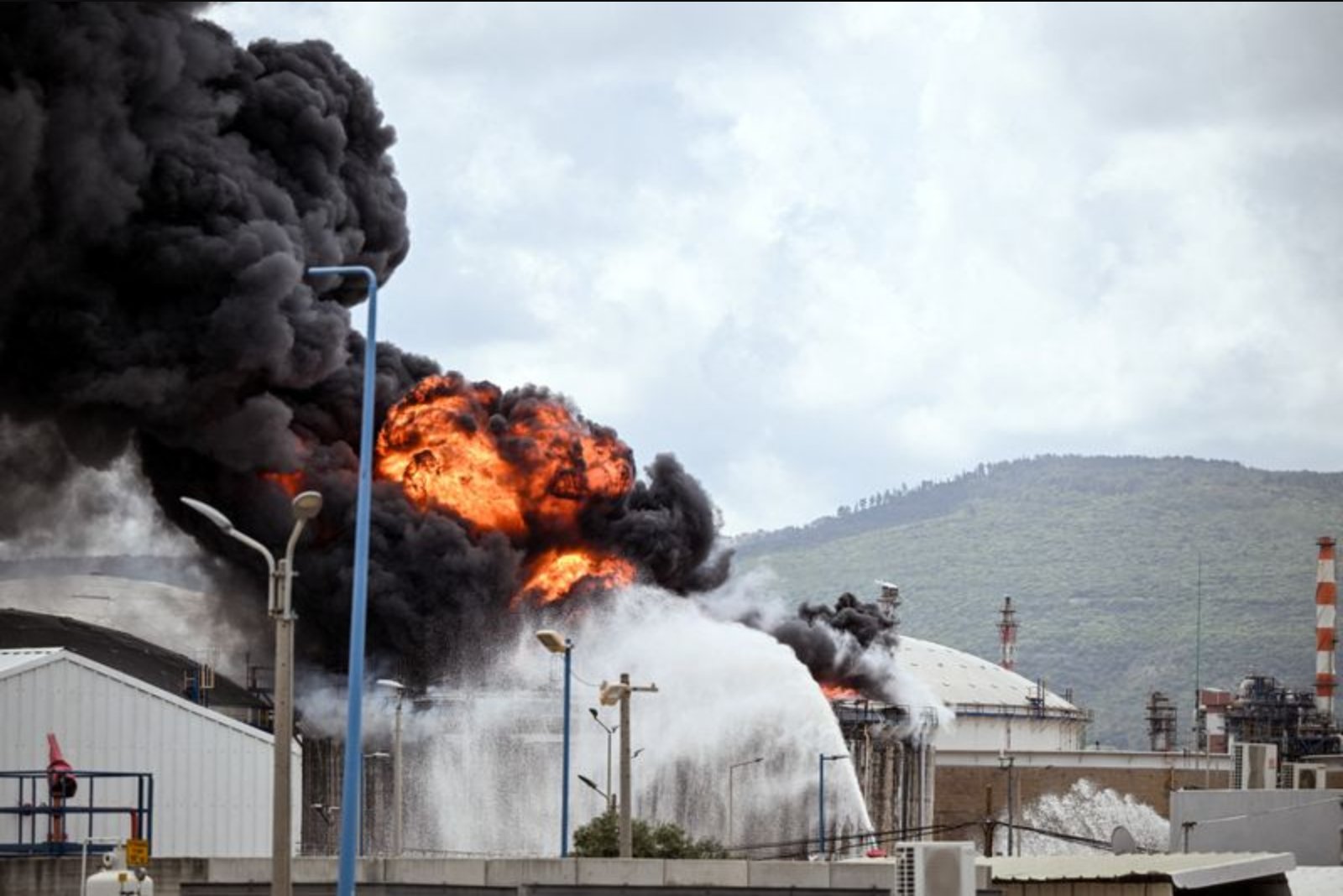
Iran carried out an apparent strike that set alight a fully loaded crude oil tanker off Dubai on Monday, according to regional reports, while U.S. President Donald Trump issued a threat to destroy Iranian energy infrastructure if Tehran does not allow free passage through the Strait of Hormuz.
The vessel affected is the Kuwait-flagged Al-Salmi, a ship designed to carry roughly 2 million barrels of crude oil. At prevailing market levels, that cargo was worth more than $200 million. Kuwait Petroleum Corp, which owns the vessel, said it was assessing the damage to the ship and warned of a possible oil spill.
Dubai authorities later reported they had succeeded in bringing the fire under control following what they described as a drone strike on the tanker. Officials said there were no reported injuries.
Context of the attack
The strike on the Al-Salmi is the most recent in a sequence of attacks on merchant vessels in the Gulf and the Strait of Hormuz. Those attacks have involved missiles and explosive unmanned aerial and sea vehicles and began after U.S. and Israeli attacks on Iran on February 28. Observers say the countrywide conflict has expanded across the Middle East over the past month.
The recent violence has had immediate consequences for energy markets. Kuwait's state news agency reported the tanker attack, and crude prices briefly spiked on the news. Tightening global supplies have pushed U.S. crude prices above $101 a barrel, and the U.S. national average retail price of gasoline crossed $4 a gallon on Monday for the first time in just over three years, according to data from price-tracking service GasBuddy. Rising fuel costs are beginning to affect household finances and have become a political problem for the U.S. administration ahead of the November midterm elections, with Republicans having campaigned on lowering energy prices and expanding U.S. oil and gas production.
Regional escalation and military movements
Attacks by multiple parties show no sign of easing and have raised fears of broader confrontation. Iran-aligned Houthi forces recently entered the conflict by firing missiles and drones at Israel, while Turkey reported that a ballistic missile launched from Iran entered Turkish airspace before it was intercepted by NATO air and missile defenses.
Israel said it conducted missile strikes on sites it described as military infrastructure in Tehran, and also hit infrastructure it linked to Iran-backed Hezbollah in Beirut, producing plumes of black smoke over the Lebanese capital. In southern Lebanon, two separate incidents killed three United Nations peacekeepers from Indonesia.
At the same time, thousands of soldiers from the U.S. Army's 82nd Airborne Division have begun arriving in the Middle East, two U.S. officials told Reuters on Monday. U.S. troop reinforcements are intended to broaden Washington's military options - including the possibility of deploying forces inside Iranian territory - even as diplomatic contacts continue.
Diplomacy, deadlines and public statements
The White House said President Trump still sought a diplomatic resolution and set a new deadline for negotiations. White House press secretary Karoline Leavitt said the president wanted to reach a deal with Tehran before an April 6 deadline he set last week after extending an earlier timeline for Iran to reopen the Strait of Hormuz. Leavitt added that talks with Iran were progressing and suggested that Tehran's private communications with U.S. officials differed from its public statements.
Reporting in U.S. media later indicated that the president had told aides he might be willing to halt the military campaign against Iran even if the strait remained largely closed, leaving a complex operation to reopen it to be addressed at a later date.
Iran said it had received U.S. peace proposals through intermediaries following recent talks among the foreign ministers of Pakistan, Egypt, Saudi Arabia and Turkey. Iranian Foreign Ministry spokesperson Esmaeil Baghaei described the proposals as "unrealistic, illogical and excessive." He said, "Our position is clear. We are under military aggression. Therefore, all our efforts and strength are focused on defending ourselves," at a press conference.
Soon after Baghaei's remarks were made public, President Trump said the U.S. was in communication with a "more reasonable regime" to end the war in Iran but also renewed his warning about the Strait of Hormuz. In a social media post he wrote: "Great progress has been made but, if for any reason a deal is not shortly reached, which it probably will be, and if the Hormuz Strait is not immediately ’Open for Business,’ we will conclude our lovely ’stay’ in Iran by blowing up and completely obliterating all of their Electric Generating Plants, Oil Wells and Kharg Island." The post also included a threat to attack Iranian desalination plants.
U.S. financing and political headwinds
The White House said President Trump was considering asking Arab nations to help cover the cost of the U.S. military effort. In response to a reporter's question, Karoline Leavitt said, "It’s an idea that I know that he has and something that I think you’ll hear more from him on." The administration has requested an additional $200 billion in funding for the war, a request that faces strong opposition in the U.S. Congress, which must authorize any new spending.
Implications for markets and households
Analysts and market participants point to immediate impacts from the spate of attacks. The strike on a fully laden crude carrier capable of transporting about 2 million barrels of oil, and the potential for oil spills, add to market anxieties. Higher crude and gasoline prices have started to put pressure on U.S. household budgets and threaten to complicate the political landscape for policymakers who have campaigned on lower energy costs.
Authorities and industry participants continue to assess the physical damage to the Al-Salmi, the potential environmental consequences, and the broader effects on shipping security in a waterway that typically carries about a fifth of global oil and liquefied natural gas supplies.
Reporting on this developing situation is ongoing as officials and companies continue to provide updates on damage assessments, diplomatic talks and military movements.