
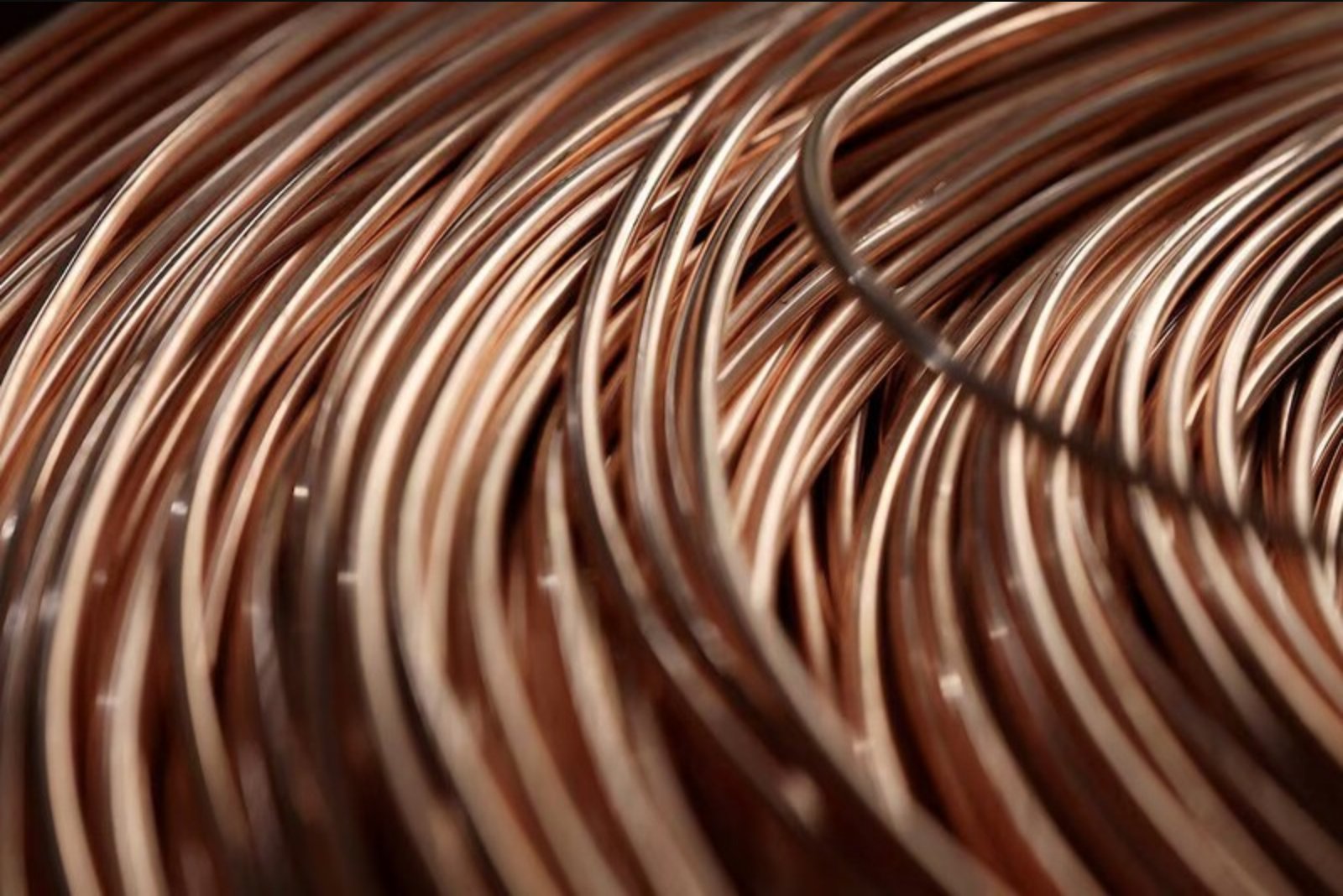
Copper continues to function as a broad indicator of industrial activity because of its extensive use across construction, power networks, manufacturing and transport. In 2025 global refined copper production reached roughly 28 million metric tons, while total copper demand including scrap was about 34 million tons.
Production and the ore split
Mine production accounted for around 23 million tons of refined-equivalent copper in 2025, while secondary supplies such as scrap contributed roughly 5 million tons. The metal is sourced primarily from two ore types. Sulphide ores make up about 80% of mine output and are processed by crushing, flotation, smelting and refining to generate copper cathode with purity above 99%.
Oxide ores account for roughly 20% of production and are typically treated through heap leaching followed by solvent extraction and electrowinning (SX-EW). The end product, copper cathode, trades internationally and is generally priced off futures benchmarks from the London Metal Exchange or the Shanghai Futures Exchange plus regional premiums that reflect logistics and local market conditions.
Geography of mining and refining
Mine production is spread across more than 400 operations globally, but a relatively small set of producers concentrates a significant share of output. The top 10 producing mines supplied about 37% of mined copper in 2025. Country-level supply shares show Chile as the largest miner with about 23% of the global mined total, followed by the Democratic Republic of Congo at 14%, Peru at 12%, China at 8% and the United States at 5%.
At the company level, Codelco and BHP each supplied about 6% of global mine output, while Freeport-McMoRan accounted for about 4%.
China dominates the refined side of the market, producing about 44% of the world’s refined copper in 2025. Other significant refining centres included the Democratic Republic of Congo, Chile, Japan and Russia. A major trade flow in the global market involves copper concentrate exported from Latin America - notably Chile and Peru - to be smelted and refined in China.
Refining capacity, curtailments and global refined output
Despite curtailments and delays to refined production outside China during 2024 and 2025, global refined output still rose by about 4% in 2025. That increase was driven by capacity additions within China, which offset some of the disruptions elsewhere.
Demand by region and end use
China remained the dominant consumer of copper, accounting for more than half of global demand - roughly 18 million tons in 2025. Europe took about 15% of total demand, while North America accounted for approximately 9%.
By end use, construction and electrical infrastructure were each responsible for about 25% of global copper consumption. The remainder of demand was composed largely of machinery, transport, consumer goods and appliances.
The role of scrap and secondary supply
Recycling is a significant component of the copper supply picture given the metal’s ability to be reused indefinitely without loss of quality. Of total copper units consumed globally in 2025, about 10 million tons - roughly 30% - were derived from scrap.
- Direct-use scrap is introduced at the fabrication stage and substitutes for refined copper demand.
- Secondary scrap is fed into smelting and refining processes and acts as a substitute for mined copper supply.
Market structure and pricing mechanics
Two primary product forms underpin pricing in the copper market: copper concentrate and copper cathode. Concentrate is sold to smelters and refiners with pricing based on copper content less treatment and refining charges. Cathode, which is 99.99% pure copper, is traded via futures, warrants and swaps on exchanges in London, New York and Shanghai. Regional premiums and treatment charges vary according to supply dynamics, smelter capacity and the availability of concentrate.
Supply growth and disruptions
Mine supply growth has slowed in recent years. Global mined copper production totaled about 23 million tons in 2025, and disruptions to supply exceeded 5% of potential output. These interruptions were caused by a range of operational factors such as technical problems, weather-related impacts, strikes and delayed ramp-ups at major operations including Grasberg, Kamoa-Kakula and El Teniente. UBS Research said that these disruptions constrained supply growth despite elevated prices.
Takeaway
Copper’s market balance in 2025 reflected a combination of concentrated mining supply, dominant Chinese refining capacity, substantial contributions from recycling and periodic disruptions that limited mine expansion. Prices are set by exchange benchmarks and regional premiums, and remain sensitive to the balance between mined output, availability of scrap and refining throughput.
The metal’s broad industrial use in construction, power networks, manufacturing and transport means these market dynamics have direct implications for related sectors and for the logistics and refining businesses that link mine output to final users.