
Pre-dawn damage to homes and dozens of injuries in a Bahraini residential neighborhood on March 9 has now been linked by independent academic investigators to a Patriot interceptor that most likely was launched from a U.S. air defense battery, according to a detailed open-source review of video and commercial satellite imagery.
The March 9 explosion tore through houses in the Mahazza neighborhood on Sitra island and left dozens injured, including children, officials in the kingdom said. Initially, Bahraini authorities and U.S. Central Command attributed the blast to an Iranian drone strike. In later comments, Bahrain acknowledged for the first time that a Patriot missile was involved in the incident, saying the interceptor successfully intercepted an Iranian drone mid-air and that damage and injuries were not the result of a direct ground impact by either the Patriot interceptor or the Iranian drone.
The academic research team - two research associates and a professor at a U.S. institute - examined multiple open-source visuals together with commercial satellite imagery and concluded with moderate-to-high confidence that the suspect interceptor likely originated from a Patriot battery located roughly four miles (about seven kilometers) to the southwest of Mahazza. The researchers reached this finding after sequentially geolocating video evidence, tracing the flight trajectory, and cross-referencing the direction and location with satellite images of known air defense sites.
Official statements and unanswered questions
U.S. Central Command posted on social media that an Iranian drone struck a residential neighborhood in Bahrain on the night of the incident. The Pentagon deferred to regional command for comment on specific questions, and the regional command did not immediately respond to requests for detail about the interceptor or its origin. A senior U.S. official in response to separate questions said the United States was focused on degrading Iran's ability to shoot or produce drones and missiles and emphasized that the U.S. military "never targets civilians," but the official did not answer detailed questions about the Patriot’s involvement in the Bahrain explosion.
Bahrain’s government statement described the interceptor as having intercepted an Iranian drone and asserted that the missile and drone did not strike the ground. The kingdom did not disclose whether the Patriot that detonated was fired by Bahraini forces or by the United States. The Bahraini spokesperson also rejected suggestions that a Patriot malfunction or misfire had occurred, saying suggestions of malfunction were "factually incorrect."
Neither Bahrain nor the United States provided visual evidence publicly confirming that an Iranian drone was present over Mahazza at the time of the explosion. Independent investigators were likewise unable to obtain or review physical fragments of a missile or drone to support either scenario. Witnesses approached for comment in Bahrain often declined to speak, citing fear of reprisals for discussing the incident publicly.
How the researchers reached their conclusion
The research team’s work centered on a video filmed from an apartment building in a different city and shared online. That footage shows what the researchers identify as a Patriot interceptor crossing the night sky at low altitude on a northeasterly heading, before angling downward and disappearing from view. The video contains a visible flash followed by what the researchers assessed to be a detonation about 1.3 seconds later.
Digital forensics review of the clip found no apparent signs of manipulation. A professor who specializes in digital forensics reviewed the footage and reported no obvious evidence that the video had been generated or altered by artificial intelligence. The research team geolocated the video to a neighborhood in Riffa, and their geolocation of that recording was independently confirmed.
From the Riffa vantage point, the trajectory of the missile in the video aligned with the strike area in Mahazza and traced back to a site the researchers identified as a Patriot battery based on its visible features in commercial satellite imagery. Those features included a cluster of radar and launcher positions and a layout the team characterized as distinctly similar to other U.S.-operated Patriot sites in the region, including protective walls, unpaved access roads and an absence of permanent buildings on the emplacement itself.
Using commercial imagery from two days before the March 9 incident, the team counted five visible launchers at the Riffa site. They noted that a full battery integrates a radar unit, a command hub and up to eight launchers. The satellite record shows the battery has occupied the site since at least 2009, while Bahrain’s own armed forces reportedly did not begin operating their own Patriot systems until 2024, according to a defense industry release about Bahraini acquisition. From these elements, the researchers judged that the Riffa battery is likely U.S.-operated and that a Patriot fired from that site is the most plausible origin for the suspect interceptor.
Physical and acoustic evidence mapped to the trajectory
On the ground in Mahazza, multiple morning-after videos and photographs show damage concentrated along roughly four streets. The pattern of destruction included heavily damaged homes and rubble strewn across the streets. One extensively damaged home was located approximately 400 feet (around 120 meters) from what the researchers identified as the center of the main blast area; interior photos of that home show holes in a wall consistent with shrapnel impacts.
An audio specialist who reviewed the flight video for the investigation examined the timing between the visible flash and when the explosion’s sound would have reached the video’s cameraman. The analysis noted that light reaches an observer far faster than sound, and based on the interval in the clip the explosion would have occurred at a distance of more than four miles from the cameraman. The damaged homes in Mahazza sit approximately 4.6 miles (7.4 kilometers) from the Riffa recording location, a distance the audio timing aligns with, according to the specialist’s assessment.
When considered together, the spatial pattern of damage on the ground and the timing from the remote video are consistent with the sequence expected if an interceptor fragmented in the air over a road intersection, with missile debris traveling outward and one piece striking a nearby house roughly 120 meters beyond that intersection. The researchers emphasized that these observations are consistent with an in-flight detonation of an interceptor and not inconsistent with the recorded audio and visual evidence.
Possible causes and competing scenarios
The researchers stressed that they could not determine with certainty what caused the interceptor to detonate. Based on the available imagery and the distribution of damage, they described two principal scenarios that could account for the evidence.
- Intercept of a low-flying drone - One possibility is that the Patriot engaged and struck a low-altitude drone. In that scenario, the interceptor and the drone could have detonated in proximity in the air, and the combined blast would have caused the damage and casualties on the ground. This interpretation is consistent with Bahrain’s public statement that an interceptor intercepted an Iranian drone mid-air and that neither struck the ground directly.
- Warhead or propellant detonation mid-flight - The researchers said another plausible explanation is that the interceptor’s warhead or unexpended propellant detonated in flight without making contact with a target. The directionality of the ground damage and the absence of clear evidence of a drone over the neighborhood made the mid-flight detonation scenario appear more likely to the researchers based on the material they reviewed.
While acknowledging both possibilities, the researchers judged it less likely that the missile successfully struck and detonated upon contact with a drone. They noted, however, that given the absence of recovered physical fragments or other definitive evidence, they could not conclusively rule out either explanation.
Additional technical observations
The researchers observed in the flight video a steep smoke trail that they assessed likely belonged to a first interceptor fired moments before the suspect Patriot. Air defense doctrine for the Patriot system often calls for firing interceptors in pairs to increase the probability of a successful intercept. The second interceptor in the video flew on a lower trajectory and deviated from the earlier smoke trail’s path; the researchers noted that the low trajectory and deviation could suggest a possible guidance or propulsion problem, though they could not exclude the possibility that the missile was intentionally directed along that path.
Patriot misfires and errant interceptors have occurred in the past, although defense and industry officials describe such events as rare. The researchers referenced at least one prior instance in which an errant interceptor struck territory outside a test or combat zone, providing historical context for the types of rare failures that can occur with complex interceptors.
Damage to nearby oil infrastructure and regional security context
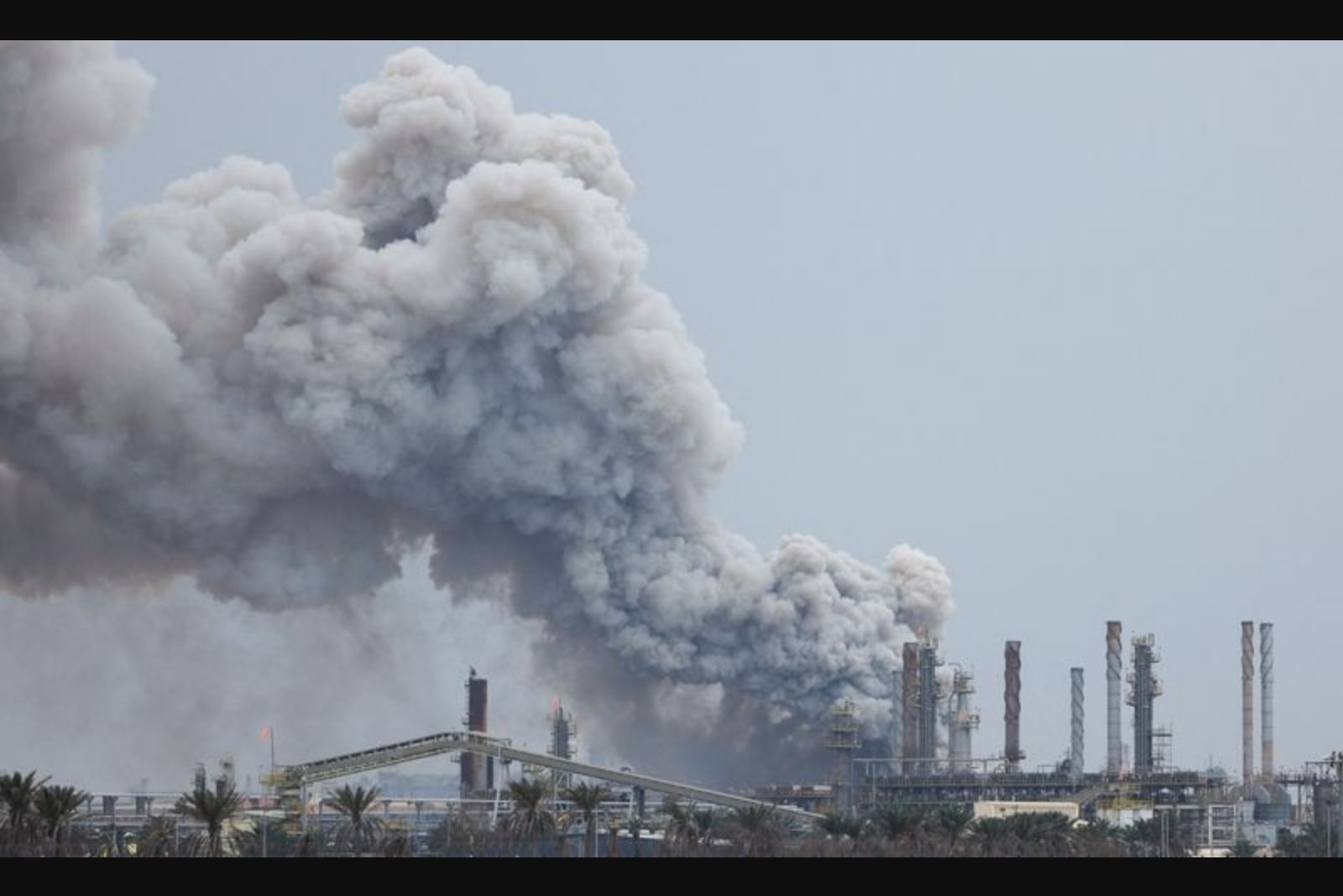
The Mahazza neighborhood sits on Sitra island, which is also home to a refinery. On the night of the explosion, the refinery came under attack, and the national oil company reported the facility had been struck. Videos from the morning after show smoke rising from the refinery. The oil company declared force majeure hours later.
The incident occurred against a backdrop of heightened hostilities in the region and bears directly on the security of maritime transit points. A small Gulf state, Bahrain occupies a key position relative to the Strait of Hormuz, a strategic chokepoint that carries a significant share of the world’s oil and liquefied natural gas. The research notes that disruptions tied to activity in the region have led to severe disturbances in global oil flows.
Information gaps and limits of open-source analysis
The researchers and independent specialists involved in the review acknowledged the important limits of open-source analysis. They did not have access to recovered missile fragments, radar logs, or classified tracking and engagement data from the night in question. They relied on commercial satellite imagery, multiple social media videos, photographs released by authorities, and acoustic timing analysis to reach their findings. Because some lines of evidence are absent, their conclusions are framed around confidence levels rather than definitive proof.
Government statements did not include evidence that would independently verify the presence of an Iranian drone over the neighborhood at the time of the blast. Likewise, neither U.S. nor Bahraini authorities publicly released tracking or engagement data that could confirm which battery fired the suspect interceptor, the precise launch time, or the engagement chain of events. The research team noted these absences and anchored their conclusions to the geolocation and physical-consistency analysis they were able to complete with open-source tools.
Responses and broader implications
When asked about the event, the Pentagon directed questions to regional command and did not provide an immediate response detailing the origin of the interceptor. A high-level U.S. official who answered related questions emphasized continuing efforts to reduce adversaries’ ability to produce and launch drones and missiles and reaffirmed that the U.S. military does not target civilians, while declining to address specifics about this interceptor engagement.
The research team’s assessment highlights the practical tensions inherent in using high-end interceptors against low-cost, low-flying threats such as small drones. The use of advanced, expensive systems to defend against inexpensive unmanned systems can produce unintended consequences when intercepted ordnance detonates above populated areas. In this case, whether the detonation arose from contact with a drone or from a malfunctioning interceptor, the resulting blast produced civilian casualties and significant residential destruction.
Investigators at defense organizations have also grappled with complicated targeting and data issues in the region. In a separate, earlier incident tied to the broader campaign of strikes and counterstrikes, investigators at a U.S. defense organization assessed that friendly forces were likely responsible for a strike on an educational facility, with outdated targeting data flagged as a possible contributing factor. That earlier assessment underscores the broader challenge of ensuring accurate, current targeting information in dynamic operational environments.
Concluding observations
The academic investigators presented a step-by-step open-source reconstruction that links a low-altitude interceptor flight captured on video to an air-defense battery with characteristics of a U.S.-operated Patriot site. Their multi-disciplinary review combined geolocation, digital forensics, acoustic timing analysis, and pattern-of-damage matching to reach a conclusion expressed with moderate-to-high confidence that the suspect interceptor originated from the Riffa site and detonated in flight over the Mahazza neighborhood.
At the same time, the researchers and independent reviewers emphasized that definitive attribution to a specific launch authority or a conclusive causal chain - whether the interceptor struck a drone or detonated for other reasons - remains unproven in the absence of recovered fragments, radar tracks or official engagement data. Bahraini statements describing an intercept of an Iranian drone align with one possible scenario, but the researchers judged that the totality of observable evidence made a mid-air detonation of the interceptor itself a more likely explanation based on what was publicly available for review.
The episode draws attention to both the operational challenges of defending allied territory with high-end interceptors against low-cost aerial threats and the persistent difficulties investigators face when trying to reconstruct complex kinetic events from open sources amid limited official transparency. The human cost - dozens of injured civilians and significant residential damage - remains at the center of the factual record of what occurred that night on Sitra island.
Note on methodology: The conclusions summarized here were derived from the researchers’ public presentation of their geolocation, satellite imagery review, and digital-forensics findings, and from independent specialists who evaluated those materials. All assessments are made with acknowledgement of the evidentiary gaps described above.