
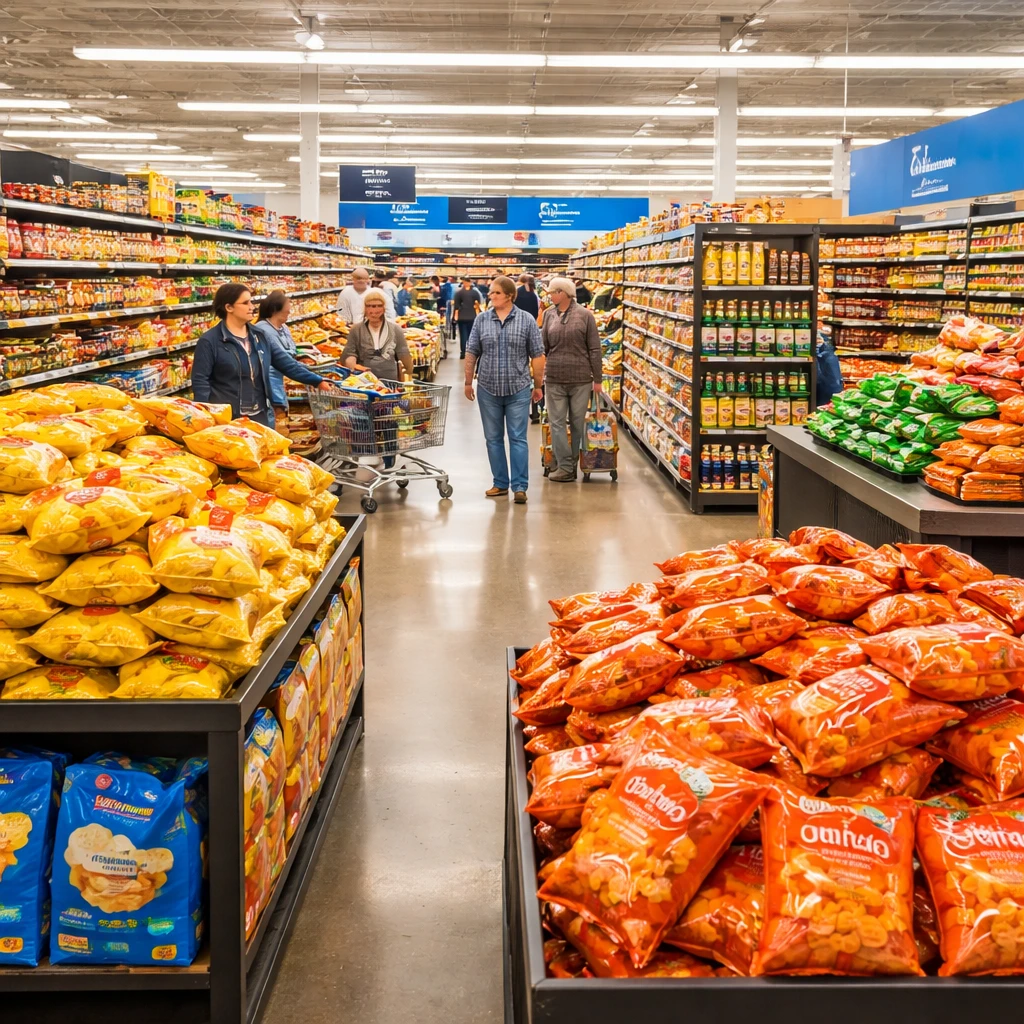
Jefferies has affirmed a Buy recommendation on Walmart and left its price objective at $132.00, saying the retailer is positioned to capture disproportionate benefits from recent pricing moves by PepsiCo. The research note describes PepsiCo's cuts - reductions of up to 15% on prominent brands including Lay's and Doritos - as "the beginning, not the end, of branded price normalization" after a period of elevated inflation that pushed salty snack prices roughly 38% higher between 2020 and 2024.
Walmart's quoted share price of $127.29 sits close to the company's 52-week high and reflects a 26.5% advance over the past six months. Jefferies frames the retailer's combination of large food volumes, acceleration in private-label offerings, and consistent market messaging around price leadership as key reasons it stands to gain as national brands move prices lower.
In Jefferies' view, manufacturers are shifting strategies toward affordability amid several headwinds: slowing volumes, consumer resistance to higher prices, and mounting pressure from private-label alternatives. PepsiCo has said it anticipates retailers will implement the supplier's suggested pricing changes, and Jefferies expects Walmart to benefit disproportionately if national brands follow through, since lower branded prices can give the retailer more room to reinforce its everyday low-price strategy while continuing to drive food traffic.
The research firm also highlighted Walmart's position within the Consumer Staples Distribution & Retail industry. With a market capitalization in excess of $1 trillion and an analyst consensus recommendation of 1.4 (Strong Buy), the company remains a dominant market participant, according to the note.
InvestingPro data points to Walmart's long record of returning capital to shareholders: the company has paid dividends for 53 consecutive years and increased its payout for 30 consecutive years. While Jefferies' $132 price target implies only modest upside from current share levels, some analysts maintain higher valuations, with price targets reaching as high as $145.
Beyond the pricing discussion, the note and related coverage mention several operational and strategic developments at Walmart. The company has elevated roughly 3,000 pharmacy technician roles into operations team lead positions, raising their average hourly pay from $22 to $28, with potential wages up to $40.50 per hour. This change is part of an effort to expand digital and pharmacy healthcare services.
On the analyst front, Piper Sandler revised its own price target for Walmart to $130, citing strength in apparel assortments and value-based pricing. Tigress Financial Partners moved its target to $135 and pointed to Walmart's investments in artificial intelligence across areas such as retail media and supply chain automation. Wolfe Research reiterated an Outperform rating and kept a $130 price objective while noting leadership changes with John Furner expected to assume the CEO role.
The retailer has also broadened its product assortment on the marketplace, launching a Premium Musical Instrument Shop that features brands such as Fender and Roland. These initiatives are presented as part of Walmart's broader push to diversify offerings and deepen engagement across categories.
Context and implications
Jefferies' outlook centers on the idea that branded price normalization will create a more favorable environment for a retailer that emphasizes low everyday prices and commands significant food volumes. The brokerage's thesis relies on manufacturers following through on price adjustments and consumers responding to lower retail prices by increasing purchase volumes.
What remains uncertain - Jefferies' view assumes retailers will implement manufacturers' suggested price changes and that national-brand price moves will translate into stronger traffic and volume gains for large discount retailers. How broadly and quickly those dynamics play out is not certain.
Data points referenced in this article derive from the Jefferies research note and InvestingPro metrics cited in that coverage.