
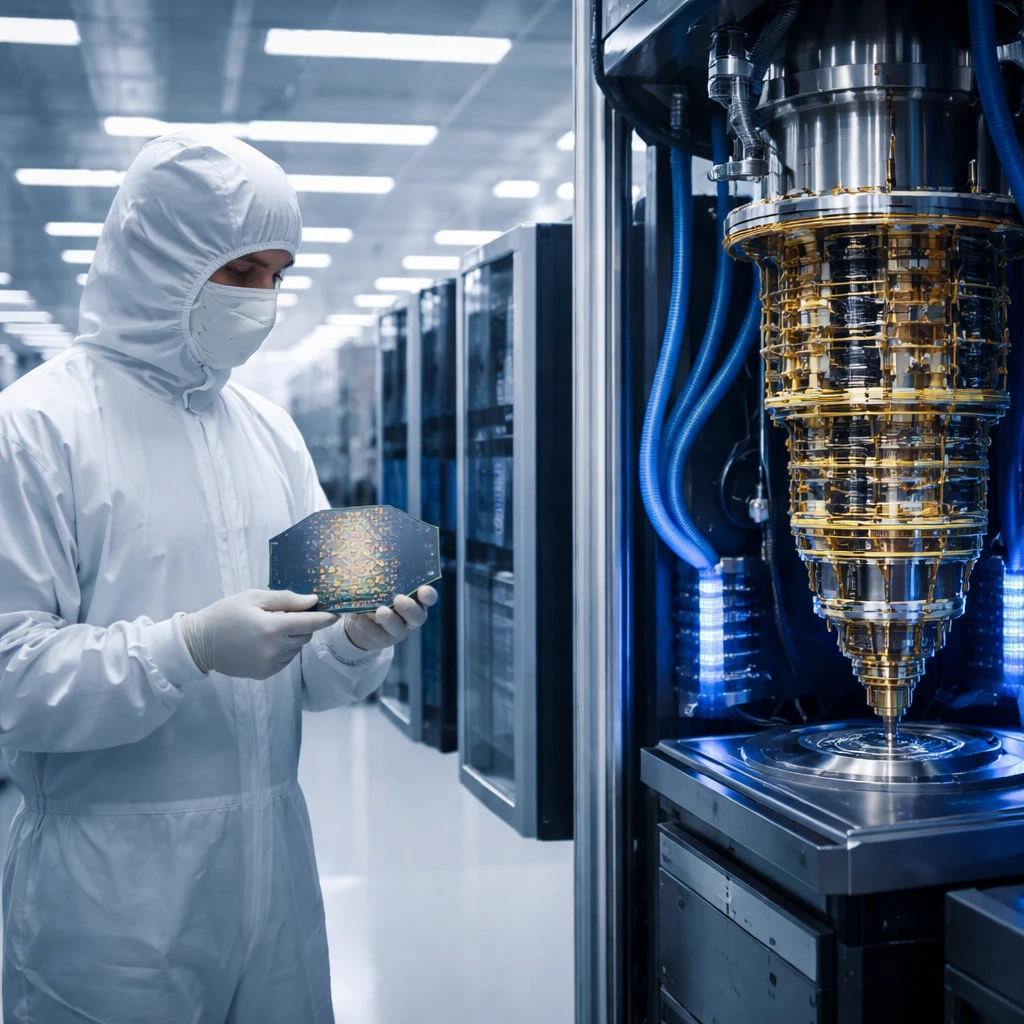
IonQ, Inc. (NYSE:IONQ) has reached terms to acquire U.S. semiconductor foundry SkyWater Technology (NYSE:SKYT) for a total equity value of $1.8 billion, according to the deal details made public in recent market commentary. The transaction is structured as a combination of cash and stock, valuing SkyWater at $35.00 per share. SkyWater shareholders are to receive $15.00 in cash plus $20.00 in IonQ common stock for each share they hold.
The agreement is subject to customary closing conditions and the approval of SkyWater shareholders and regulators, with the companies targeting completion in the second or third quarter of 2026. IonQ, which had a market capitalization of $15.37 billion and a closing share price of $43.37 at the most recent market close cited in the report, is relying in part on its available cash resources to fund the cash portion of the consideration. Data cited in the analysis indicates IonQ holds more cash than debt on its balance sheet.
Strategic rationale
Company and analyst commentary frame the acquisition as a strategic step to integrate manufacturing capability into IonQ's full-stack quantum platform. Vertical integration of a foundry supplier is presented as a way to compress development timelines and achieve cost advantages on quantum hardware components. Analysts note that the transaction could materially shorten IonQ's chip iteration cadence - with projections suggesting the cycle time for a 256-qubit chip could fall from nine months to two months under the integrated model. The same analysis indicates the potential to accelerate IonQ’s goal of reaching 2 million physical qubits from a 2030 target to 2029.
Another dimension of the deal is SkyWater’s standing as a government-accredited manufacturing partner. SkyWater holds DMEA Category 1 trusted accreditation as a government partner, a credential that market observers say should strengthen IonQ’s ability to serve government and defense customers.
Regulatory and market considerations
Even as the acquisition is presented as strategically complementary, analysts caution there could be regulatory scrutiny because SkyWater functions as a foundry supplier to multiple companies in the quantum sector. The relationship between a supplier and numerous industry customers introduces potential regulatory complexity that the transaction will need to navigate.
In pricing context, the $35.00 per-share offer represents a 38% premium to SkyWater’s 30-day volume-weighted average price as of January 23, the deal disclosure shows.
Financials, guidance and valuation
Alongside the acquisition announcement, IonQ updated its outlook by pre-announcing that full-year revenue will land at the high end or above its previously stated range of $106 million to $110 million, with audited results scheduled for the next monthly reporting cycle. The company has been on a strong revenue trajectory: reported revenue growth reached 113.07% over the last twelve months.
That said, investing-platform analysis referenced alongside the deal suggests IonQ looks overvalued based on a platform fair-value assessment, despite the rapid revenue expansion. The valuation note is part of the broader market context investors will weigh when assessing the strategic merits of the acquisition.
Leadership and operational updates
IonQ also announced two senior appointments in connection with its expansion: Katie Arrington has been named Chief Information Officer and Leslie Kershaw will serve as Chief Information Security Officer. Arrington’s remit is described as overseeing protection and modernization of IonQ’s global enterprise systems.
Operationally, IonQ disclosed an agreement to deliver its 100-qubit Tempo quantum system to the Korea Institute of Science and Technology Information (KISTI). The system will be integrated with what the report describes as South Korea’s largest high-performance computing cluster, enabling the country’s first hybrid quantum-classical onsite integration. Access to the platform will be provided through a secure private cloud environment, and the deployment is indicated to support South Korea’s National Quantum Computing Center of Excellence.
Market backdrop
Industry forecasts cited in the analysis project global quantum computing revenues of roughly $2 billion by 2026, with defense and aerospace sectors identified as primary drivers of that near-term market growth.
As the deal moves through approvals and integration planning, market participants will watch how the combined entity balances foundry obligations to other customers, captures the anticipated cycle-time gains, and realizes the government market opportunity while managing valuation perceptions and regulatory review.