
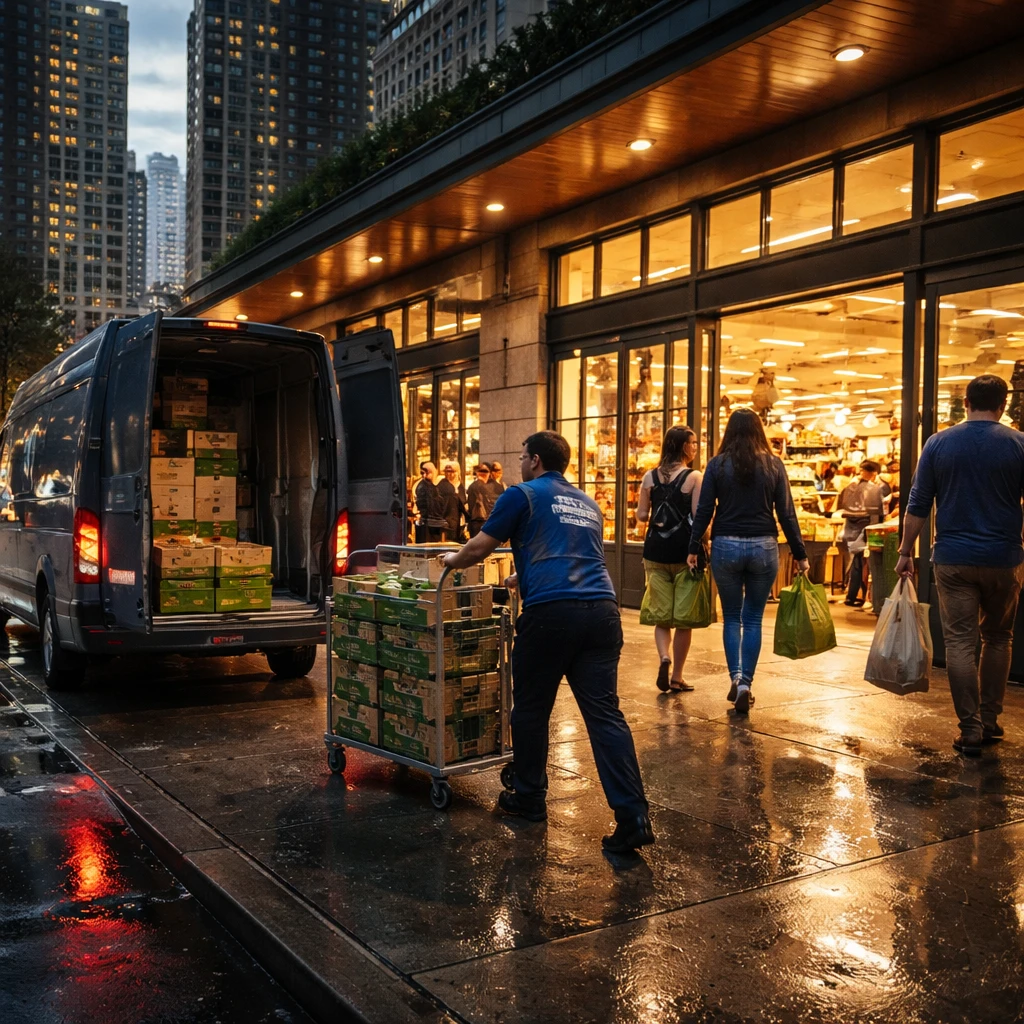
Amazon said in a company blog post that it is sharpening its focus on online grocery delivery and expanding the number of Whole Foods stores it operates. The announcement has prompted market reactions across the grocery sector, with several retailers seeing share-price pressure.
In a research note titled "AMZN Grocery with Another Direct Shot at WMT," Mizuho analysts reviewed Amazon's push into grocery. The note observed that Amazon has not yet landed on a differentiated customer experience in physical grocery stores nor identified the economic model necessary for a scaled physical grocery rollout. That assessment framed the brokerage's view of how Amazon's renewed effort should be interpreted.
Mizuho highlighted that Walmart experienced the steepest share decline among grocery retailers after Amazon's announcement. The firm pointed to Walmart's more than 4,000-store network as the company's major differentiator in grocery competition, noting that this advantage remains meaningful unless Amazon undertakes a substantial grocery-focused acquisition.
The Mizuho team also characterized Amazon's grocery strategy as concentrated on urban, densified markets rather than rural or suburban geographies. This emphasis reflects a preference for leveraging Amazon's existing strengths in areas where customer density and logistics economics can make online grocery delivery more viable.
On Costco, Mizuho said Amazon's grocery push presents "some, but limited, impact." The brokerage argued that Costco's core customer proposition - bulk purchases and a warehouse retail format - is oriented differently from daily online grocery needs and therefore is less dependent on online grocery penetration.
Costco's most recent reported figures cited in the material show annual revenue of $280.39 billion and a market capitalization of $428.4 billion. InvestingPro's assessment listed Costco's financial health score as GREAT, while noting a gross profit margin of 12.88 percent. Analysis from InvestingPro also indicated the stock was trading above its Fair Value, with a suite of additional ProTips and a Research Report available to subscribers.
Separately, Costco announced a quarterly cash dividend of $1.30 per share, payable on February 13, 2026, to shareholders of record as of January 30, 2026.
Analyst sentiment on Costco remains generally positive. Bernstein kept an Outperform rating, describing the company as undervalued despite recent stock recovery. UBS maintained a Buy rating while highlighting a 6.3 percent increase in core U.S. comparable sales for December. Jefferies also reiterated a Buy stance after reporting an 8.5 percent rise in net sales for December and favorable trends in ticket size and customer traffic. DA Davidson held to a Neutral rating, pointing to a 7.0 percent total comparable sales gain in December. These analyst updates were cited as part of a constructive outlook from several firms, many of which continue to carry elevated price targets for Costco.
Investors and industry watchers will likely continue to evaluate how Amazon translates its stated online grocery ambitions and Whole Foods expansion into operational and economic realities. For now, the market reaction underscores the sensitivity of traditional grocers to Amazon's moves even as analysts debate the scope of competitive threat across urban versus non-urban retail footprints.
Key points
- Amazon said it will intensify online grocery delivery and expand its Whole Foods store base, with the company communicating the plan in a blog post.
- Mizuho notes Amazon has not yet developed a differentiated in-store grocery experience or the necessary economics for large-scale physical grocery expansion; the firm sees Amazon's efforts as more urban-focused.
- Walmart shares fell the most among grocery retailers after the announcement, while analysts expect only limited direct impact on Costco due to its bulk-oriented warehouse model and different customer base; several analysts reiterated positive ratings on Costco after strong December sales metrics.
Risks and uncertainties
- Amazon has not demonstrated a clear consumer experience and economic model for scaled physical grocery growth - this creates uncertainty about how effective its expansion will be and affects the grocery retail sector.
- Walmart's scale advantage - a network of more than 4,000 stores - remains a critical differentiator; unless Amazon pursues a significant grocery acquisition, the competitive dynamics may not shift as dramatically as investors fear.
- Costco's different customer and format orientation implies limited direct pressure from Amazon's online grocery push, but ongoing consumer trends and comparable sales performance will influence investor views in the retail and consumer staples sectors.