
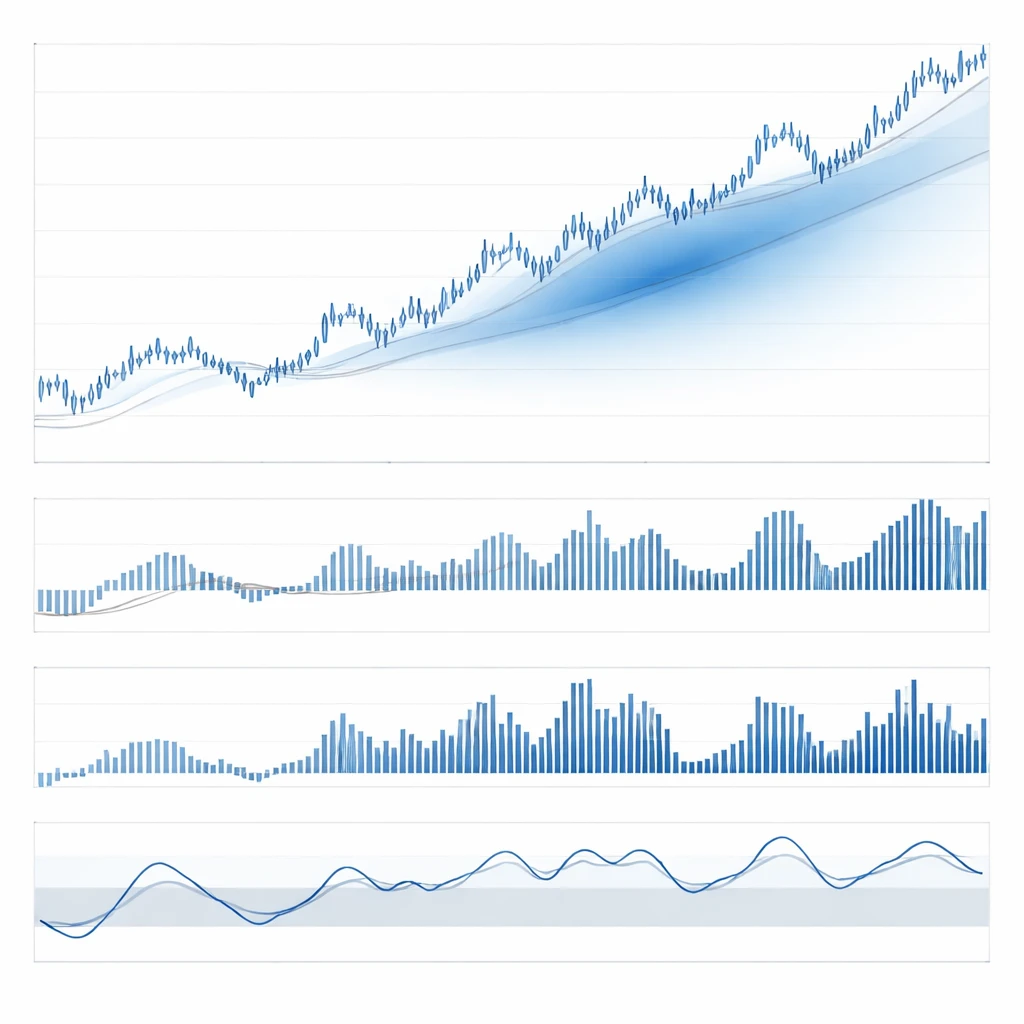
Trend following seeks to harvest persistent directional moves by aligning exposure with prevailing price behavior. Within this family of strategies, the idea of trend strength is central. Strength is not the same as direction. Direction identifies whether the market is rising or falling. Strength describes the conviction, persistence, and robustness of that directional movement. Traders and researchers use strength to determine when a trend is more likely to continue, when to scale exposure, and when to reduce risk as conditions deteriorate.
Defining Trend Strength
Trend strength is a quantitative and qualitative assessment of the quality of a directional move. A strong trend exhibits persistence across time, resilience to counter moves, and a pattern of range expansion that supports the current direction. A weak trend often drifts, reverses frequently, or advances on low volatility only to give back gains quickly.
Strength is best conceived as multi dimensional. Common dimensions include:
- Direction and slope: The rate of change of price over a defined window, often captured by moving average slopes or linear regressions.
- Persistence: The tendency for returns to remain of the same sign across adjacent periods, often summarized by run length or serial correlation estimators.
- Range expansion: The extent to which price makes fresh extremes and holds them, for example the frequency of new highs in an uptrend or new lows in a downtrend.
- Volatility context: Whether volatility is supportive. Strength typically coincides with volatility that expands in the direction of the trend without becoming chaotic.
- Breadth and confirmation: Whether related assets or internal components move in concert, such as sector level participation in an equity index trend.
Each dimension can be measured in multiple ways. No single indicator captures the entire concept. A practicable definition usually blends several measures into a composite that is stable, interpretable, and testable.
Core Logic in Trend Following Systems
Trend following relies on the empirical observation that returns can display positive autocorrelation over certain horizons. If a market moves higher over a sustained interval, it is more likely to continue than to reverse within that same structural regime. The logic of strength builds on this by distinguishing between environments where continuation is statistically more probable and environments characterized by noise.
In structured systems, trend strength influences three areas:
- Exposure filters: A system can avoid taking exposure unless the measured strength exceeds a predefined threshold. The intent is to reduce whipsaws during range bound conditions.
- Sizing modulation: When strength improves, the system may allow greater risk allocation within limits. When strength fades, the system can step down exposure to control drawdowns.
- Exit governance: Weakening strength can act as an early warning that the regime is changing, complementing price based exit rules such as stops or trailing exits.
These uses do not predict outcomes. They structure decisions so that the system behaves consistently when confronted with similar conditions.
From Concept to Measurement
Any workable notion of strength must be translated into numerical rules that are testable and repeatable. The process usually follows a set of steps:
- Choose horizons: Define the timescale of interest, such as short term, intermediate, or long term. Strength measured over a week can look very different from strength measured over six months.
- Select proxies: Specify indicators that approximate the dimensions you care about, such as moving average slope for direction, average true range for volatility context, or a count of new highs for range expansion.
- Normalize: Put measures on comparable scales, for example by dividing by volatility, using z scores, or converting to ranks across a universe.
- Combine: Aggregate into a composite score using a transparent rule, such as an equal weight average or a simple decision tree that requires multiple confirmations.
- Validate: Test the composite for stability. Ensure it is not overly sensitive to small parameter changes and that it behaves sensibly across regimes.
Normalization is essential. A raw slope of one asset is not directly comparable to that of another if their volatilities differ significantly. Volatility scaling helps avoid mistaking high noise levels for genuine strength.
Common Quantitative Proxies for Strength
Price based slope and persistence
Simple moving average slopes and linear regression betas provide interpretable measures of trend direction and speed. To capture persistence, one can evaluate the proportion of up closes in a rolling window or compute a simple first order autocorrelation of returns. A strong uptrend typically shows a positive slope and a high proportion of positive returns, with relatively short interruptions.
Range expansion and breakout behavior
Counts of new highs or lows within a window, or the distance from price to its recent extreme normalized by volatility, capture whether price is exploring territory consistent with continuation. Strong trends often break and hold beyond prior ranges. Weak trends probe extremes but revert quickly.
Volatility adjusted momentum
Momentum signals that divide return by a volatility estimate attempt to separate signal from noise. The idea is that two assets with identical returns are not equally strong if one achieved that advance with far less fluctuation. A volatility adjusted measure also helps with position sizing across a diversified portfolio.
Directional movement and compression release
Measures that summarize directional movement relative to true range aim to detect whether directional moves dominate the overall activity. Uptrends characterized by orderly range expansion and small retracements often score higher on such metrics compared with choppy, overlapping trading ranges.
Market structure and higher highs or lower lows
Price structure can be summarized by counting sequences of higher highs and higher lows in an uptrend, or lower lows and lower highs in a downtrend. A robust trend shows continuation in structure, not only in returns. Combining structure counts with volatility context can offer a more resilient definition than either alone.
Cross sectional confirmation
In equities, breadth indicators that measure the percentage of constituents in a sector or index that are above a trend filter provide context for the parent index. A broad base of participation tends to be more resilient than an index driven by a small subset of large constituents. In futures, related contracts within a complex can offer confirmation, such as strength across multiple energy markets.
Multi timeframe Considerations
Trends form across multiple horizons. A market can exhibit a strong daily trend while the weekly chart remains range bound. Defining strength on a single timeframe may lead to inconsistent behavior if the system trades at a different frequency. Many systems therefore condition exposure on a primary timeframe and use a higher timeframe to confirm the regime.
A practical approach is to compute strength on the trading timeframe and to consult a slower, more stable measure of regime as a structural filter. If the slower measure signals neutral conditions, the system can reduce position sizes even if the faster measure suggests strength. This avoids concentrating risk in conflicts between timeframes.
How Strength Fits Into a Structured Workflow
Trend following strategies generally follow a loop of observe, decide, and act. Trend strength can appear at each stage:
- Observation: Compute strength metrics daily or intraday with clean, validated data. Use robust calculations that are resistant to outliers and data errors.
- Decision: Apply rules that map strength states to allowed actions. For instance, allow exposure only when the composite score exceeds a neutral band, and scale within a defined range as strength changes.
- Action: Implement orders with attention to liquidity, expected slippage, and risk constraints. Execution quality can materially affect realized outcomes, particularly during volatile periods.
By defining strength states and corresponding actions ex ante, the system behaves consistently during both favorable and unfavorable periods. This consistency is central to repeatability and to credible performance evaluation.
Risk Management Considerations
Strength is often misunderstood as a guarantee of reduced risk. A strong trend can reverse sharply and without warning. Proper risk governance therefore operates independently from the strength assessment, even if the two interact.
Volatility scaling and risk budgets
Position sizes are commonly scaled to target a consistent level of volatility across assets. When a trend strengthens because of rapid price increases accompanied by volatility expansion, volatility scaling can mechanically reduce exposure to avoid over concentration. The strength score might still be high, yet total risk remains bounded by the risk budget.
Drawdown controls and step down rules
Many systems define a maximum drawdown threshold at the strategy or portfolio level. If breached, the system steps down gross exposure, regardless of current strength readings. This enforces survival discipline during adverse sequences that may reflect a regime change.
Stop mechanisms and weakening strength
Exit mechanisms based purely on price, such as trailing stops or structure breaks, can be complemented by strength thresholds. When strength deteriorates below a neutral band, the system can transition to a protective posture. This is a governance overlay, not a forecast, intended to limit participation when the expected payoff profile weakens.
Correlation and clustering
Strength often appears across related assets at the same time. Without explicit correlation controls, a portfolio can become unintentionally concentrated. Universe level or sector level caps prevent a collection of individually reasonable positions from aggregating to excessive correlated risk.
Liquidity, gaps, and execution risk
Strong trends can coincide with crowded conditions. Liquidity can thin out, spreads can widen, and overnight gaps can dominate realized risk. Execution assumptions used in backtests should be conservative, and live risk controls should account for gap risk that bypasses intended exit levels.
Interpreting Strength Across Market Regimes
Trends occur within broader regimes such as low volatility expansion, high volatility dislocation, or mean reverting ranges. The same strength score can carry different implications in different regimes. A high score in a calm expansion may reflect orderly participation. A similar score in a stressed regime might be driven by episodic spikes, with less reliable follow through.
One solution is to estimate a simple regime label using measures like realized volatility level or range compression. The system can then modify its thresholds or sizing bands conditional on the regime label. Another approach is to incorporate regime directly into the composite by converting raw metrics into ranks within the current regime context.
Practical Example: A High Level Walkthrough
Consider a systematic process trading a diversified set of liquid instruments. The workflow defines an intermediate horizon for trend following and evaluates strength daily. The process may follow these conceptual steps:
- Data preparation: Use end of day prices and compute volatility, recent extremes, and regression slopes on rolling windows. Validate data to remove obvious errors.
- Strength components: For each instrument, compute a directional slope measure, a range expansion metric relative to recent highs or lows, and a volatility adjusted momentum value. Convert each to a standardized score so that magnitudes are comparable across instruments.
- Composite score: Average the standardized components. Impose a neutral band around zero. Scores above the upper band indicate strong uptrend conditions, scores below the lower band indicate strong downtrend conditions, and scores inside the band represent indeterminate conditions.
- Exposure map: Allow exposure only when the score is outside the neutral band and when a slower regime filter is not neutral. Within allowed states, size positions using volatility scaling, and modulate sizes within preset limits as the score changes.
- Exit governance: Use price based exits to manage adverse moves and incorporate a rule that reduces exposure when the score reenters the neutral band. If drawdown thresholds trigger, reduce gross exposure regardless of individual scores.
Suppose a particular instrument begins to make a sequence of higher highs and higher lows, accompanied by steady range expansion. The slope measure rises, the expansion metric confirms persistence near recent extremes, and the volatility adjusted momentum improves. The composite score moves beyond the neutral band and remains there for several weeks, during which the position size fluctuates within limits as volatility changes. Later, the score drifts toward the neutral band as pullbacks deepen and range expansion fades. Exposure is gradually reduced before a separate price based exit fully closes the position. Throughout the episode, the system follows the same rules without reference to discretionary judgments.
Design Choices and Trade offs
Every measurement choice implies a trade off between responsiveness and stability. Short windows react quickly but are prone to noise. Long windows are stable but can be late during sudden transitions. Blending multiple windows or using an ensemble of metrics can improve robustness, but complexity must be justified by out of sample evidence.
Smoothing methods matter as well. Simple moving averages are easy to interpret, but they can introduce lag. Regression based slopes reduce certain types of noise but can be influenced by outliers. Rank based transformations are robust to extreme values, yet they discard magnitude information that may be relevant for sizing decisions.
Weighting schemes in the composite also require care. Equal weights promote transparency and reduce the risk of overfitting. Optimized weights can improve in sample performance but are vulnerable to instability. A conservative approach is to constrain weights, test across multiple samples, and prefer parameter regions where performance is relatively flat rather than spiky.
Validation and Robustness
Strength definitions should be tested with realistic assumptions and a focus on generality. Effective validation practices include:
- Out of sample testing: Reserve periods not used for design and verify that the behavior of the strength composite holds up.
- Walk forward analysis: Recalibrate periodically and test forward to simulate live conditions and parameter drift.
- Sensitivity analysis: Vary lookback windows, thresholds, and weights to see whether results are stable. Prefer configurations with wide regions of acceptable performance.
- Transaction cost modeling: Include conservative estimates of slippage and commissions. Strong looking signals can degrade once realistic costs are applied.
- Survivorship and look ahead controls: Ensure the dataset does not omit delisted instruments and that no future information contaminates calculations.
It is also useful to examine the distribution of the strength score itself. A bimodal distribution may indicate that the composite distinguishes clearly between trend and range regimes. A unimodal distribution centered near zero may suggest that the composite is not discriminative enough, which could lead to frequent state switching and unnecessary turnover.
Interpreting Drawdowns and Whipsaws
Trend following systems tend to suffer during range bound or mean reverting conditions. If strength measurement is effective, exposure during these phases should be lower on average. Nevertheless, whipsaws are inevitable. A transparent evaluation compares periods of strong score readings with subsequent drawdown behavior. If drawdowns cluster when scores are weak or neutral, the composite is functioning as a filter. If heavy drawdowns occur while the score remains high, the composite may be too slow to detect regime changes or too dependent on one dimension of strength.
One practical enhancement is to incorporate measures of consolidation. When price compresses and volatility falls below a rolling baseline, the system can treat strength readings with additional caution until expansion resumes. This adjustment helps reduce false continuation signals that arise from low activity environments.
Portfolio Construction with Strength
In multi asset settings, strength can inform selection and ranking. A system might maintain a list of instruments that pass a minimum strength threshold and then allocate capital across that subset using volatility scaled weights. To maintain diversification, the system can apply constraints at the sector, region, or factor level. The goal is to avoid concentration while still aligning the portfolio with prevailing trends.
Cross sectional strength must be tempered by liquidity and risk parity considerations. Instruments with high measured strength but thin liquidity can distort realized risk. Rank based techniques help by capping allocation to any single instrument and by smoothing transitions through bands that reduce turnover when rankings change marginally.
Communication and Governance
Strength metrics should be explainable to stakeholders. The composite and its components need clear interpretations, such as slope, range expansion, and volatility context. Rule based descriptions facilitate oversight and reduce the temptation to intervene based on short term discomfort. Regular reviews can compare realized behavior to expected behavior drawn from historical tests, focusing on whether deviations are within the range implied by model uncertainty.
Limitations and Practical Pitfalls
Several pitfalls recur when practitioners operationalize trend strength:
- Overfitting to one regime: Building and validating the composite during a dominant bull phase or crisis phase can produce rules that fail elsewhere. Balanced samples matter.
- Indicator redundancy: Combining highly correlated components can create an illusion of confirmation without adding information. Correlation analysis helps select complementary measures.
- Unstable thresholds: Small changes in thresholds that cause large changes in behavior suggest fragility. Prefer thresholds that are robust to modest variation.
- Ignoring costs and capacity: Strong signals that require frequent rebalancing or that concentrate in illiquid assets can be impractical at scale.
- Delayed response to reversals: Overly smoothed composites can stay strong as price reverses. A hybrid approach that includes a structure break component can mitigate this delay.
Putting It All Together
Trend strength is not a single formula but a framework for judging the quality of directional movement. When integrated thoughtfully, strength helps systems avoid noise, allocate risk in proportion to opportunity, and recognize deteriorating conditions. The concept adds discipline by specifying when the system is willing to take risk and when it prefers to preserve capital. It also structures evaluation by linking realized outcomes to clearly defined states that can be analyzed over time.
For researchers and practitioners who favor systematic methods, the value of strength lies less in any individual indicator and more in the consistency of the process. Use interpretable components, normalize them properly, and validate with realistic assumptions. Preserve independence between risk control and signal generation so that both can function even when one errs. Over time, these practices tend to produce a strategy that is transparent, auditable, and better aligned with the uncertain nature of markets.
Key Takeaways
- Trend strength measures the quality of directional movement across dimensions such as slope, persistence, range expansion, and volatility context.
- In structured systems, strength guides exposure filters, modulates position sizing, and complements exit rules without predicting outcomes.
- Robust strength definitions rely on normalization, composite scoring, multi timeframe context, and conservative validation practices.
- Risk management remains independent of strength, with volatility scaling, drawdown controls, and correlation limits governing total exposure.
- Practical implementation emphasizes explainability, stability across regimes, and realistic assumptions about costs, liquidity, and execution.