
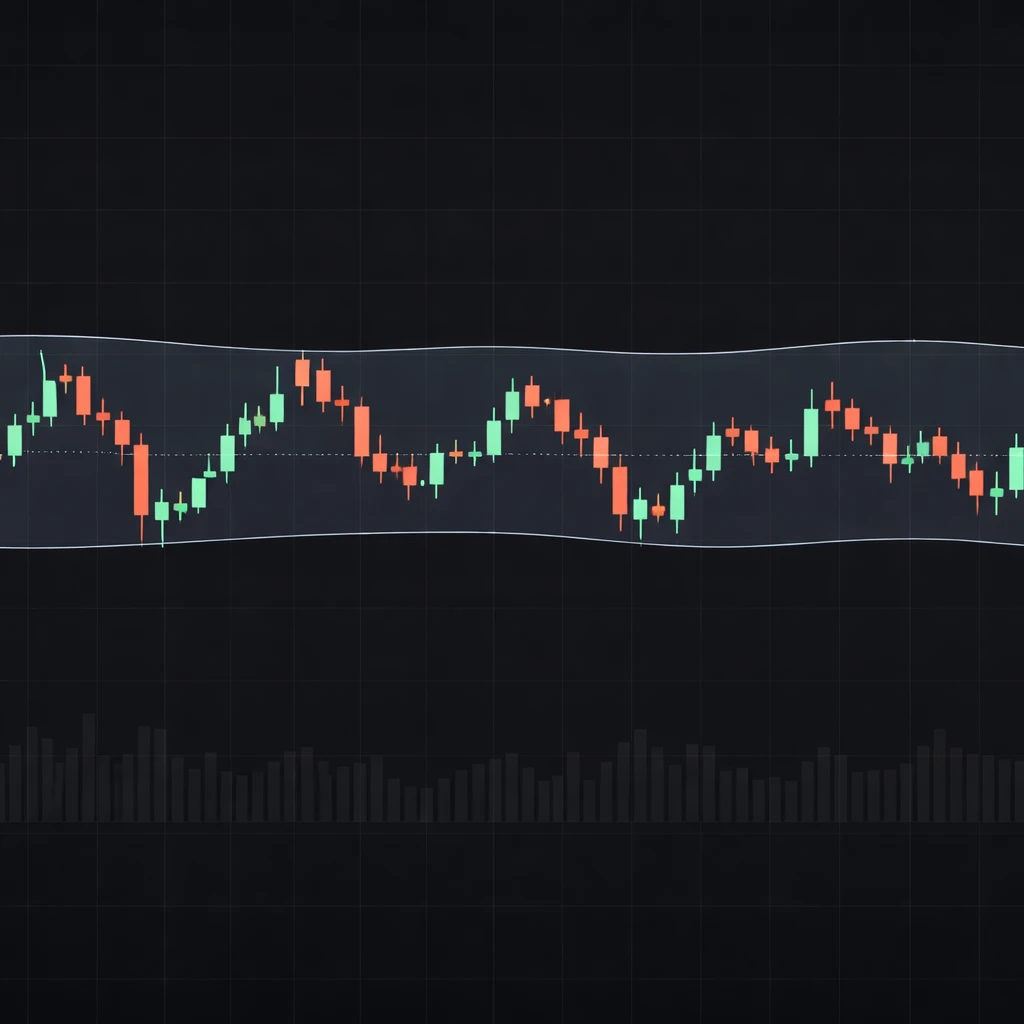
Range-bound markets are periods when prices oscillate within relatively stable upper and lower boundaries and show no persistent directional trend. In such regimes, short-term moves away from a central tendency often fade rather than extend. This behavior places range-bound trading squarely within the mean reversion family of strategies. The objective is not to forecast long-term valuation or momentum, but to systematically exploit temporary deviations from a range and the tendency of price to re-center.
This article defines range-bound markets precisely, situates them within mean reversion, and outlines how to design disciplined, repeatable processes that respect risk. It emphasizes rules for regime identification, the logic that supports range behavior, and the controls needed to manage structural breakouts and false stability. Examples are provided only at a conceptual level without prescribing exact signals or recommendations.
What Is a Range-Bound Market
A range-bound market is a regime in which price fluctuates between identifiable upper and lower bounds, with a relatively stationary mean. The bounds may be visual, such as repeated rejection at similar highs and lows, or statistical, such as containment within volatility bands or quantiles around a central estimate. The slope of the central tendency is typically near zero over the chosen horizon, and successive price swings overlap rather than cascade in one direction.
Two complementary perspectives help formalize the definition:
Structural view. Price interacts repeatedly with similar levels, showing tendency to turn near prior highs and lows. Overlapping swings, recurrent consolidation zones, and horizontal congestion are consistent structural markers.
Statistical view. Dispersion is bounded and symmetric enough that a stationary mean is meaningful over the horizon of interest. Variability often compresses relative to trending phases. Autocorrelation in returns can be weak or negative at short horizons, consistent with reversals of short-term moves.
Both views are horizon dependent. A market can be range-bound on an intraday basis while trending over weeks, or stable over weeks while volatile over minutes. A robust process makes the horizon explicit and aligns detection tools with that horizon.
Range-Bound Trading Within the Mean Reversion Family
Mean reversion strategies assume that price deviations from a reference level are temporary more often than not. In range-bound contexts, the mean is typically defined by a moving average, a volume-weighted price, a midline of a channel, or another central estimate that responds appropriately to the selected timeframe. Entry and exit logic in such systems is designed to act near edges and reduce exposure near the center. The system does not rely on direction continuation; it relies on the tendency for extremes to soften after short bursts.
In contrast to momentum approaches, which seek to align with directional persistence, range reversion assumes that liquidity provision, inventory management by intermediaries, and optionality hedging by market participants create forces that absorb moves at the boundaries. When those forces weaken or are overwhelmed, the range ends and the mean reversion premise no longer applies. A sound range strategy therefore includes explicit detection of range conditions and safeguards that deactivate the logic when evidence of a break accumulates.
Core Logic Behind Range Reversion
Several mechanisms can underpin range behavior, though no single explanation covers all markets and periods:
Inventory and liquidity effects. Market makers and liquidity providers manage inventory risk. When price reaches edges of recent value, liquidity can appear as participants rebalance, tempering further movement.
Behavioral counter-moves. Short-term overreactions to news or order flow often retrace as participants reassess fundamentals. Mean reversion strategies align with the idea that such overreactions are not sustained without fresh information.
Options hedging and gamma effects. In some markets, hedging activity by options dealers can reduce directional volatility inside certain zones. This can dampen trends and encourage oscillation around a mean.
Information arrival patterns. When there is no decisive new information, price discovery can revolve around a consensus value. The absence of trend-driving catalysts can support range conditions until a new event resets expectations.
These mechanisms are tendencies, not guarantees. They suggest why range regimes occur and why reversion may dominate within them. They also imply that when new information arrives, or when order flow becomes one-sided, the range can fail abruptly.
Defining the Mean and the Bounds
A range strategy requires three explicit definitions aligned with the chosen timeframe:
Central tendency. The mean can be represented by a moving average, a volume-weighted benchmark, or a statistically robust estimator less sensitive to outliers. The estimator should be stable enough to reflect value over the horizon, but responsive enough to adapt when value drifts.
Bounds. Bounds can be constructed from historical highs and lows over a rolling window, volatility-based bands around the mean, or quantile envelopes from the recent return distribution. The method should produce bounds that are tight enough to be meaningful, yet not so tight that noise triggers constant signals.
Regime state. A separate module should decide whether conditions are range-like. Typical ingredients include relatively flat slope of the mean, compressing volatility, high overlap between consecutive swings, and low directional conviction. The system proceeds only when the regime classifier indicates stability.
Regime Identification at Multiple Horizons
Range detection can be improved by mixing short-horizon and intermediate-horizon information. For example, a short horizon may show oscillation around a nearly horizontal mean, while a longer horizon confirms that price is not forcefully trending. The overlap between the two strengthens the case for range behavior.
Regime filters often include:
Slope tests. The central estimate’s slope remains close to zero over the selected window.
Volatility compression. Realized volatility is contained within a band that reflects historically low dispersion for the instrument.
Overlap metrics. Successive swing highs and lows cluster and overlap rather than step progressively.
Breadth or cross-sectional context. In equity indices, many constituents may also be range-bound, indicating a broad lack of trend pressure.
These elements are descriptive. They do not, by themselves, generate trade instructions. They provide the regime context without which range logic is fragile.
System Design Without Specific Signals
Once a regime is identified, a structured process translates the concept into repeatable steps.
1. Define the observation window. Select a rolling period consistent with your timeframe. The window governs how the mean and bounds are computed and ensures consistency in comparisons.
2. Specify the mean estimator and envelope. Choose a central estimate and a method for setting upper and lower thresholds. In practice, the envelope might reflect recent volatility or percentiles of price relative to the mean. The choice should be evaluated empirically for stability rather than tuned aggressively.
3. Formulate proximity and exhaustion criteria. A strategy often requires price to be near a boundary and for short-term measures to indicate slowing momentum, stretched distance from the mean, or temporary order imbalance. Oscillator-type indicators can serve as proxies for exhaustion, but the precise thresholds are system specific. No single indicator is necessary.
4. Manage entries and exits conceptually. The generic logic is to consider exposure when price is near a boundary and to reduce exposure as price moves toward the center. In well-behaved ranges, many practitioners favor partial scaling rather than binary in-or-out decisions. The granular approach can reduce sensitivity to noise and slippage, but it must be implemented with discipline.
5. Include a breakout and invalidation protocol. Because ranges end, the system requires criteria that suspend range logic when price shows directional expansion, when volatility spikes, or when the mean begins to slope. Invalidation should be automatic and unambiguous within the system’s framework.
Risk Management Considerations
Risk management is central because the cost of trading against a breakout can offset many small range gains. Important elements include:
Position sizing. A volatility-aware sizing scheme keeps exposure proportional to recent dispersion. This makes position sizes smaller when risk expands and larger when risk compresses, within predefined caps. Fixed-fraction or risk-parity style approaches are also common. The key is consistency with the horizon and instrument.
Stop mechanisms. Price-based or volatility-based stops define the point at which the range hypothesis is considered invalid for the current attempt. Time-based exits can assist when price lingers near the boundary without mean reversion, which may indicate regime change. Explicit stop logic reduces discretion and preserves the integrity of backtests.
Adverse selection and slippage. Range edges can be thin on liquidity when many participants attempt similar ideas. Spreads can widen during extensions. The system should account for realistic execution costs and avoid unrealistic assumptions about fills, particularly near obvious levels.
Event and gap risk. Scheduled announcements and news can abruptly reset value and break ranges. Systems can include event calendars to suspend activity around known catalysts. Overnight gaps in some instruments require special treatment, including pre-defined risk limits for openings outside the envelope.
Correlation and crowding. Multiple range strategies on correlated instruments can amplify drawdowns. Risk limits should consider portfolio-level effects, not only trade-level metrics. Diversification by instrument and timeframe can reduce concentration.
Drawdown controls and regime switching. A rolling performance monitor can deactivate the module after a sequence of losses or when realized volatility exceeds a threshold that historically disrupts range behavior. Deactivation is part of risk control, not a discretionary decision in reaction to stress.
A High-Level Example of How a Range Strategy Operates
Consider a liquid index fund or currency pair that has traded sideways for several weeks. The process below illustrates a structured workflow without imposing specific parameters.
Step 1: Regime classification. Calculate a central estimate over a rolling window suited to the timeframe. Evaluate whether its slope is approximately flat. Confirm that realized volatility is moderate relative to the instrument’s history and that recent swing highs and lows overlap.
Step 2: Define a working range. Create upper and lower envelopes around the mean using a volatility-aware band or recent extreme prices. Validate that price has respected these envelopes with multiple touches that did not lead to follow-through.
Step 3: Identify tests of the boundaries. Monitor when price approaches the envelopes. Seek signs that the approach is slowing rather than accelerating. Such signs might include reduced bar ranges as price nears the boundary, oscillator readings that typically accompany exhaustion in your tests, or divergence between price and a short-horizon momentum proxy. The system avoids reacting to the first touch mechanically; it waits for evidence that aligns with historical reversals in similar conditions.
Step 4: Manage exposure and exit. When boundary tests satisfy the exhaustion criteria, the system establishes exposure sized according to current volatility. The logic anticipates partial reduction as price moves back toward the mean, and completion of exit near the center or upon loss of the regime characteristics. If price accelerates through the boundary, the system follows its stop or invalidation rules rather than relying on discretion.
Step 5: Evaluate and reset. After each completed cycle, the system updates its statistics. If performance deteriorates or volatility expands, the module reduces activity or switches off until conditions normalize.
Throughout this workflow, the system avoids anchoring to precise numeric levels. The emphasis is on repeatable detection of range conditions, disciplined response to boundary behavior, and pre-defined risk limits. This produces historical results that are testable and a live process that is auditable.
Testing and Validation
A credible range-bound strategy depends on careful research and validation. Sound practices include:
Out-of-sample testing. Separate historical data into development and validation periods. Evaluate whether the range module behaves similarly in both sets. If performance deteriorates sharply in validation, reassess the feature set and the robustness of the regime filter.
Transaction cost modeling. Small mean reversion edges can be erased by slippage and fees. Incorporate realistic spreads and partial fills into backtests. Sensitivity tests should vary cost assumptions and verify that the idea remains viable over plausible ranges.
Parameter robustness. Avoid overfitting by assessing a broad grid of parameter choices for mean estimators, envelope widths, and exhaustion criteria. A strategy that works only for a narrow combination of settings is fragile.
Stress testing. Examine performance during volatility spikes, news-driven breaks, and regime transitions. Verify that stop and deactivation rules contain losses when ranges fail. Include gap scenarios and thin-liquidity conditions for instruments where these features are common.
Walk-forward procedures. Refit or recalibrate at scheduled intervals using recent data, then test on the subsequent unseen period. This approximates how the system will adapt in live conditions and reveals sensitivity to structural changes.
When the Range Ends
All range strategies face the challenge of regime transitions. Early warning signs include:
Directional expansion. Price begins to register elongated bars in one direction, with reduced overlap and follow-through beyond prior highs or lows.
Rising volatility without mean re-centering. Swings grow wider, but reversals fail to return to the midline. This indicates that the mean is drifting.
Information shocks. New information alters the consensus value. Post-event price may establish a new, higher-volatility range or begin a trend.
Practical systems handle transitions by reducing exposure as evidence accumulates, shifting to neutral, or handing off to a different module designed for breakouts. This modular approach recognizes that no single strategy suits all regimes and that persistence of edge depends on switching logic as much as it does on entry heuristics.
Asset-Class and Horizon Considerations
Equities and equity indices. Range behavior often appears during earnings off-cycles or macro data lulls. Intraday ranges can be influenced by opening auctions and midday liquidity patterns. Overnight gaps and corporate events require additional safeguards.
Foreign exchange. FX pairs frequently exhibit range patterns during sessions with limited macro releases. Liquidity varies by time of day, and session boundaries can create predictable compressions and expansions. Funding considerations and rollover conventions may affect holding costs.
Futures. Contract rolls and delivery constraints can create idiosyncratic behavior near expiration. Continuous contracts require careful construction to avoid artifacts in backtests. Exchange hours and limit rules influence gap dynamics.
Exchange-traded funds. ETF prices can show additional microstructure effects due to creation and redemption mechanisms. Intraday deviations from net asset value can complicate very short-horizon logic but are typically minimal for liquid funds.
Digital assets. Continuous trading and variable liquidity across venues can produce extended ranges punctuated by abrupt breaks. Venue selection, funding rates, and latency to news dissemination are important considerations for system performance and risk.
Common Mistakes to Avoid
Assuming permanence of ranges. Ranges can persist for long periods and then vanish quickly. A system that assumes continuity rather than testing for it is exposed to sharp losses.
Ignoring costs. Range strategies often realize many small gains. Underestimating spreads, fees, and implementation shortfall can convert apparent historical edge into live underperformance.
Overfitting indicators. Layering many filters and thresholds to optimize backtest performance usually yields a brittle system. Prefer a small set of durable features and tune conservatively.
Using absolute levels without context. A fixed level that worked in one regime may fail when volatility or liquidity changes. Normalize by volatility or by distributional features rather than relying on static distances.
Neglecting portfolio interactions. Multiple range modules deployed across instruments can accumulate similar risks. Aggregate exposures and scenario test portfolio-level drawdowns.
Integrating Range-Bound Logic Into a Broader System
Range-bound modules are most effective when integrated within a diversified framework that includes alternative regimes. A practical architecture separates the tasks of regime detection, signal generation, risk controls, and execution. The range module activates only when its state indicators are favorable, and it deactivates when conditions fall outside validated boundaries. This separation improves auditability and simplifies maintenance.
Execution quality is a distinct component. Range strategies can be sensitive to timing and slippage because activity concentrates near edges. Simple execution tactics such as slicing orders, avoiding thin periods, and monitoring spread dynamics can materially affect realized results. Execution logic should be tested with the same rigor as signal logic.
Finally, oversight and monitoring matter. Real-time dashboards that track regime state, realized costs, slippage relative to benchmarks, and adherence to risk limits help maintain discipline. Regular reviews compare live behavior with backtested expectations, and deviations trigger pre-defined investigation steps rather than ad hoc changes.
Concluding Perspective
Range-bound strategies occupy a clear niche within mean reversion. Their strength lies in exploiting the human and structural tendencies that hold price within boundaries during information-light periods. Their weakness arises when new information or one-sided order flow breaks those boundaries. The difference between robust and fragile implementations is rarely a clever indicator. It is usually the presence or absence of systematic regime detection, conservative parameterization, realistic cost modeling, and uncompromising risk management.
Key Takeaways
- Range-bound markets are defined by oscillation between boundaries and a stable mean over a stated horizon, placing them within the mean reversion family.
- Structured systems separate regime detection, signal logic, risk controls, and execution, and they activate range logic only when conditions warrant.
- Risk management focuses on volatility-aware sizing, explicit invalidation rules, and event and gap controls to address the asymmetry of breakout losses.
- Validation requires out-of-sample testing, realistic cost modeling, and robustness checks across parameters, instruments, and regimes.
- No single indicator defines a range; a combination of flat slope, volatility compression, and overlapping swings provides the most reliable context.