
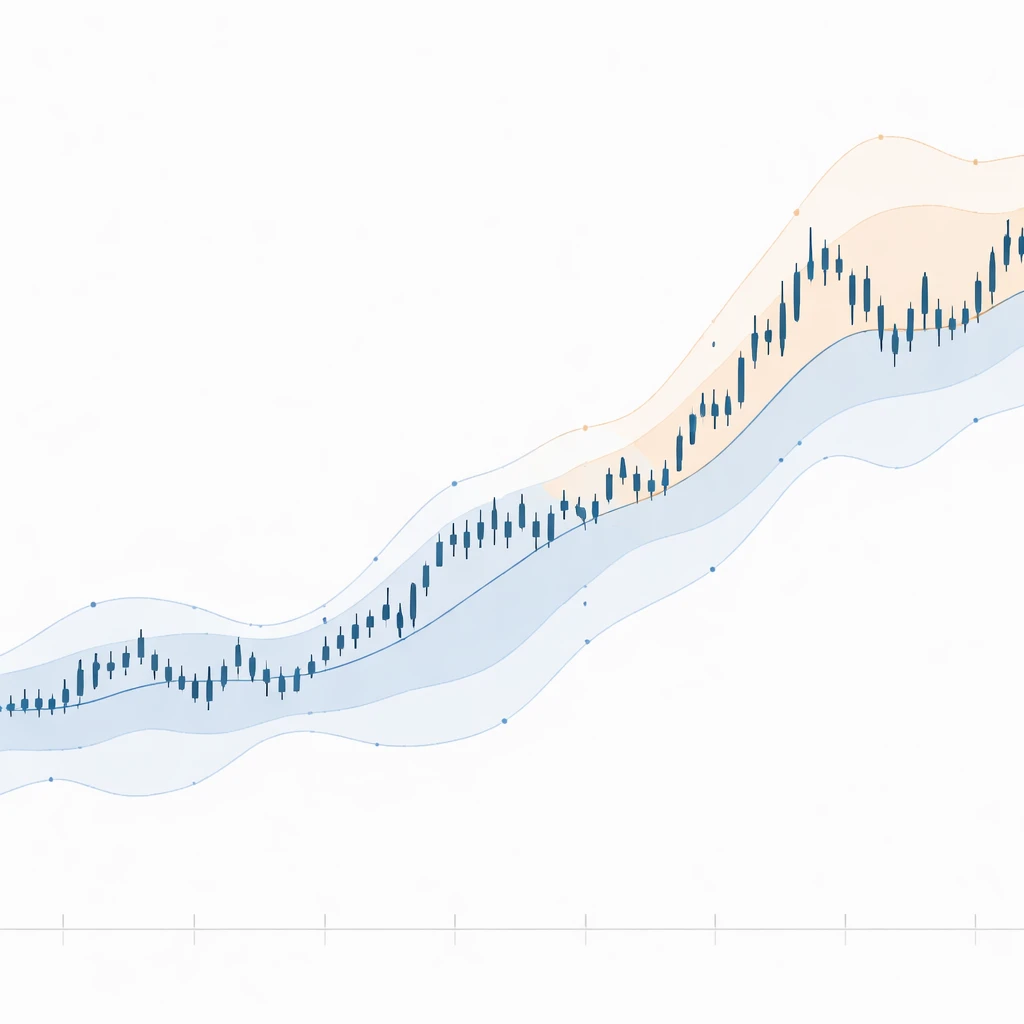
Mean reversion strategies attempt to profit from the tendency of prices, spreads, or other market variables to move back toward a central tendency after deviating from it. The idea is simple, yet many implementations perform poorly. The problem rarely lies in the general concept. It typically stems from recurrent design and testing errors that compromise robustness, discipline, and risk control. This article defines common mean reversion mistakes and situates mean reversion within the framework of structured, repeatable trading systems.
Mean Reversion in a Systematic Context
Mean reversion presumes that some measured process fluctuates around a central value or equilibrium. In markets, that process might be a single asset’s price relative to a moving average, a pair’s price ratio, a factor spread, or an intraday imbalance that statistically normalizes within a given horizon. A structured system formalizes this logic through clear rules for signal definition, position sizing, risk limits, and execution. It is evaluated with consistent metrics and monitored for stability over time.
Several assumptions quietly underpin this approach. First, the process exhibits stationarity at the horizon of interest. Second, deviations contain information about short-horizon expected changes that are not entirely erased by costs. Third, there exists a practical execution path that captures a portion of the theoretical edge. When these assumptions are weak, errors compound and the strategy becomes fragile.
How Mean Reversion Fits into a Repeatable Trading Process
A repeatable system decomposes into modules. Each module addresses a distinct part of the problem and limits ambiguity in both testing and live operation:
- Signal definition: the statistical measure that marks a deviation from the mean, along with horizon and normalization choices.
- Portfolio construction: rules for ranking opportunities, allocating capital, and managing correlation across positions.
- Risk controls: constraints on position size, leverage, exposure concentration, holding period, and drawdown.
- Execution and costs: order type logic, slippage modeling, and a consistent approach to partial fills and reversion decay.
- Monitoring and review: performance attribution, regime diagnostics, and triggers for pausing or resizing the strategy when conditions change.
Without this disciplined structure, a mean reversion idea quickly becomes a sequence of ad hoc decisions that are difficult to audit and even harder to improve.
Common Mistakes in Mean Reversion Strategies
1. Misdefining the “Mean”
An average is not a mean in a statistical sense unless the underlying process is sufficiently stationary. Many implementations select a fixed moving average with an arbitrary window and assume reversion. If the process trend dominates the chosen window, the so-called mean drifts. The signal then captures trend or noise rather than reversion. A related error is computing deviations on price levels when the process behaves more stably in returns or log prices. Another is overlooking structural components such as seasonality, volatility regimes, or scheduled events that shift the location parameter over time.
Structured systems address the mean explicitly. They specify what is being mean-reverted and under what assumptions. They also document the transformation used to achieve stability, such as demeaning returns, using spreads or ratios, or adjusting for calendar and intraday patterns.
2. Measuring Deviations Without Normalization
Mean reversion signals often rely on the magnitude of a deviation. Measuring that magnitude in raw price terms ignores volatility and liquidity. The same absolute deviation can be trivial in a high-volatility environment and extreme in a low-volatility environment. Without normalization, thresholds drift with conditions and produce inconsistent behavior across assets and regimes.
Normalization typically uses a volatility estimate or another scale parameter from a rolling window. The precise choice varies by design. The key point is consistency with the horizon and instrument characteristics. Ignoring scale contaminates signal quality and undermines risk controls, because position sizes and exit expectations are calibrated to an implicit but unstable notion of distance.
3. Confusing Pullbacks in Trends with Mean Reversion
Trend and mean reversion can coexist at different horizons. A frequent mistake is to trade a short-horizon pullback as if it were a pure reversion signal without accounting for the prevailing trend. If the trend is strong, the pullback may be a brief pause rather than a true deviation likely to revert. This mismatch leads to one-sided exposure when the trend extends and the reversion assumption fails.
Robust systems often specify what horizon they target and how trend context is treated. Some designs condition on regime proxies, while others define separate modules for trend and reversion and arbitrate capital between them. Regardless of approach, a clear statement of horizon alignment reduces the risk of interpreting trend noise as mean reversion.
4. Averaging Down and Implicit Martingale Behavior
Because mean reversion anticipates convergence, there is a temptation to increase size as the deviation grows. If the sizing function increases faster than risk declines, the system approaches martingale behavior. The resulting path dependency can produce long stretches of small gains punctuated by large losses when reversion does not occur quickly. The distribution becomes negatively skewed, with tail risk concentrated in extended deviations.
A structured system clarifies how size maps to deviation and enforces hard limits that do not expand automatically in adversity. It also articulates maximum exposure per asset and per theme, and caps cumulative additions during a single signal episode to prevent drift into unintended leverage.
5. Ignoring Regime Shifts and Autocorrelation Decay
Reversion rates are not constant. The strength and speed of reversion depend on microstructure, market participation, and volatility. Assuming a fixed half-life or decay function locks the strategy into a static expectation that can be invalid for extended periods. The result is prolonged holding times, rising costs, and exposure to additional risk factors.
Systems should explicitly define how they estimate or bound the expected time to reversion. They also benefit from rules that address stale positions, such as time-based exits or regime filters that pause new entries during anomalous conditions.
6. Overfitting through Threshold Optimization
Backtests often optimize thresholds for entry and exit, window lengths, or z-score cutoffs until in-sample results look smooth. That smoothness can be an artifact of noise harvesting rather than a stable edge. When such a system goes live, real-world frictions erase the apparent advantage and the equity curve degrades.
Evidence that mitigates the overfitting risk includes stability across nearby parameter choices, consistent performance in out-of-sample data, and walk-forward tests with fixed rebalancing dates. Emphasis on parsimony and hypothesis-driven design helps distinguish structural effects from lucky configurations.
7. Neglecting Transaction Costs, Slippage, and Market Impact
Mean reversion frequently turns over capital rapidly. This magnifies the effect of costs. Many backtests apply a single cost figure that is unresponsive to volatility, liquidity, queue position, or order size. The result is a performance estimate that is unrealistically high and a live strategy that struggles to cover costs.
More complete modeling accounts for spread, fees, expected slippage relative to volatility and depth, and partial fills. The modeling should reflect the intended order types and average participation rate. Without this, a strategy that appears profitable in theory can be unviable in practice.
8. Capacity and Liquidity Mismatch
Strategies that operate well with small size may not scale. Liquidity varies over time and concentrates at specific times of day. As size increases, the system consumes a larger fraction of available liquidity and becomes sensitive to market impact and adverse selection. Signals also become correlated across participants, which weakens reversion.
Capacity analysis is integral to design. It considers typical depth, volatility, number of concurrent signals, and the decay of opportunities when multiple positions compete for capital. A robust plan specifies a practical capital range and how the system behaves as it approaches capacity limits.
9. Incomplete Exit Logic
Some implementations define entry rules but leave exits ambiguous beyond crossing the mean. This can produce a fragile payoff profile if volatility expands or if the process only partially reverts. Without a time-based or volatility-aware exit, positions can linger as opportunity cost rises, while risk remains tied up in stale ideas.
A clear exit framework addresses at least three paths: reversion to a defined target area, failure to revert within a reasonable window, and adverse volatility shocks that alter the underlying assumption. Each path benefits from explicit handling that maps to risk and capital constraints.
10. Mixing Horizons and Signals Inconsistently
Combining multiple reversion signals that occupy different horizons can dilute statistical power. A daily reversion signal and an intraday signal might reference different microstructure effects, scaling the same position in conflicting directions. The blended decisions become hard to attribute and tend to overtrade.
Systems avoid this by clarifying the unit of decision. They specify which horizon governs sizing and execution, and how faster or slower indicators are used, if at all, within that structure.
11. Survivorship, Lookahead, and Corporate Action Biases
Backtests that use current index constituents or vendor-cleaned data introduce survivorship bias. Using revised rather than point-in-time data introduces lookahead bias. Corporate actions handled inconsistently can distort price series, especially when signals rely on moving averages or spread ratios.
Data handling must be precise. Point-in-time membership, appropriate treatment of delisted securities, and correct corporate action adjustments are necessary for credible results. Failure here can create the illusion of a strong edge that vanishes in live trading.
12. Portfolio Concentration and Correlated Exposure
Mean reversion signals cluster within sectors, factors, or themes. Taking many positions that respond to the same driver concentrates risk. The portfolio then behaves like a single large bet. Diversification measured by the number of positions can be misleading if those positions are highly correlated during stress.
Portfolio construction should address correlation clustering. Limits by sector, theme, and factor exposure help maintain a balanced risk profile. Systems that monitor correlation under volatility spikes avoid false comfort from nominal diversification.
13. Misaligned Measurement and Execution
A common mismatch arises when signals are computed from end-of-day data but executed intraday, or when intraday signals are executed at the close. Deviations estimated at one time often compress or expand at another, leading to execution slippage and unexpected behavior. Time-of-day effects also influence spreads and depth, which affects fill quality and reversion speed.
Alignment between measurement and execution improves fidelity. If signals rely on intraday microstructure, the execution logic should reflect the same window. If they rely on daily closes, the strategy should be consistent about the timing of decisions and orders.
14. Underestimating Tail Risk and Gap Exposure
Mean reversion trades are frequently held through periods where price can gap. Earnings announcements, macro releases, and unscheduled news can overwhelm reversion tendencies. A series of small gains can be offset by a single gap that exceeds position limits.
Risk planning recognizes gap dynamics and the asymmetry they introduce. It also distinguishes between intraday and overnight strategies, since their risk profiles differ materially.
15. Insufficient Stress Testing and Scenario Analysis
Historical backtests rarely capture the full range of possible outcomes. Market structure changes, regulatory shifts, and rare events can break previously reliable patterns. Relying solely on historical averages produces fragile expectations.
Robust processes incorporate stress tests that alter volatility, costs, liquidity, and reversion rates. They also examine sequences of adverse outcomes and the time to recover from drawdowns. The objective is not prediction. It is to understand sensitivity and potential failure modes.
16. Overcomplicated Models with Minimal Incremental Value
Adding complexity often improves in-sample fit but delivers little out-of-sample benefit. Layers of filters and thresholds increase the chance of accidental alignment with noise. Monitoring and maintenance also become harder, which reduces the system’s adaptability to change.
Parsimony is a design principle. A smaller set of well-motivated features with clear economic or microstructure rationale tends to yield more stable behavior than a sprawling set of loosely justified components.
17. Ignoring Borrow Constraints and Short-Sale Mechanics
Many mean reversion strategies involve short exposure. Backtests that assume unrestricted shorting ignore locate availability, borrow fees, and recall risk. These frictions vary across names and over time. They can meaningfully alter profitability and turnover.
A credible design integrates short-sale mechanics into both data and execution assumptions. This includes the possibility that a signal cannot be implemented due to constraints that are external to price data.
Risk Management Considerations Specific to Mean Reversion
Risk management in mean reversion focuses on the distribution of outcomes during deviations and the speed at which positions normalize. Several dimensions are particularly important:
- Position sizing: mapping deviation magnitude to size without creating runaway exposure. Many systems cap size at thresholds that reflect both volatility and liquidity.
- Holding period limits: time stops that bound stale positions and reduce capital lockup when mean reversion weakens.
- Volatility and regime awareness: adaptive constraints that reflect changing variance, spreads, or depth, which influence both expected reversion and cost.
- Concentration limits: controls by asset, sector, or theme to prevent correlated drawdowns.
- Loss containment: predefined rules for adverse moves that violate the reversion premise, including gap risk policies.
- Execution discipline: order handling logic that respects liquidity to limit impact and adverse selection.
These controls do not guarantee favorable outcomes. They bound the consequences of unfavorable sequences and preserve the ability to continue operating the system through different conditions.
A High-Level Example of a Mean Reversion System
The following example illustrates how a mean reversion system can be organized without specifying exact signals or numerical thresholds:
Universe and data: Define a liquid set of instruments with reliable point-in-time data, including accurate corporate action adjustments. For each instrument, compute a transformed series that better approximates stationarity, such as log returns or a spread between related instruments. Apply data quality checks that flag outliers, missing values, and events where execution might be constrained.
Signal construction: For each instrument, estimate a central tendency over a rolling window appropriate to the strategy’s horizon. Normalize deviations relative to a rolling volatility estimate that matches the window. This produces a dimensionless indicator of distance from the mean. Complement the signal with a basic regime proxy that describes whether recent behavior supports reversion at the target horizon.
Opportunity selection: Rank instruments by the magnitude of normalized deviation and filter out cases with insufficient liquidity or conflicting event risk. Optionally, include filters that reduce exposure when signals cluster in a single sector or theme.
Sizing and constraints: Map deviation to position size using a concave function to avoid explosive growth in exposure as deviations increase. Impose maximum size per instrument, maximum cumulative exposure to correlated groups, and a hard cap on simultaneous positions. Define a maximum holding period to limit capital tied up in slow or failing reversions.
Exit logic: Specify three exit paths. First, exit when deviation compresses toward the mean by a defined proportion. Second, exit on a time stop if the signal persists without sufficient compression. Third, exit on a volatility or regime alert that indicates the premise has weakened. Record outcomes for each exit type to support ongoing diagnostics.
Execution and costs: Use an execution schedule tied to liquidity and volatility characteristics of each instrument. Model costs that include spread, fees, and expected slippage as a function of volatility and participation rate. Track realized slippage in live trading and compare it to modeled values to detect drift in microstructure.
Monitoring and review: Attribute performance to entry quality, sizing, exit path, and execution. Evaluate stability across adjacent parameter settings and over distinct market regimes. Maintain a policy for pausing or resizing the system when diagnostics depart from historical ranges.
This architecture is intentionally modular. Each piece is testable and measurable, and each can be adjusted without disrupting the entire strategy. The goal is not to optimize every component, but to produce consistent behavior and clear risk boundaries that survive the inevitable variability of markets.
Evaluating Robustness Without Exact Signals
Even without publishing precise thresholds, it is possible to evaluate whether a mean reversion concept is structurally sound. Several diagnostics are especially informative:
- Parameter stability: performance that persists across nearby window lengths and normalization choices suggests a real effect rather than a narrow optimization.
- Time decomposition: similar behavior across different market regimes indicates resilience.
- Attribution balance: a healthy mix of profits across entries and exit types, rather than reliance on a rare subset of conditions.
- Cost dominance check: gross edge that remains positive after realistic costs and slippage, particularly under elevated volatility.
- Capacity sensitivity: stability in performance as simulated capital increases, before slippage or impact assumptions become dominant.
When these diagnostics are aligned with a coherent narrative about the microstructure or behavioral mechanism that drives reversion, the system’s foundations are stronger.
Case Discussion: Why Small Tweaks Often Harm Mean Reversion
Mean reversion strategies often show attractive in-sample metrics after minor tweaks to filters or thresholds. These improvements rarely survive out-of-sample testing. The reason is that reversion edges typically have low signal-to-noise ratio. Small parameter changes adjust the strategy’s sensitivity to market microstructure artifacts, which are not stable. For example, a slight increase in the rolling window can anchor the mean to a different volatility regime. A narrow change in deviation threshold can move the system from capturing transient microstructure rebounds to capturing broader pullbacks that behave more like small trend following. The backtest appears smoother, but the underlying process has changed.
This is why a design anchored in hypotheses rather than parameter hunts tends to be more reliable. If the hypothesized mechanism is inventory rebalancing by liquidity providers, the horizon and normalization should reflect that mechanism. If it is behavioral overreaction to news, the system might include event filters and different holding expectations. Either way, parameters serve the hypothesis, not the other way around.
Practical Pitfalls in Live Operation
Moving from research to live trading introduces additional sources of error:
- Operational timing: delays between signal computation and order placement can degrade edge, especially for fast reversion.
- Partial fills: reality rarely matches modeled execution. Unfilled residuals can bias the book toward one side of exposure.
- Data latency and revisions: intraday data feeds can differ across venues or vendors. Mid-course revisions change the measured deviation post hoc.
- Human overrides: discretionary adjustments that are not encoded in the system reduce repeatability and add untracked risk.
Live processes benefit from controls that detect deviations from expected behavior and log decisions. This reinforces discipline and creates an audit trail for later analysis.
Integrating Mean Reversion with Other Strategy Types
Mean reversion often coexists with momentum and carry in multi-strategy portfolios. Integration requires clarity on conflict resolution and capital allocation. If a single asset simultaneously exhibits a reversion signal and a trend signal, the system should specify which has priority. Alternatively, it can allocate capital proportionally to statistical confidence in each module. Portfolio-level risk is then managed with constraints that reference the combined exposure, not each module in isolation.
Cross-module diversification can smooth the equity curve, but only when the modules are genuinely distinct in horizon, drivers, and turnover. If both rely on similar microstructure effects or closely related signals, the apparent diversification is weaker than expected.
Documentation and Governance
A structured mean reversion strategy is documented as a living specification. The document describes the hypothesis, signals, data sources, costs model, risk limits, operational procedures, and testing protocol. Proposed changes are reviewed and tested via a standard process, with pre-defined criteria for acceptance. This governance approach reduces the risk of ad hoc modifications that creep in after a drawdown and preserves the integrity of the research.
Conclusion
Mean reversion strategies can be part of a disciplined trading framework when their assumptions are explicit, their design is parsimonious, and their risks are bounded. Most failures trace back to a small set of mistakes: misdefining the mean, ignoring regimes and costs, overfitting, relying on martingale dynamics, and underestimating tail risk. A structured, repeatable process helps expose these issues early and keeps the system aligned with its intended edge.
Key Takeaways
- Mean reversion depends on a well-defined, stable notion of the mean and a normalization that matches the horizon and instrument.
- Common pitfalls include overfitting thresholds, ignoring costs and capacity, and relying on averaging down that concentrates tail risk.
- Robust designs specify clear exits, time limits, and portfolio-level constraints that bound exposure during failed reversions.
- Alignment of measurement, execution, and data hygiene is essential to avoid biases and unexpected slippage.
- Continuous monitoring, stress testing, and governance preserve repeatability and help the strategy adapt to changing regimes without ad hoc decisions.