
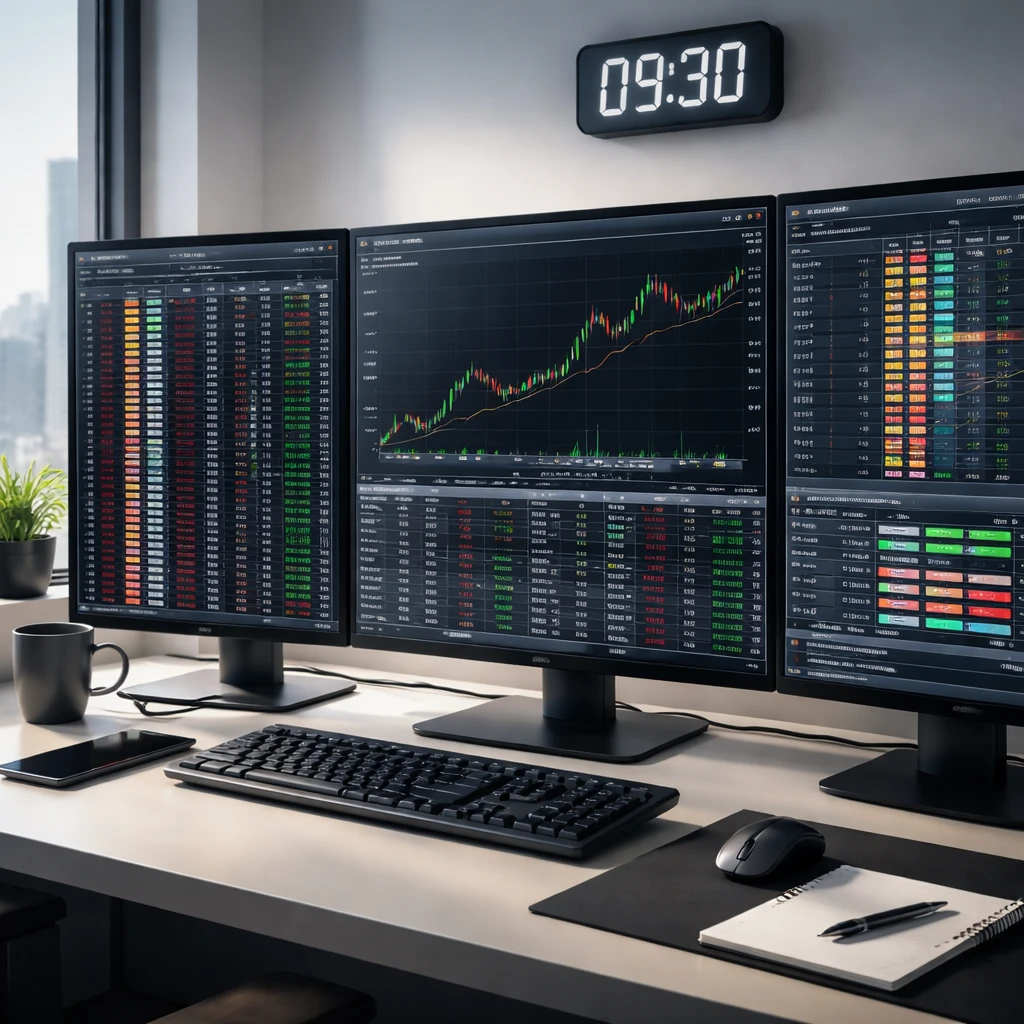
Defining Day Trading
Day trading is a trading style defined by time. A day trader opens and closes positions within the same trading session, intentionally holding no positions overnight. The objective is not tied to a specific strategy or forecast method. The defining feature is the decision to confine risk, costs, and management to a single calendar trading day.
Day trading can occur in many markets, including equities, futures, foreign exchange, and digital assets. The exact session length varies by venue. Some markets operate nearly 24 hours, while others have distinct opens and closes. Despite these differences, the core principle remains the same: flat exposure when the session ends.
By design, day trading separates intraday risk from overnight risk. Rather than attempting to capture multi-day trends or long-term value, the day trader focuses on price changes observable and manageable within hours or minutes.
Day Trading Within the Spectrum of Timeframes and Styles
Trading styles can be organized by holding period. Scalping typically refers to very brief holding times, often seconds to minutes. Day trading spans minutes to several hours but ends with no positions at the close. Swing trading and position trading extend to days, weeks, or longer. Investment horizons can stretch to years.
Timeframe choice affects nearly every practical decision. A day trader pays close attention to the market opening and closing process, intraday liquidity cycles, scheduled economic releases, and exchange-specific rules. Longer-term participants focus more on earnings cycles, macro data over weeks or months, and overnight financing and borrowing costs. These differences shape the tools used, the order types selected, and the monitoring required.
Core Mechanics: How Day Trading Works in Practice
Regardless of strategy, the practice of day trading centers on a repeatable execution and risk management workflow confined to one session. The following elements are common to intraday operations.
Account setup and market access
A broker or clearing firm provides market access and defines the account’s permissions, margin framework, and fee schedule. The trader selects markets and products that align with intraday trading. Operationally, this includes understanding trading hours, pre-market or after-hours access if available, and the mechanics of settlement for the instruments traded.
Order types and routing
Day traders rely on standard order types to control execution:
- Market orders seek immediate execution at available prices.
- Limit orders specify a maximum purchase price or minimum sale price.
- Stop orders and stop-limit orders trigger when a price condition is met.
- Time-in-force instructions, such as day-only or immediate-or-cancel, align execution with session constraints.
Routing may be automatic or chosen by the trader. Different venues can offer distinct liquidity, rebates, or fees. For day traders, the ability to control or understand routing can influence realized spread costs and slippage.
Intraday monitoring and flat-at-close management
Because positions must be closed before the session ends, day traders track positions and orders continuously. Closing positions is not only a preference. In some markets, overnight margin or borrowing rules differ meaningfully from intraday conditions. Maintaining a flat book at the end of the day avoids overnight price gaps and compliance issues tied to session boundaries.
Record-keeping and post-trade analysis
Even without discussing strategies, day trading is data intensive. Traders often log fills, fees, slippage, and latency. Many reconcile realized profit and loss by product and by time-of-day. These records are used to refine mechanics such as order type selection and trading windows, rather than to predict prices.
Why Day Trading Exists in Modern Markets
Day trading serves several functions within the market ecosystem and for individual participants.
- Liquidity provision. Intraday participants add bids and offers that help others transact. Even if not acting as formal market makers, day traders collectively deepen order books and reduce transaction frictions for all participants.
- Price discovery. Markets incorporate new information rapidly. Day trading activity can accelerate the process by responding to order flow, corporate disclosures, and public news within the session.
- Risk segmentation. Some participants prefer to avoid overnight risk. Others specifically seek it. Day trading allows risk to be segmented by time, so capital is deployed only when the trader is present to manage positions.
- Operational focus. Working within a single session concentrates analysis, monitoring, and decision-making into a defined window. For some, this structure is practical from a workflow standpoint.
- Institutional specialization. Many professional roles, including certain proprietary trading desks and market making operations, operate with limited or no overnight exposure. Retail day trading mirrors this specialization at a smaller scale.
Regulatory and Operational Framework
Rules vary by jurisdiction and by product. A few recurrent elements shape intraday activity.
Pattern day trading in U.S. equities
In U.S. equities, regulators define a pattern day trader as an account that executes four or more day trades within five business days, where those day trades are more than 6 percent of total trades in the same period. Accounts labeled as pattern day traders are generally required by FINRA rules to maintain at least 25,000 dollars in equity on any day the customer day trades. Brokers may enforce additional risk controls beyond the minimums. The definition applies at the account level and is specific to U.S. equity and option accounts, not to futures or spot foreign exchange.
Margin and buying power
Intraday margin can differ from overnight margin. In some products, such as exchange-traded futures, clearing firms and brokers publish day-session margin requirements that are lower than overnight requirements. In equities, margin buying power for pattern day trader accounts can be higher intraday than overnight, subject to firm policies. These rules affect the maximum position sizes that can be carried at different times of day. Understanding them is a prerequisite to avoiding forced liquidations.
Short selling mechanics
Day trading often involves the ability to sell short. In U.S. equities, short sales require a borrow or a reasonable expectation of borrow. Uptick rules can restrict short sales when a stock has declined by a defined percentage. Fees can apply to hard-to-borrow securities, and these costs influence whether a trade is economically viable over intraday horizons.
Market halts and session boundaries
Exchanges can halt trading for news dissemination or for volatility control. Limit up and limit down mechanisms constrain extreme price moves and can pause trading. For day traders, halts can interfere with the plan to flatten exposure before the close. Contingency planning for halts is part of intraday risk management.
Clearing and settlement
Although day traders close positions during the session, trades still settle on the standard cycle for the product, such as T+1 for U.S. equities. Settlement mechanics matter for cash usage, margin availability, and the availability of proceeds for subsequent transactions.
Costs, Liquidity, and Microstructure
Day trading concentrates activity into relatively short holding periods, which magnifies the effect of transaction costs and market microstructure.
Explicit costs
Commissions, exchange fees, and regulatory fees apply to many transactions. Even when advertised commissions are zero, routing fees or pass-through exchange charges can exist. High turnover can convert small per-trade costs into a significant line item.
Implicit costs
Bid-ask spreads and slippage are central. A one-tick spread can be a small fraction of price in a liquid futures contract and a larger fraction in a thinly traded stock. Order book depth and the presence of hidden liquidity affect realized execution quality. Routed orders can experience partial fills or price improvement. The combined effect of spread and slippage often dominates explicit fees for intraday trades.
Financing and inventory
Intraday financing costs can be limited compared to overnight holdings, but they are not zero. Leverage may carry interest charges. For short positions, borrow fees and the possibility of recalls apply even if the position lasts minutes. Hard-to-borrow fees can make short intraday trades uneconomic, regardless of price movement.
Intraday Risk Profile
Day trading does not eliminate risk. It reshapes it.
- Price risk. Prices can move sharply within minutes, especially around economic releases, earnings announcements, or large orders hitting the book.
- Gap avoidance. Closing positions before the session ends avoids overnight gaps, but it also concentrates exposure into periods that can be volatile. Focusing solely on intraday moves can increase sensitivity to microstructure noise.
- Operational risk. Connectivity outages, platform crashes, and delayed market data can impair execution. Redundancy and clear error-handling procedures are operational priorities.
- Liquidity risk. Liquidity is not constant during the day. Open and close periods can be deep and active, while midday can be thinner. Sudden liquidity withdrawal can cause larger-than-expected slippage.
- Compliance risk. Violations of day trading rules, margin requirements, or short sale restrictions can lead to account limitations or forced liquidations.
A Real-World Intraday Workflow Example
The following example illustrates the mechanics of a single day trade without implying any strategy or recommendation. The times and prices are illustrative.
Assume a trader is authorized to trade U.S. equities with pattern day trader permissions. The trader monitors a highly liquid stock, Stock A, which typically trades with a 1 cent tick size and a narrow spread during the regular session.
- 09:25 New session preparation. The trader confirms connectivity, verifies margin availability, and loads a default order template for 500 shares with a day-only time-in-force. A news feed and the broker’s order management panel are open.
- 09:30 Opening auction completes. The consolidated tape shows the opening print. The inside market tightens to a 1 cent spread. Depth of book shows several thousand shares on each side.
- 09:42 Entry. The trader decides to participate in a short-lived price move. A limit buy order for 500 shares is entered at 25.20 dollars, posted to a displayed venue. The order receives a partial fill of 300 shares, then completes minutes later as additional liquidity arrives. The average fill price is recorded automatically by the platform.
- Risk control orders. Immediately after the fill, the trader submits a stop order to exit if price trades at 24.95 dollars. A separate limit sell order is placed at 25.35 dollars to reduce the position if price reaches that level. The trader monitors both orders and the live position.
- 10:05 Partial exit. The 25.35 limit sell order fills for 200 shares as the bid lifts. Realized profit and loss is updated. The remaining 300 shares remain open with the stop order still resting.
- 10:12 Liquidity change. Spreads briefly widen to 3 cents as the depth of book thins. The trader cancels and replaces the stop order with a stop-limit instruction to control slippage, accepting the risk of a non-fill if price gaps through the stop.
- 10:20 Forced decision point. A scheduled economic release is approaching. The trader chooses to flatten exposure before the event to avoid a sudden volatility spike. A market sell order closes the remaining position at an average price of 25.28 dollars, and the stop order is canceled.
- Post-trade. The platform shows commissions, regulatory fees, and net realized profit or loss for the sequence of orders. The trader exports the order log for record-keeping.
Nothing in this sequence relies on a specific predictive method. It demonstrates how day trading constrains decisions to intraday mechanics: order entry and exit, position size within margin limits, and the commitment to end the session flat.
Time-of-Day Effects and Session Structure
Intraday activity is not uniform. Several patterns arise from market structure rather than strategy.
- Open. Opening auctions consolidate overnight information into a single price. Immediately after, liquidity can be high but so can volatility. Order priority and routing decisions can have outsized effects during this period.
- Midday. Many markets see reduced activity around the middle of the session. Spreads can widen, and larger orders can move price more easily. This affects the timing of order placement and the patience required for fills.
- Close. Closing auctions often concentrate institutional rebalancing and benchmark tracking flows. Day traders must ensure positions are closed before any relevant cutoffs to remain flat, taking into account auction imbalances and halt risks.
- Extended hours. Some venues allow trading outside regular hours with different liquidity and rules. Day traders who operate in extended hours accept different spreads, fewer counterparties, and different volatility patterns.
Markets Where Day Trading Is Common
Day trading is not limited to a single asset class, and the operational details differ across products.
- Equities and equity options. Session-based with well-defined opens and closes. Pattern day trading rules can apply, along with short sale restrictions and locate requirements.
- Futures. Nearly continuous trading with exchange-defined maintenance and initial margins. Many brokers offer lower intraday margins relative to overnight. Centralized order books and standardized tick sizes are common.
- Foreign exchange. Decentralized over-the-counter market with continuous trading during the business week. Spreads and liquidity vary by currency pair and time zone.
- Digital assets. Continuous trading on multiple venues with heterogeneous fee schedules and varying market quality. Liquidity can fragment across exchanges, and settlement mechanics differ from traditional brokerage.
These structural differences change how a day trader monitors positions and manages orders, but the core idea of ending the session without open exposure is consistent.
Measuring Outcomes without Prescribing Strategy
Without discussing how to forecast prices, performance can still be measured using objective statistics.
- Turnover and holding time. Total shares or contracts traded and the average holding time provide a sense of how active the intraday approach is.
- Realized profit and loss distribution. The average gain per trade relative to the average loss per trade, and the variability of outcomes, shape risk.
- Expectancy. The product of win rate and average gain minus the product of loss rate and average loss is a simple way to summarize per-trade results.
- Slippage and spread capture. Comparing theoretical prices to actual fills highlights execution quality. Over many trades, small differences accumulate.
- Capacity. Larger order sizes can move prices or reduce fill rates. Capacity constraints often appear sooner in day trading than in longer-term styles because the trader must complete both entry and exit within hours.
- Drawdown. Peak-to-trough declines during a period measure risk independent of the average trade. Day trading can produce frequent small losses and gains. The pattern matters as much as the average.
Human Factors and Workflow Discipline
Day trading concentrates decision-making into a narrow window. That can be cognitively demanding. A practical intraday workflow usually includes clear pre-market checks, defined times for breaks, and a cutoff for initiating new positions that allows for orderly exit before the session ends. Error handling procedures for misclicks, duplicate orders, or platform malfunctions are part of professional practice.
Documentation is not optional. Time-stamped notes on decisions, system behavior, and observed liquidity conditions create an audit trail. For regulated products, accurate records support compliance and tax reporting. From a process perspective, documentation reduces ambiguity when reviewing fills and fees.
Common Misconceptions
Several misconceptions cloud discussions of day trading.
- Day trading is a single method. It is a timeframe choice, not a specific technique. Participants can use many different decision rules within the intraday window, from discretionary judgment to automated execution, subject to regulation.
- Short holding periods remove risk. Short horizons avoid some forms of risk, such as overnight gaps, but they increase sensitivity to microstructure noise, slippage, and operational issues.
- Commissions are the only cost. Spread and slippage often exceed explicit fees over time, especially in highly active approaches.
- Only equities are suitable for day trading. Many liquid futures and currency pairs support intraday activity with different rule sets and cost structures.
- More leverage guarantees better outcomes. Leverage changes exposure, not edge. Margin amplifies both gains and losses and introduces the possibility of forced liquidation.
Putting the Elements Together
Day trading is best understood as a practical choice about time. All other mechanics follow from that choice. If positions must be opened and closed within one session, then execution quality, transaction costs, market rules, and operational reliability become central. The trader’s tools, record-keeping, and risk controls are built around these requirements.
Because day trading serves clear market functions, it persists across asset classes and technology cycles. Participants who choose this timeframe focus on what can be observed and managed within hours. They plan around session boundaries, liquidity cycles, and the realities of market microstructure, rather than around multi-day information flows. The result is a disciplined emphasis on execution mechanics and on the measurement of outcomes within a single trading day.
Key Takeaways
- Day trading is defined by the decision to end each session with no open positions, not by a specific predictive method.
- Intraday rules, margin, and cost structures shape execution, risk, and feasible position sizes across different markets.
- Transaction costs, including spread and slippage, often dominate outcomes over short holding periods.
- Operational discipline, including order routing, error handling, and record-keeping, is central to day trading practice.
- Day trading exists because it provides liquidity, accelerates price discovery, and allows risk to be segmented by time.