
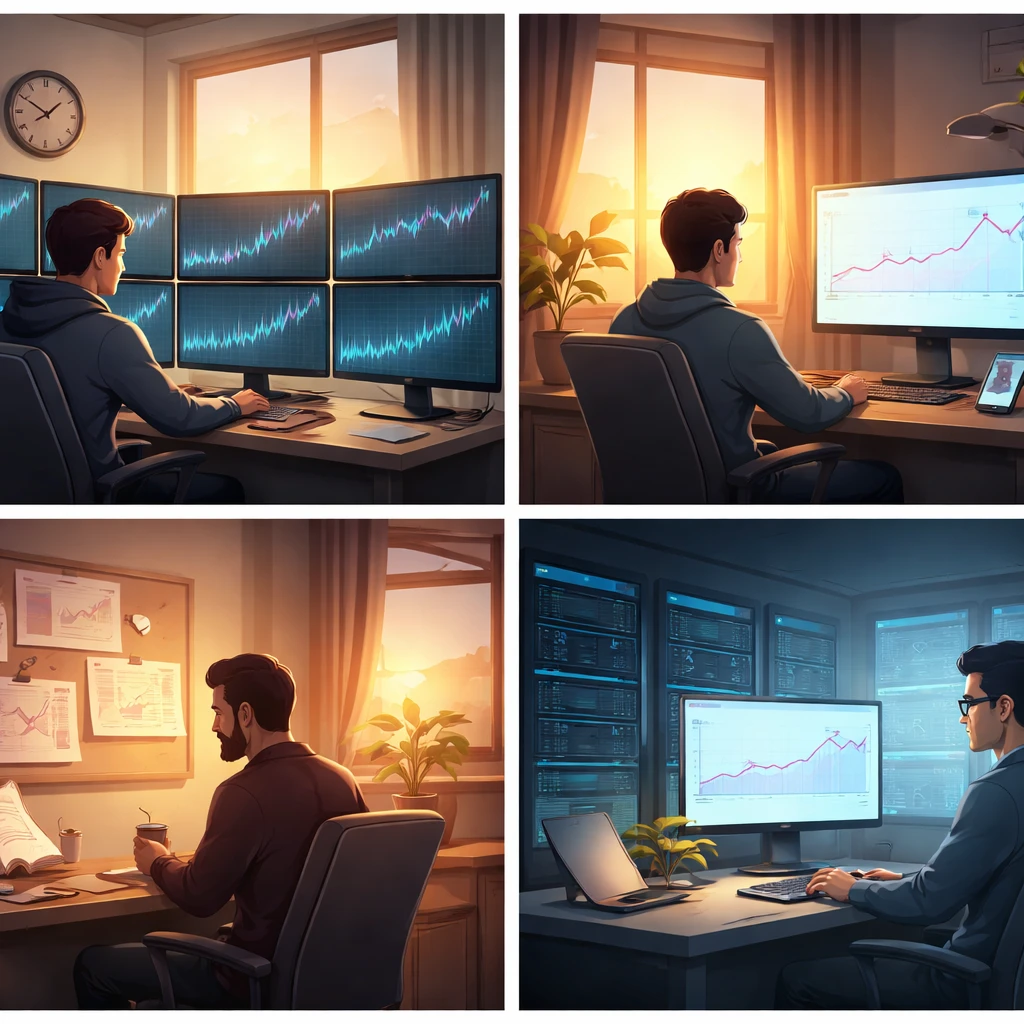
Trading style is more than a set of tactics. It is an operating environment that sets the pace, intensity, and emotional profile of decision making. Psychological Demands by Style refers to the characteristic mental, emotional, and behavioral loads that arise when one trades within a given timeframe and approach. Understanding these demands clarifies why the same person may function smoothly under one style while struggling under another, even when risk and expected return are held constant.
The topic is practical because execution and management are not performed in a vacuum. Attention, patience, impulse control, and tolerance for uncertainty all vary with the speed of feedback, the frequency of decisions, and the persistence of drawdowns. A durable trading process must therefore fit the human who operates it. The fit is not about adopting a particular strategy. It is about recognizing the demands that a timeframe and style will impose and building daily routines that make those demands manageable.
Defining Psychological Demands by Style
Psychological Demands by Style is the pattern of cognitive load, emotional pressure, and self-regulatory effort required to execute and manage trades consistently within a given trading style and timeframe. The pattern includes:
- Decision density and speed, which influence attention and fatigue.
- Feedback cadence, which shapes learning and emotional reinforcement.
- Variance in outcomes, which affects stress and confidence.
- Duration of uncertainty, which tests patience and commitment.
- Information complexity, which burdens working memory and judgment.
- Social and identity pressures, which color reactions to gains and losses.
These elements interact. For example, a style that demands frequent decisions under time pressure amplifies attentional costs and increases the odds of impulsive errors. A style that involves long holding periods reduces time pressure but raises the psychological cost of sitting through prolonged drawdowns or apparent inactivity.
Why Markets Create Different Psychological Loads
Markets generate different experiences at different time scales. That fact alone produces distinct psychological demands by style. Several mechanisms are especially relevant.
Feedback cadence and reinforcement
Short timeframes provide frequent feedback. A trader may see dozens of outcomes in a single session. Behavioral research shows that variable and rapid reinforcement shapes emotions powerfully. Wins and losses arrive quickly, magnifying arousal and the urge to act. Longer timeframes deliver feedback slowly. The immediate emotional spikes are smaller, but ambiguity persists longer, which strains patience and increases the temptation to override plans during quiet periods.
Signal to noise ratio
At very short horizons, price movements contain more randomness relative to informational content. That randomness raises the base rate of false impressions. Interpreting such movement requires tight attention and strict control over impulsive reactions to noise. At longer horizons, signal tends to dominate noise, but the road to clarity is slow. Waiting for the signal to express exposes the trader to narratives, news, and social commentary that can unsettle conviction in the absence of quick confirmation.
Decision density and time pressure
Some styles call for dozens of small, time-constrained decisions. Others require only a handful of decisions each month. Frequent, time-limited choices are cognitively expensive and can erode discipline through fatigue. Infrequent choices seem comfortable but can invite overthinking, procrastination, or inertia because each decision feels significant.
Drawdown profile
Short-term styles often experience a series of small losses and gains with quick reversals. The drawdowns may be shallow but frequent. Longer-term styles can experience fewer but deeper or longer drawdowns. The psychological strain differs. Rapid sequences of small losses challenge persistence and self-talk. Long drawdowns challenge patience and risk tolerance as days or weeks pass without resolution.
Information environment
Fast styles rely on immediate market micro-movements and timely monitoring. Longer styles face broader information sets such as macro, seasonality, corporate events, or secular themes. Managing a narrow stream of high-frequency data is different from digesting a broad stream of slowly changing information. Working memory, attention switching, and selective focus are taxed in different ways.
Social comparison and visibility
Short horizons invite rapid comparison to others because outcomes are visible daily. This can intensify competitive stress and promote reactive behavior. Longer horizons have less daily scorekeeping but more narrative risk. External commentary may question a thesis before the timeframe has had a chance to play out, creating social pressure to abandon a plan prematurely.
Core Components of Psychological Demand
It is useful to name the core components that most traders encounter regardless of style, then observe how each expands or contracts across timeframes.
- Attention and vigilance. The need to monitor screens or alerts and detect relevant changes without overreacting to noise.
- Impulse control. The restraint required to avoid premature entries, exits, and revenge trading after losses.
- Tolerance for boredom. The capacity to stay engaged and not manufacture trades during quiet periods.
- Tolerance for ambiguity. Comfort with not knowing whether a position will work and for how long uncertainty will persist.
- Emotional regulation. The ability to experience gains and losses without destabilizing subsequent decisions.
- Working memory and processing speed. The cognitive resources needed to integrate information quickly and accurately.
- Patience and commitment. The willingness to hold through normal fluctuations if that is consistent with the plan.
- Resilience. Recovery after mistakes or adverse sequences without abandoning a sound process.
Different styles press on these components in different proportions. A good fit aligns a trader’s existing strengths with the demands most emphasized by the chosen style, while minimizing chronic reliance on weaker capacities.
Mapping Demands Across Timeframes and Styles
Intraday trading
Intraday trading includes styles that open and close positions within a single session. The psychological profile is dominated by time pressure, decision density, and rapid reinforcement. Attention must remain narrowly focused, and working memory must be maintained despite continuous distraction. Because outcomes are visible immediately, emotion fluctuates quickly. The demands often include:
- High vigilance to detect changes and execute promptly.
- Quick emotional recovery after small losses to maintain objectivity.
- Strict impulse control to avoid chasing movement or forcing trades during lulls.
- Fatigue management as concentration wanes across the session.
Execution in this context must account for human limits under speed. Practitioners often use pre-defined decision rules, checklists, and pre-commitments to manage the volume of choices. Many also define session structures with planned breaks to reduce attentional drift. The management effort shifts from long-term thesis maintenance to moment-to-moment consistency under stress.
Short-term swing trading
Swing trading typically involves holding positions for several days to a few weeks. Time pressure relaxes compared to intraday work, but ambiguity expands. The trader experiences overnight risk and must maintain conviction across market open and close cycles. The demands emphasize:
- Patience to wait for the setup and to hold across minor fluctuations.
- Boredom tolerance during periods when price consolidates.
- Emotion regulation around overnight gaps that may reframe the trade quickly.
- Structured review outside market hours to avoid tinkering during the day without cause.
Execution and management hinge on separating signal from short-term noise while not micro-managing positions. Many practitioners schedule checks at defined times and rely on alerts to reduce screen time and impulsive adjustments. The challenge is maintaining consistency without the reinforcing rhythm that intraday traders receive.
Medium-term position trading
Positions held for weeks to months shift the psychological load toward thesis maintenance and drawdown endurance. Information is broader and slower. The trader’s identity can become entwined with the position, especially if the thesis is narrative rich. The demands include:
- Ambiguity tolerance, since confirmation or disconfirmation arrives slowly.
- Restraint to avoid reacting to every headline that touches the thesis superficially.
- Clear criteria for continuing or exiting a position to prevent incremental rationalization.
- Capacity to experience large but normal swings without either capitulation or complacency.
Real-world management often formalizes review intervals and decision checkpoints. Practitioners differentiate between noise, adverse information, and true thesis impairment. Documentation and after-action reviews play a larger role because each decision carries more weight and occurs less frequently.
Long-horizon position investing
Holding periods of many months or years minimize time pressure but maximize exposure to prolonged uncertainty, shifting regimes, and social scrutiny. Patience is paramount. The trader must withstand extensive commentary, alternative opportunities, and narrative cycles. Demands often include:
- Deep patience and consistency across multiple market phases.
- Myopic loss aversion management, since frequent monitoring of long-term positions increases perceived volatility and discomfort.
- Clarity about the horizon to resist pressure to react to short-term moves.
- Acceptance of long periods of underperformance relative to benchmarks or peers without abandoning the process.
Execution and management focus on infrequent but well-prepared decisions, documentation of rationale, and predefined review cadences. The psychological cost is paid in waiting and in living with extended drawdowns rather than in rapid-fire execution stress.
Systematic or algorithmic oversight
Some traders deploy rules-based or automated systems. The psychological demands shift from discretionary choice to design, monitoring, and restraint. Unique pressures emerge:
- Trust in the system during inevitable underperformance streaks.
- Change control discipline to avoid overfitting or impulsive parameter tweaks.
- Process vigilance to ensure data integrity, execution quality, and risk controls.
- Comfort with ceding real-time decision making to code while retaining responsibility for outcomes.
In practice, the operator manages meta-decisions about when to intervene and how to evaluate performance windows. The emotional strain is less about minute-to-minute choices and more about tolerating mechanical adherence when instincts suggest otherwise.
Event-driven discretion
Trading around discrete events such as earnings releases or economic data compresses uncertainty into short windows. The psychological demands concentrate around preparation, rapid assimilation of new information, and outcome variance. Even with careful planning, results can deviate widely from expectations. The style often requires:
- Composure under sudden information shocks.
- Fast but structured decision making immediately following releases.
- Acceptance of jump risk without retroactive self-blame when probability tails realize.
- Recovery routines to reset after emotionally intense episodes.
Execution thrives on pre-defined roles for before, during, and after the event. The demands spike briefly but intensely, and then abate, which calls for deliberate downshifting to avoid lingering arousal that can distort subsequent decisions.
How the Concept Operates in Daily Practice
Psychological Demands by Style become visible in seemingly mundane choices. Consider the structure of a trading day. Intraday operators often arrange their environment to reduce distractions because each interruption can degrade execution quality. They might rely on alarms and hotkeys to lower cognitive load per decision. Swing and position traders often curate information flow, using limited windows for review so that constant monitoring does not provoke unnecessary changes. Systematic operators might set clear thresholds for intervention to prevent ad hoc overrides. None of these are strategies. They are process architectures tuned to the demands of the chosen style.
Trade management reveals the concept even more clearly. An intraday approach requires rapid error correction. When a plan deviates, the operator must reset quickly without carrying emotional residue into the next decision. A medium-term approach requires sticking with the plan through normal volatility while distinguishing normal from abnormal changes. The ability to sit, rather than the ability to act, becomes the scarce resource. An event-driven approach requires pre-commitment to decision criteria before the event to avoid being swept away by the release. The psychological demand is front-loaded in preparation and back-loaded in debriefing.
Tools and routines are chosen to match demands. For example, timers, breaks, and hydration are simple methods intraday operators use to manage fatigue. Written decision logs and scheduled reviews are common in longer horizons to counter selective memory and hindsight bias. Alerts can replace constant monitoring for swing traders to reduce compulsion to act. Again, these are not endorsements of particular practices. They are illustrations of how different demands pull for different process supports.
Why Misfit Occurs and What It Costs
Misfit arises when a trader’s psychological profile conflicts with the dominant demands of the chosen style. A person who enjoys deep analysis and reflection but dislikes time pressure may gravitate to intraday trading because of perceived excitement, only to discover that fatigue and impulsivity degrade execution. Conversely, a person who prefers action may choose a long-horizon approach and later experience discomfort during quiet months, leading to unnecessary changes.
The costs of misfit are concrete:
- Inconsistent execution. Plans are abandoned under pressure or boredom, producing variance unrelated to edge.
- Overtrading or undertrading. Activity becomes a response to emotion rather than to the plan.
- Process drift. Rules are adjusted frequently to relieve discomfort, obscuring whether the approach works.
- Emotional exhaustion. Fatigue degrades judgment, creating a feedback loop of errors and frustration.
These costs appear in performance metrics as increased dispersion, higher error rates after certain times of day, or chronic deviation from intended holding periods. They also appear in qualitative markers such as dreading certain sessions, ruminating about losses, or feeling compelled to check positions compulsively.
Real-World Vignettes
Alex, intraday operator. Alex begins the session energized. After two small losses, heart rate rises, and attention narrows. The urge to recover quickly appears. Alex’s style demands rapid emotional reset. If this reset fails, the next decision quality drops. Alex’s process includes a brief break after two consecutive losses to restore composure. Without that pause, judgment skews toward chasing. The psychological demand here is not finding a new opportunity. It is protecting decision quality under speed and arousal.
Maya, swing trader. Maya holds positions for a week or two. A position moves sideways for several days. Social media debates the outlook. Maya’s style demands patience and boredom tolerance. The risk is not missing a sudden move. It is growing restless and altering the plan in response to chatter. Maya reviews the position at predetermined times and logs any changes with reasons. The management challenge is to avoid translating daily noise into structural changes. The psychological work is in waiting without disengaging.
Daniel, position trader. Daniel holds a multi-month position that draws down for three weeks without new information. Colleagues question the thesis. Daniel’s style demands ambiguity tolerance and criteria-based decision making. The danger is confirmation seeking or incremental rationalization to maintain comfort. Daniel evaluates the position at monthly intervals using documented criteria. If nothing material has changed, the plan continues. The psychological task is to live with extended uncertainty while avoiding both capitulation and inflexibility.
Error Types by Style
Certain mistakes cluster by timeframe because the psychological demands shape failure modes.
- Intraday. Commission errors dominate. Acting too often, chasing, abandoning protective rules after a loss streak, and failing to stop activity when fatigued.
- Swing. Timing drift. Exiting too early during normal consolidation, re-entering repeatedly, and tinkering outside planned review windows.
- Position and long-horizon. Thesis drift. Gradual redefinition of the idea to avoid discomfort, or excessive monitoring that magnifies short-term noise, producing myopic loss aversion.
- Systematic oversight. Rule drift. Tweaking models after small samples, disabling the system during drawdowns, and mixing discretionary overrides with automated logic in a way that defeats testable assumptions.
Recognizing the dominant error types helps frame what self-regulatory resources are most scarce in a given style.
Capacity, Learning, and Fit
Psychological demands are not fixed in their effects. Capacity can be developed. Practice builds automaticity, and automaticity lowers cognitive load. Intraday traders often find that routines reduce decision friction over time. Position traders often find that documented review cycles lower anxiety. As skills improve, the same style may feel less taxing. Still, styles differ in their baseline demands. A style that fundamentally conflicts with a trader’s disposition can be made workable only up to a point before costs outweigh benefits.
Newer traders sometimes attribute discomfort to lack of discipline rather than to a structural misfit. Distinguishing between a skill gap and a mismatch matters. A skill gap responds to training and repetition. A mismatch persists even after skill improves, showing up as chronic fatigue, dread, or relief when not trading. Understanding Psychological Demands by Style offers a lens to make this distinction without reference to specific strategies.
Institutional and Retail Contexts
Context amplifies or dampens psychological demands. Institutional settings divide roles. One person may research, another may execute, and a third may manage risk. This separation distributes psychological load. Retail traders often combine all roles. The same person must research, execute, monitor, and review. That concentration magnifies demands and makes process architecture more important. Team environments also provide feedback and social regulation, which can stabilize emotions but can also introduce conformity pressures. Solo environments provide autonomy but can intensify rumination and second-guessing.
Applying the Concept to Execution and Management
Traders in different styles commonly adopt distinct process features that map to their psychological demands, not as strategies but as execution hygiene.
- Session design. Intraday operators often define session start, mid-session resets, and session end. The structure counters attention decay. Longer-horizon operators anchor reviews to weekly or monthly cycles to avoid daily noise.
- Decision architecture. Pre-trade checklists, if-then plans, and documented criteria reduce ad hoc judgment when arousal is high. For slower styles, these artifacts prevent narrative drift.
- Information diet. Fast styles prefer minimal but timely inputs. Slower styles curate broader sources but with limited frequency. Both aim to match information flow to cognitive bandwidth.
- Monitoring tools. Alerts, dashboards, and summaries fit slower styles by reducing constant screen time. Quick access execution tools and clear on-screen layouts fit faster styles by lowering friction.
- Review and recovery. Brief post-session notes fit fast styles to capture lessons before memory fades. More comprehensive monthly or quarterly reviews fit slower styles to assess process fidelity over meaningful samples.
These elements do not prescribe what to trade or when. They show how the psychological profile of a style shapes the everyday mechanics of making and managing decisions.
Diagnosing Fit Without Strategy Discussion
Fit can be evaluated through observable behavior. Markers include deviations from intended holding periods, increased error rates at specific times of day, and emotional patterns such as anger after quick losses or anxiety during quiet periods. Another marker is the type of relief felt when stopping. If an intraday trader feels profound relief every day at midday, fatigue may be overwhelming the current routine. If a long-horizon trader feels compelled to check positions hourly, discomfort with slow feedback may be driving counterproductive monitoring.
Peer observation can also help. In teams, comparing execution notes can uncover style-related stresses. For example, multiple intraday operators might record that the final hour produces the most errors, prompting a change in session structure. Multiple position traders might note that review meetings shortly after major news produce more plan changes than reviews held after cooling-off periods. In both cases, the insight concerns timing and process, not strategy.
Why the Concept Matters
Markets reward consistency across many repetitions. Consistency is not just a function of having a method. It is a function of operating a method under human constraints. Psychological Demands by Style anchors this reality. By naming the demands, traders can design processes that make stable execution possible. Without this framing, process failures are often misattributed to the quality of ideas rather than to the mismatch between human capacities and the operating environment required by a style.
Key Takeaways
- Each trading style and timeframe imposes a distinct pattern of cognitive load, emotional pressure, and self-regulatory effort that affects execution quality.
- Differences in feedback cadence, decision density, drawdown profile, and information environment explain why psychological demands vary across styles.
- Common failure modes align with style: commission errors for intraday, timing drift for swing, thesis drift for position, and rule drift for systematic oversight.
- Process architecture, not strategy choice, is the primary lever for matching human capacities to the demands of a style in day-to-day management.
- A durable fit shows up as consistent execution with manageable stress, while persistent misfit appears as chronic fatigue, plan deviation, and process drift.