
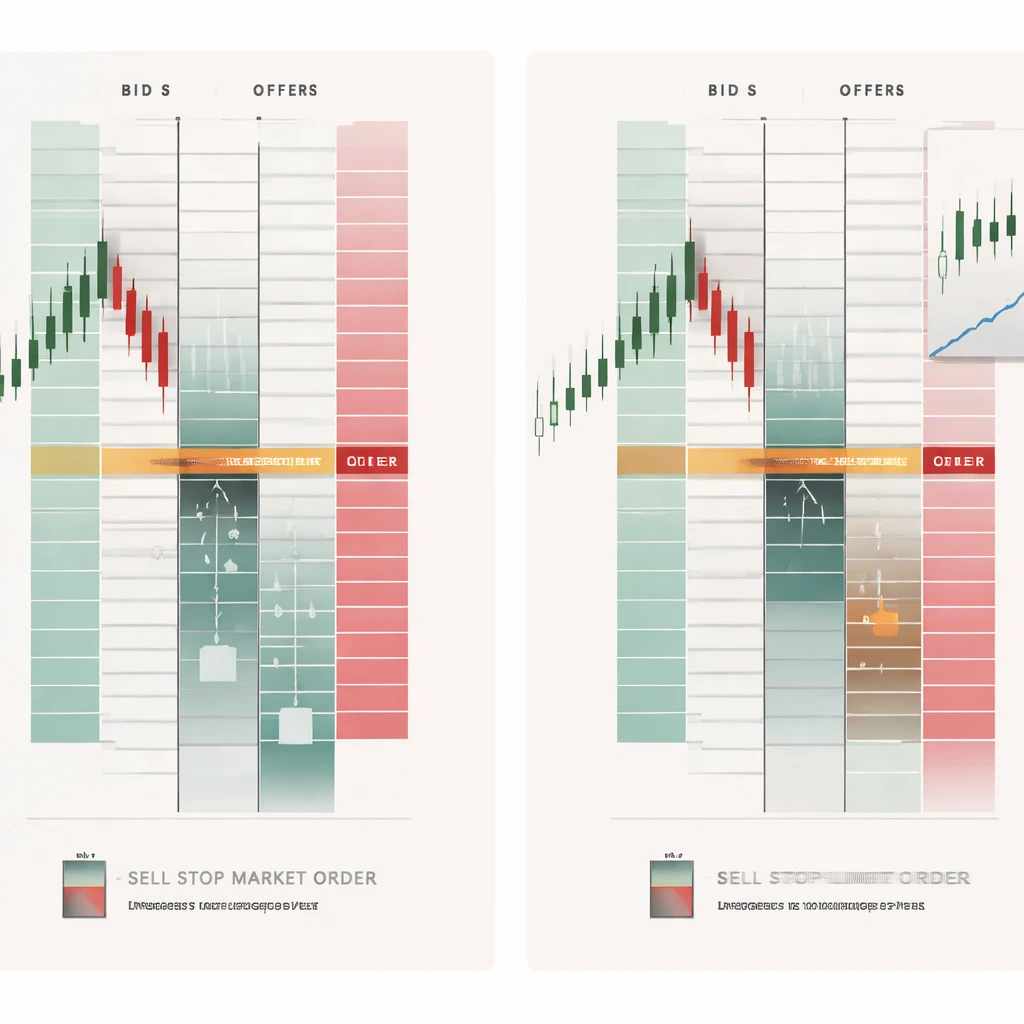
Stop orders are among the most commonly used conditional instructions in modern markets. They exist to automate an order only when price reaches a specified threshold, transforming intent into action without continuous monitoring. Although the idea sounds simple, the mechanics that govern when a stop triggers, how it becomes a live order, and where it fills can differ across instruments, brokers, and trading sessions. Understanding these details is part of basic order literacy and helps set realistic expectations for how an order may execute in real time.
What a Stop Order Is
A stop order is an instruction to submit an order to buy or sell once the market trades at or through a chosen price called the stop price or trigger price. Prior to that event, the stop order is inactive and does not appear in the public order book. Once triggered, it becomes a live order according to its type and terms.
Two core variants define how a stop behaves after it is triggered:
- Stop market: once the trigger condition is met, the order is submitted as a market order. It seeks immediate execution against available liquidity at prevailing prices.
- Stop limit: once the trigger condition is met, the order is submitted as a limit order with a specified limit price. It will only execute at the limit price or better, and may not fill if the market trades through the limit without sufficient liquidity.
Stop orders can be set to buy above the current price or to sell below the current price. A buy stop activates when price rises to or above the trigger. A sell stop activates when price falls to or below the trigger.
Why Markets Use Stop Orders
Stop orders exist for several operational reasons within market design and brokerage services:
- Automation of conditional intent. Stops allow an order to rest off book until a specific price condition is met, then enter the market promptly without manual input.
- Risk controls and policy adherence. Institutions and individuals often operate with predefined thresholds for exiting or entering positions. Stops provide a structured way to act at those thresholds.
- Operational efficiency. By withholding inactive instructions from the public book, stops reduce displayed clutter while preserving the ability to quickly route orders when conditions apply.
- Session coverage. Stops can be held during off hours and released at the open or during extended sessions, depending on the terms and broker implementation.
These functions are part of the plumbing of markets rather than a trading strategy. The value of a stop order lies in the predictability of its activation rules and the transparency of how it becomes executable flow.
Trigger Mechanics and Activation Rules
At the heart of a stop order is the trigger condition. The exact data that causes a trigger can vary by venue, instrument, and broker setting. Common triggers include:
- Last trade price. The stop activates when a reported transaction prints at or beyond the stop price.
- Bid or ask. Some brokers offer stops that trigger on the bid for sells or the ask for buys, which can be relevant in thin markets where quotes move before trades occur.
- Reference or mark price. In derivatives, a designated reference such as a settlement price or exchange-calculated mark can be used for triggering in certain products.
Activation logic also differs in how it treats equality. For a buy stop, the condition is typically price greater than or equal to the stop price. For a sell stop, the condition is typically price less than or equal to the stop price. Once the condition is met, the stop transitions immediately into the chosen order type.
Because public order books display executable orders, a stop remains hidden until it triggers. This feature avoids revealing intent prematurely. It also means that other participants cannot trade directly against a stop before activation.
From Trigger to Fill: What Happens Operationally
Once a stop triggers, several operational steps occur quickly:
- Order transformation. The instruction is converted into a market or limit order, including its size and any modifiers such as time-in-force.
- Routing. The order is routed to one or more venues. Routing policies vary by broker and may consider price, liquidity, fees, and internalization rules.
- Matching. The order executes against resting liquidity according to price-time priority or other matching rules in the destination venue.
This path introduces two important practical effects. First, there can be slippage, which is the difference between the expected price and the executed price. For stop market orders, slippage reflects the available liquidity at the moment of arrival. Second, for stop limit orders, there can be non-execution if the limit price is not reachable given current liquidity and price movement.
Stop Market and Stop Limit in Practice
Understanding the practical differences between stop market and stop limit orders is essential for realistic expectations.
Stop market
A stop market order prioritizes execution once triggered. If a sell stop at 47.00 triggers during a fast move, the converted market order will seek immediate fills across the bid stack. If the best available bids are at 46.98, 46.90, and 46.75 for the total requested size, the average fill price will reflect those levels. The order will complete unless the market halts or the venue imposes price bands that delay or reject parts of the flow.
The benefit is high fill probability after triggering. The trade-off is uncertain price, especially during gaps, thin liquidity, or rapid repricing.
Stop limit
A stop limit order specifies a stop price and a limit price. After triggering, the order posts as a limit order at the limit price. Using the earlier example, a sell stop at 47.00 with a limit at 46.90 will only fill at 46.90 or better. If the market trades from 47.05 to 46.60 on the next print, no shares or contracts will trade at 46.90 or better until the market rebounds. The order remains working at 46.90, potentially unfilled.
The benefit is price control once the order is live. The trade-off is execution risk during fast or gapping markets.
Buy Stops and Sell Stops
A stop can be set above or below the current price depending on direction.
- Buy stop. Triggers at or above the stop price. Often used to cover a short position or to initiate a buy only if price rises to a specified level. Triggering converts the instruction into a market or limit buy.
- Sell stop. Triggers at or below the stop price. Often used to exit a long position if price falls to a threshold. Triggering converts the instruction into a market or limit sell.
Both buy and sell stops rely on the same trigger logic. In practice, buy stops can activate during sharp upward moves and encounter thin offers, while sell stops can activate during downward moves and encounter thin bids. In both cases, the surrounding liquidity determines fills.
Trailing Stops
A trailing stop modifies the stop price based on favorable price movement. The trailing amount can be expressed as a fixed absolute value or as a percentage. For a long position, a trailing sell stop ratchets upward when price rises and remains unchanged when price falls. For a short position, a trailing buy stop ratchets downward when price falls and remains unchanged when price rises.
Consider a trailing sell stop with a 1.00 trail on a stock trading at 50.00. The initial stop price is 49.00. If the stock rises to 52.10, the stop ratchets to 51.10. If price then declines, the stop stays at 51.10 and will trigger if price prints at or below that level. Percentage trails work similarly but recompute the distance based on the most favorable price reached.
Implementation details can vary. Some systems trail based on last trade, others on bid or midpoint. Rounding to tick size can affect the exact stop level. Trailing stops retain the same choice of stop market or stop limit behavior once they trigger.
Time-in-Force and Trading Sessions
Stop orders can include time constraints that control their lifespan and which sessions they participate in.
- Day. Expires at the end of the regular trading session if not triggered and executed.
- Good-til-canceled. Persists across multiple days until executed or canceled, subject to broker limits on maximum duration.
- Extended-hours eligible. Some brokers allow stops to trigger during premarket or after-hours sessions. Others restrict triggering to the primary session to reduce noise from thin liquidity.
Session behavior matters. If a stock closes at 50.00 and opens the next day at 46.80, a sell stop at 49.00 will typically trigger at the opening print. For a stop market order, the fill will occur at the opening price or the best available bids when the order reaches the book. For a stop limit with a limit at 48.90, the order will rest at 48.90 and may not fill if the opening price is below that level and never trades back up.
Where Stop Orders Are Held
Where a stop resides before activation has practical implications. In many equity markets, exchanges no longer host native stop orders. Brokers hold the stop instruction on their systems and simulate the trigger. When the condition is met, the broker submits a market or limit order to the exchange or to other venues. This process is sometimes called a broker-held stop.
In several futures markets, exchange-native stop or stop-limit instructions are widely supported. The exchange monitors prices and activates the order when the trigger is met. Differences in design lead to differences in timing, protect bands, and routing. The outcome is the same in concept, but the triggering party can be the exchange or the broker, depending on the product.
Because stops are not displayed until activation, there is no public record of their presence before they convert. This characteristic reduces information leakage but can also mean that a wave of stops appears simultaneously if a key level is reached during an auction or a volatile move.
Asset Class Considerations
Stop order behavior reflects the structure of each market.
- Equities. Many brokers simulate stops using last trade or quote-based triggers. Pre and post-market sessions have lower liquidity, and some systems restrict stop triggering to the primary session.
- Futures. Exchange-native stops are common. Several futures contracts operate nearly 24 hours on electronic platforms, so stops can trigger overnight. Some exchanges use protection bands that convert stop market orders into protected orders with bounded prices to reduce extreme prints.
- Foreign exchange. OTC spot FX prices are quoted by multiple liquidity providers. Brokers typically trigger stops based on their aggregated bid or ask feeds. Disparities between feeds can affect triggering during illiquid periods.
- Options. Not all brokers or venues accept stop orders for options. Where supported, triggers and routing can be more restrictive due to the multi-strike, multi-expiry nature of options markets and underlying reference pricing.
The core principles remain consistent, but the details of triggering, routing, and protection mechanisms differ. Reviewing the specifications for a given product and venue clarifies what conditions control activation.
Execution Risks and How They Manifest
Stop orders create predictable points at which instructions transform into executable flow. Several execution risks follow from that design:
- Gaps. If the next available price after the trigger is far from the stop, a stop market order will fill at that available price. Slippage can be material in this case. A stop limit may not execute at all until the market trades back to the limit price.
- Thin liquidity. In instruments with shallow order books, a triggered stop market order can sweep multiple price levels to complete. The average price will reflect the depth available, not the stop price.
- Halts and price bands. If trading halts or limit up or limit down mechanisms engage near the trigger, the order may be delayed. On resumption, a wave of latent stops can release simultaneously into the auction.
- Quote versus trade triggers. A quote-based trigger can activate before an actual trade occurs, especially in fast markets. A trade-based trigger can lag in a quickly moving book. Either choice has trade-offs.
- Partial fills. Stop limit orders can fill in pieces as liquidity appears at the limit price. Any unfilled quantity remains working unless canceled or expired.
These risks arise from normal market functioning. They do not indicate malfunction. They reflect the difference between a condition to begin execution and the actual liquidity available to complete it.
Worked Examples
Example 1: Sell stop market through a gap
Assume a stock closes at 50.00. A sell stop market is placed with a stop price of 49.00. Overnight news leads to a lower open at 47.10. At the opening print, the stop triggers because the price is at or below 49.00. The order converts into a market sell and routes into the opening auction or continuous book, depending on the venue. If the opening auction clears at 47.10 and the order size can be fully accommodated, fills occur at 47.10. If the order arrives slightly after the open due to routing and the best bid slips to 47.00, the fills may occur near 47.00. The final price is determined by the liquidity at the moment of arrival, not by the stop price.
Example 2: Sell stop limit during a fast move
Assume the same stock trades during the day at 50.20, then drops quickly. A sell stop limit is set with a stop of 49.00 and a limit of 48.90. The first print at or below 49.00 is 48.95. The stop triggers and places a limit sell at 48.90. If the next prints are 48.94 and 48.88, the order may fill partially at 48.94 and 48.92 until the price moves through 48.90. Once price prints 48.88, the remaining quantity will not execute unless the market trades back to 48.90 or higher bids appear. The order remains working at 48.90.
Example 3: Buy stop market using a quote trigger
An equity trades at 24.95 by 24.97. A buy stop market is set at 25.05 using an ask-based trigger. The ask moves to 25.05 without a trade at 25.05. The stop triggers and submits a market buy. If the best offer is 25.06 at that moment, the fill may occur at 25.06 or higher depending on available size and routing delay. This illustrates how a quote-based trigger can lead to activation before a trade prints.
Example 4: Trailing sell stop with tick rounding
A futures contract trades in minimum tick increments of 0.25. A trailing sell stop with a 1.00 trail is established while price is 4100.00. The initial stop is 4099.00. As price rises to 4103.75, the trailing stop ratchets to 4102.75. If price backs off to 4102.75, the stop market triggers and submits a sell market order. If instead a stop limit was used with a limit equal to the stop, the order would post a sell limit at 4102.75 and may or may not fill depending on the bid at that level.
Costs and Confirmations
The cost of execution after a stop triggers includes explicit fees and implicit costs such as slippage. Slippage can be positive or negative, although for exit-oriented sell stops during declines the realized price often falls below the stop price in a gap or fast move. Reviewing confirmations is the reliable way to see the exact time stamps, venues, and prices. Fills can span multiple prices if the order sweeps the book.
Most platforms label the activation time and the execution time. In a fast market these can be nearly simultaneous. In fragmented markets, routing can introduce small delays. An audit trail provides the data needed to reconcile expectations with outcomes.
Special Considerations Around the Open and Close
Opening and closing auctions concentrate liquidity and order flow. A stop that triggers into an auction behaves according to the auction’s rules. If a sell stop market triggers at the open, the execution price is the auction clearing price, provided the order is included in the auction. If the system releases stops only after the auction uncrosses, the order will execute in the continuous session that follows at the best available bids.
At the close, some systems prevent new marketable orders near the cutoff to protect auction quality. In such cases, a late-day stop that triggers moments before the close could route into the next session. Brokers disclose these timing rules in their platform documentation.
How Stops Interact With Other Order Modifiers
Several order modifiers can attach to a stop instruction and govern the converted order’s behavior:
- Time-in-force as discussed earlier, such as Day or Good-til-canceled.
- Immediate-or-cancel or fill-or-kill for the converted limit order in some venues. Not all brokers support these in combination with stops.
- Minimum quantity for the converted limit order. Again, support varies.
Not every modifier is compatible with every instrument. The specific combinations that are allowed depend on venue rules and broker systems.
Common Misconceptions
Several misconceptions surround stop orders:
- Stops guarantee a price. A stop market guarantees submission once triggered, not a price. Fills occur at the best available prices at that time.
- Stops always execute. Stop limit orders do not execute if the market does not trade at or better than the limit price after activation.
- Stops are displayed before triggering. They are not. Stops are hidden until activation, then they become standard market or limit orders and may be displayed according to venue rules.
- All markets treat stops the same way. Trigger references, session eligibility, and native support vary across asset classes and venues.
Practical Expectations
A practical understanding of stop orders begins with recognizing their conditional nature. The stop price is a trigger, not an execution guarantee. After activation, the order’s fate is controlled by the prevailing liquidity and the chosen order type. In calm markets, the difference between the stop price and the fill may be small. In volatile or illiquid periods, the difference can be large or the order may not fill at all in the case of a stop limit.
Clarity on the following points improves order literacy:
- Which price reference triggers the stop.
- Whether triggering is allowed in extended hours.
- How a stop market order is protected against extreme prices, if at all, in the given venue.
- Whether a stop limit has an offset or a distinct limit price and how tick size affects rounding.
- How the broker routes the converted order and whether it participates in auctions.
Summary Example: Timeline of Events
Consider a timeline for a sell stop market placed on an equity with regular hours from 9:30 to 16:00.
09:45: The stock prints at 50.12. A sell stop market at 49.70 is entered with Day time-in-force and regular-hours-only triggering.
10:22: The stock trades down to 49.74, then 49.71, then 49.69. The 49.69 print triggers the stop because it is at or below the stop price. The broker’s system instantly converts the instruction to a market sell and routes it to a venue based on its routing logic.
10:22 and a few seconds: The order arrives at the venue. The best bid is 49.68 with enough size to fill part of the order. The remainder fills at 49.66 as the book updates. The combined average execution price is 49.67. The confirmation shows the activation time and the two execution prints with their venues.
This sequence illustrates how the trigger and the fill are related but distinct, and how normal routing and matching lead to specific prints.
Real-World Context
Large institutions, retail platforms, and automated systems all rely on stop orders to transform conditions into executable flow. The differences lie in scale and control. A large institution may use exchange-native stops for futures to align with the venue’s protections. A retail platform may use broker-held stops in equities with last trade triggers. A systematic process may use trailing stops with precise tick rounding to avoid off-by-one errors. In each case, the function is the same: release an order when a predefined price condition occurs.
Markets respond to these conditional flows in aggregate. When a widely observed price level breaks, a cluster of stops can trigger together. The resulting increase in marketable orders can accelerate price movement temporarily. This is a normal feature of order-driven markets and reflects the concentration of conditional liquidity around salient prices.
Closing Perspective
Stop orders are foundational tools for translating price thresholds into executable orders. They are not predictive instruments or guarantees of outcome. Their usefulness follows from clear rules about when they trigger, what order type they become, how they route, and the liquidity available upon arrival. A careful reading of product and venue specifications, along with attention to confirmations, provides a realistic view of how stop orders behave in practice.
Key Takeaways
- A stop order is inactive until a specified trigger price is reached, then becomes a market or limit order.
- Stop market prioritizes execution after triggering, while stop limit prioritizes price control and may not fill.
- Trigger references vary by broker and venue, including last trade, bid or ask, or a designated reference price.
- Session rules, routing, and liquidity determine where and at what prices a triggered stop actually fills.
- Stops are hidden until activation and, like all orders, are subject to gaps, slippage, and venue-specific protections.