
Trading sessions are formally defined periods when a market or venue accepts, matches, and reports trades. The session sets the tempo of price discovery. It constrains when orders can be entered, what order types are eligible, how auctions determine opening and closing prices, and when official benchmarks are recorded. Although some markets operate around the clock, most still exhibit distinct regional or venue-based sessions with predictable patterns of liquidity, volatility, and operational processes. Understanding sessions is part of understanding how trades are actually executed, confirmed, and settled.
The concept matters for practical reasons. Execution quality depends on who is active at a given time, how deep the order book is, and whether the venue is running an auction or continuous limit order book. Settlement prices, fund net asset values, and index levels are often tied to specific session events such as the close. Risk controls, margin calculations, and regulatory reporting also reference session boundaries. A session is therefore not just a clock. It is a set of rules and processes that shape the market’s microstructure during defined windows.
What a Trading Session Is
A trading session is the interval during which a venue permits trading under a known rule set. In most listed markets, the session includes discrete phases:
- Pre-open or pre-market: orders are collected and sometimes matched in a call auction, but continuous trading has not started.
- Opening process: a call auction or similar mechanism establishes the official opening price for each instrument.
- Continuous trading: orders interact in real time in a limit order book or dealer market.
- Closing process: a call auction or crossing session produces the official closing price.
- Extended hours: some venues allow trading outside regular hours with different participation, tick rules, or transparency.
In over-the-counter markets such as foreign exchange and many bonds, trading is not confined to a single exchange session. Even so, activity clusters into regional sessions around major financial centers, and many institutions define internal “session” cutoffs for valuation and risk.
Why Markets Use Sessions
Sessions exist because markets need predictable windows that concentrate liquidity and standardize processes:
- Price discovery and benchmarks: Opening and closing auctions gather interest and produce reference prices used in accounting, performance measurement, and index calculations.
- Risk and control: Defined hours allow for surveillance, market-wide controls, and orderly halts if necessary. They also align with clearing and settlement cycles.
- Operations: Exchanges, clearinghouses, and brokers batch processes such as reconciliations, database maintenance, and margining when the market is closed or in a restricted phase.
- Human and institutional rhythms: Corporate news, macroeconomic data, and portfolio flows tend to follow business hours in each region, creating natural session boundaries even in 24-hour markets.
As technology has improved, many sessions have expanded. Yet the core pattern remains. Certain moments attract more orders and set the official records that institutions rely upon.
Session Structures Across Asset Classes
Listed Equities
Most stock exchanges run a daily cycle with a pre-open period, an opening auction, continuous trading, a closing auction, and often an after-hours session. The opening and closing auctions typically concentrate significant volume because many participants want the official open or close as their execution benchmark. Mutual funds value at the close, index trackers rebalance at the close, and some corporate actions reference the open or close.
Continuous trading occurs between the open and close. Liquidity can vary intra-day, often deepest during the overlap of major regional sessions and thinner during local midday. After-hours sessions exist on many venues but with different participants, potentially wider spreads, and reduced price transparency. Trades in these sessions may not set the official closing price, which is determined by the closing auction print.
Foreign Exchange
FX trades over the counter through banks, electronic communication networks, and platforms. It is effectively open from late Sunday to late Friday on a global clock. Activity still follows regional sessions associated with Tokyo, Singapore, Hong Kong, London, and New York. Liquidity usually increases when Europe and North America overlap because more institutions are active at the same time. Important reference points include fixing windows used by asset managers for benchmarked conversions. The 16:00 London fix is a common example.
Futures and Options
Most major futures trade nearly 24 hours on electronic platforms with a brief daily maintenance break. Exchanges still define a regular trading session associated with the primary cash market. The official settlement price used for margin and accounting is often calculated during a defined settlement window that may differ from the full electronic trading span. Price limits, trading halts, and special order eligibility can also be session dependent.
Fixed Income
Government and corporate bonds often trade over the counter. Electronic venues provide streaming quotes and order books, but activity tends to peak during local business hours and during overlaps of major centers. Official closing prices for valuation are derived from composite pricing services or end-of-day dealer submissions tied to a defined valuation time.
Digital Assets
Crypto-assets trade continuously through weekends and holidays. Even without an official session close, activity clusters by region. Liquidity can vary between venues and time zones, and some derivatives reference daily funding or settlement times that act as de facto session markers.
Time Zones, Overlaps, and Calendars
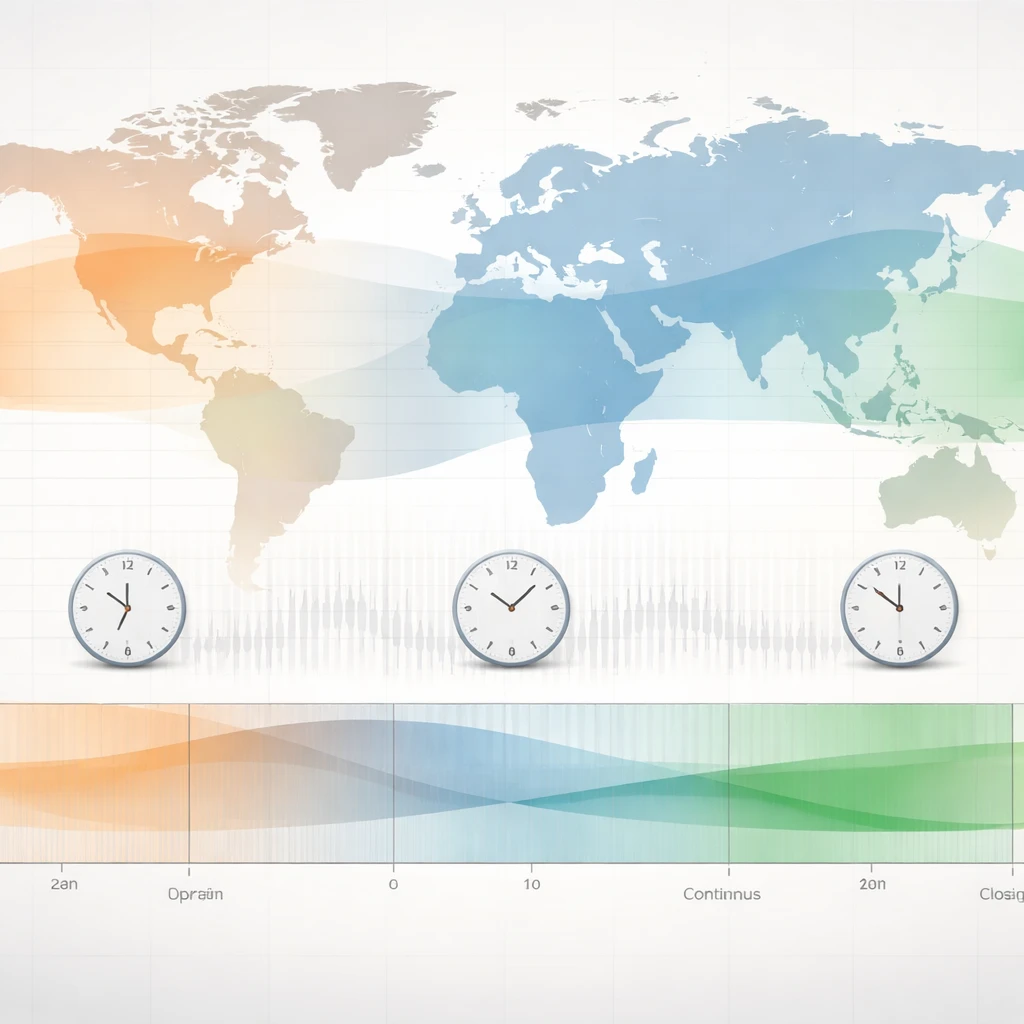
Sessions are anchored to local clocks. Viewed globally, they create a rolling wave of activity from Asia through Europe to North America. Two features are especially relevant for execution and order management.
Regional Overlaps
When two major financial centers are open at the same time, more counterparties are present, and quoted depth often improves. A common example is the European afternoon overlapping with the North American morning. By contrast, periods with few overlapping centers may show thinner order books and wider spreads, especially in instruments tied to those regions.
Daylight Saving and Holidays
Not all regions shift clocks on the same dates, and some do not shift at all. For several weeks each year, the relative timing of session overlaps changes. Exchange-specific holiday schedules add another layer. Early closes, half days, and suspension of extended hours can alter the usual pattern. Execution policies and operating procedures need to reference an authoritative calendar and time standard to avoid ambiguity. Many institutions anchor timestamps to Coordinated Universal Time and then convert for local reporting.
Session Mechanics That Affect Execution
Auctions and Opening or Closing Prints
In a call auction, the venue collects orders without immediate matching, then calculates the price that maximizes executed volume while minimizing imbalance. The result is the opening or closing print, which becomes the official reference price. Many order types are specifically designed for these events. Market on open and market on close orders participate only in the respective auction. Limit on open and limit on close orders add price protection while still targeting the auction.
Indicative prices and imbalance information may be published during auction buildup, allowing participants to observe where the cross might occur. Some venues allow imbalance-offsetting orders during a brief window. The mechanics can differ by exchange, but the idea is consistent. Auctions create a single, widely recognized print that concentrates liquidity and sets a benchmark.
Continuous Limit Order Books
Outside auction windows, most listed instruments trade in a continuous limit order book. Prices move when incoming orders match resting liquidity. Three features vary with session:
- Depth: how many shares or contracts are available near the top of the book.
- Spread: the gap between the best bid and best offer.
- Resiliency: how quickly the book refills after a trade consumes liquidity.
Depth and resiliency tend to be higher when more participants are active, which typically aligns with regional business hours and key overlaps. Early pre-market and late extended hours often show thinner books and wider spreads. Execution in those periods can be more sensitive to order size relative to available liquidity.
Order Eligibility and Time in Force
Not all order types are eligible for every session phase. Market on close orders do not trade during the day. Some venues disallow stop orders in extended hours. Time-in-force instructions matter because they define whether an order persists across session boundaries. Common instructions include Day, Good till canceled, Immediate or cancel, and Fill or kill. Whether an order carries from the pre-open into the opening auction or from regular hours into an after-hours session depends on venue rules. Platform defaults can differ, so many institutions standardize how their systems translate client instructions into venue-specific messages.
Alternate and Off-Exchange Venues
In equities, alternative trading systems and dark pools operate alongside lit exchanges. Access and matching logic can vary by time of day. Some venues run frequent batch auctions during the day, which are short call auctions rather than continuous matching. Off-exchange activity often dominates during regular hours and can recede in extended hours. For trade reporting and best execution analysis, the effective session is the one where the trade is printed and timestamped by the reporting facility.
Halts and Limits Within Sessions
Exchanges may trigger halts or price bands to stabilize trading. In many jurisdictions, limit up or limit down bands pause matching if prices move too quickly. These controls are session rules, not separate sessions. They interact with auctions because resumption from a halt may require a reopening auction. Understanding how halts transition back to continuous trading helps in interpreting prints and quote changes around those events.
Reference Prices, Benchmarks, and Data Windows
Sessions define which prices count as official and which windows define common benchmarks. Several examples illustrate the link between timing and measurement.
- Open, high, low, close: Most analytics rely on session-specific bars. The official open and close are tied to auctions. The high and low occur during continuous trading.
- VWAP and TWAP: Volume-weighted and time-weighted averages can be computed over the regular session or the full trading day including extended hours. The chosen window changes the benchmark.
- Index levels: Equity indices and many exchange-traded funds use official closing prices for constituents. That choice focuses flows into the close.
- FX fixings: Common fixes use narrow windows around specific times, such as 16:00 London, to produce a benchmark rate for that day.
- Futures settlement: Clearinghouses publish settlement prices that drive daily variation margin. The settlement calculation references a defined window near the regular close.
Because risk systems, performance reports, and compliance checks reference these benchmarks, the timing of a trade relative to the session can affect how it is evaluated even if the execution price is identical in absolute terms.
Operational Considerations Tied to Sessions
Clearing and Margin
Clearing cycles and margin processes align with session schedules. As of 2024, the United States moved most equities to T+1 settlement, which compresses operational timelines around the close. Futures clearing runs daily variation margin using settlement prices calculated near the end of the regular session. Prime brokers and clearing firms often apply intraday risk checks tied to session phases, for instance tighter controls near the open when books are thin or around scheduled events.
Corporate News and Economic Data
Public companies typically release earnings before the open or after the close of their primary listing venue. That practice concentrates price discovery into auction and immediately adjacent periods. Macroeconomic data releases follow regional calendars. Many major reports in the United States publish at set times during the morning. European releases follow local schedules. During these windows, liquidity can be abundant but transient, and price uncertainty can increase until the market incorporates new information.
Calendars, Early Closes, and Technical Windows
Exchanges publish holiday calendars, early close days, and maintenance windows. Electronic futures platforms commonly pause for a short break each day for housekeeping and risk processing. Extended hours sessions may be shortened ahead of holidays. Recognizing these modifications helps explain why a usual overlap may be missing on certain dates and why closing auctions can be larger than usual before long weekends or month-end.
How the Concept Works in Practice
Translating the structure into execution practice involves attention to who is active, which orders are eligible, and which benchmarks are in force. Consider a few common patterns that illustrate practical implications without advocating any particular approach.
Opening Dynamics
Before the open, overnight news and orders accumulate. The order book at the instant of continuous trading does not exist yet, so an opening auction aggregates supply and demand to set a clean starting point. Prices can gap from the prior close because trading was limited while information arrived. The opening print becomes the first official price, and opening minutes often show high turnover as latent orders interact with the newly formed book.
Midday Lulls and Regional Handovers
In many equity markets, the middle of the day is quieter as local participants focus on other tasks. Liquidity may improve again when another major region opens or when event-driven flows return. In global products such as index futures, liquidity may track the most active region at any time, but spreads and depth still reflect where the primary cash components trade.
Closing Concentration
The closing auction gathers portfolio rebalancing, fund flows, and benchmarked orders. Many institutions measure performance relative to the close, which focuses activity into the final minutes. For instruments that settle on a closing price or use a settlement window, the close is the reference point for margin and valuation. After-hours trading can continue, but it does not modify the official close unless a venue’s rules explicitly allow a correction.
Real-World Context and Examples
Equity Trade Across the Day
Assume an asset manager needs to buy 200,000 shares of a mid-cap stock listed in the United States. During the opening auction, displayed interest may be large relative to normal depth because many participants seek the open print. In the first hour after the open, liquidity is often high, but the order book can be more volatile as prices adjust to overnight information. Midday, the same order might face a thinner book, so individual prints could have a larger price impact for a given child order size. Near the close, the auction attracts concentrated liquidity again as indexers and funds benchmark to the official close. After-hours, displayed size can fall sharply, spreads can widen, and not all order types are eligible. The manager’s execution framework would treat these as distinct environments because the session phase affects order handling, child order sizing, and benchmark selection used for evaluation.
FX Conversion for an Overseas Payment
Consider a manufacturer converting local currency to euros for a supplier payment. During the Asian session, EUR liquidity is present but not at peak depth if European banks and asset managers are less active. Price discovery can be more constrained until Europe opens. During the European afternoon and the overlap with North America, depth often increases as more liquidity providers stream quotes. If the firm values alignment with a known benchmark, a fixing window such as 16:00 London offers a transparent reference but a narrow execution window. The choice of session and time window changes both the expected liquidity and the benchmark used for reporting, even though the market trades continuously for five days.
Futures Hedge Near the Settlement Window
A commodity producer using futures to hedge revenue monitors the exchange’s settlement procedure. The settlement price, calculated during a defined window around the regular close, determines daily variation margin and the mark used in accounting. Executions inside that window can have different evaluation context than trades outside it because they are closer to the reference mark. Liquidity can concentrate near settlement, but resting interest may shift quickly as participants manage exposure to the mark. The exchange’s daily maintenance break and any price limits are also session features that can alter when and how orders interact with the book.
Common Misunderstandings
Several points about sessions often cause confusion:
- After-hours prints are valid trades but do not change the official close if the venue defines the close via auction.
- Halts and circuit breakers are rules within a session, not separate sessions. Resumption often requires a reopening auction.
- Twenty-four-hour markets still have effective sessions because regional participation, valuation practices, and fixings create time-specific liquidity and benchmarks.
- Benchmark windows matter because many performance and risk systems evaluate outcomes relative to open, close, fix, settlement, or VWAP computed over a defined session window.
- Time zones change the overlap during daylight saving transitions, temporarily shifting when activity concentrates.
Session Changes and Structural Shifts
Session definitions are not static. Exchanges revise hours, adjust auction rules, introduce frequent batch auctions, or modify transparency around imbalances. Regulatory changes can shorten or lengthen trading days or alter who can access extended hours. Clearing reforms, such as the move to shorter settlement cycles, compress operational steps around the close. These changes alter when liquidity concentrates and how benchmarks are produced. Institutions typically maintain formal calendars and change-control procedures to keep internal systems aligned with the latest session definitions published by venues and regulators.
Information That Influences Execution Around Sessions
When coordinating orders with session structure, practitioners routinely verify a few operational details. The items below do not prescribe any action. They identify session-linked information that affects how orders interact with the market’s rule set.
- Venue trading hours, including pre-open, regular, and extended hours, plus eligibility of order types in each phase.
- Opening and closing auction mechanics, imbalance publication, and order cutoffs for auction-only instructions.
- Regional overlaps relevant to a security’s primary listing, derivatives, or related cash instruments.
- Settlement and benchmark windows that influence valuation, performance attribution, margin, or index tracking.
- Calendar adjustments such as holidays, early closes, and daylight saving mismatches that shift usual patterns.
Why Session Awareness Matters for Execution and Management
Trading sessions define the environment in which orders meet. Because sessions govern auction timing, order eligibility, and benchmark creation, they frame how execution quality is measured and how risk is carried across time. A participant interacting with a deep, resilient book during a major overlap faces a different microstructure than the same participant interacting with a thin book in extended hours. A participant trading inside a benchmark window is operating under different evaluation constraints than one trading far from that window. Recognizing these differences helps align operational processes, counterparty selection, and internal evaluation with the realities of the market’s daily cycle.
Key Takeaways
- Trading sessions are defined windows with specific rules that govern auctions, continuous trading, and benchmarks.
- Liquidity, spreads, and volatility vary by session phase and regional overlap, which affects how orders interact with the book.
- Official reference prices such as the open, close, fix, and settlement are produced in narrow windows tied to the session.
- Order types and time-in-force instructions are session dependent, and eligibility can change across phases and venues.
- Calendars, daylight saving shifts, and venue rule changes can alter session timing and thereby reshape execution conditions.