
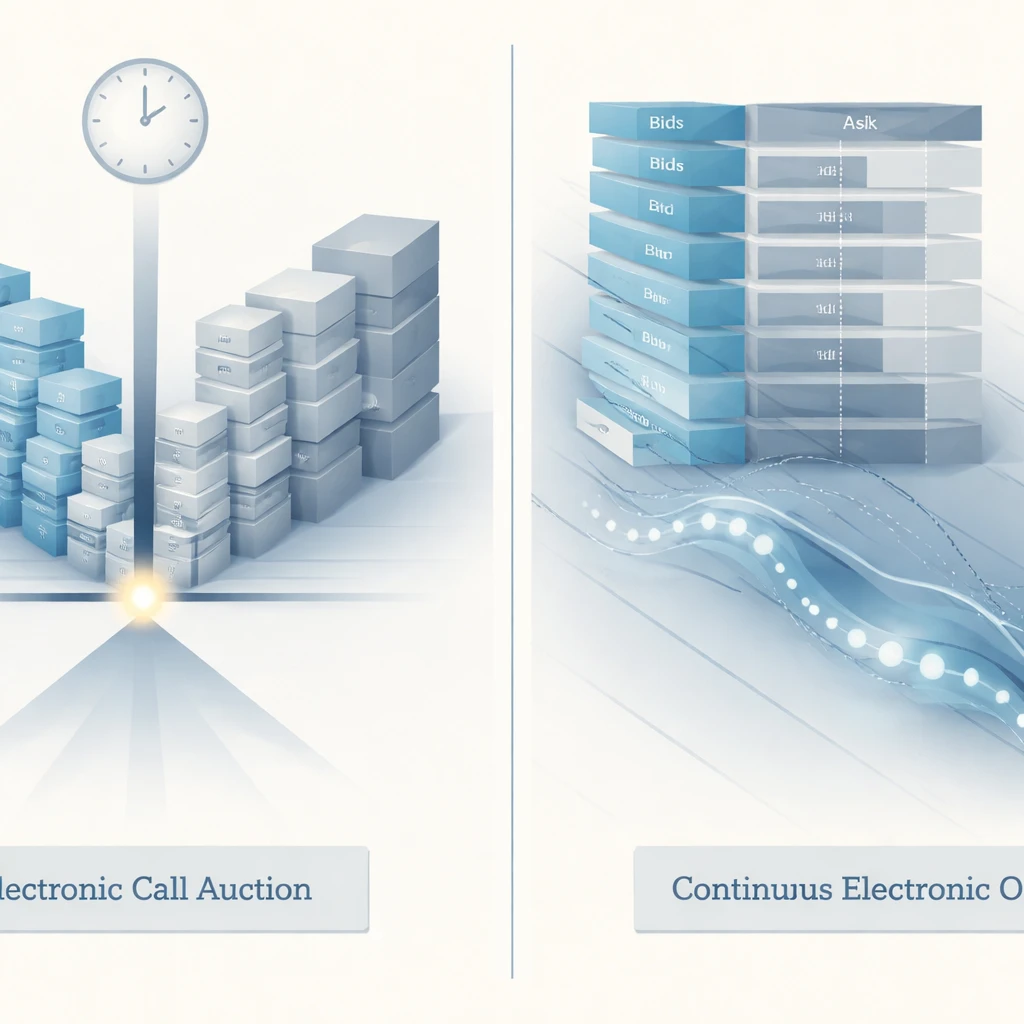
Market structure determines how orders become trades. Two foundational designs dominate modern markets: auction mechanisms that consolidate buying and selling at defined moments, and continuous trading that matches orders throughout the session. Both models serve price discovery, liquidity formation, and risk management, but they operate in different temporal patterns and use distinct rules for prioritizing and matching orders. Understanding these contrasts helps explain why the same security can behave differently at the opening, during the trading day, and at the close, and why certain asset classes favor one design over the other.
Core Definitions
What is an auction market?
An auction market aggregates orders over a period, then determines a single price at which the greatest executable volume can trade. In modern electronic venues this is often called a call auction. Orders are collected without immediate execution. At the auction moment, the system computes a price that clears the largest possible quantity given the submitted buy and sell interest. Trades then execute at that single price, sometimes called the uncrossing price.
Many equity and derivatives exchanges use auctions at the open and close. Additional auctions may occur intraday to manage volatility, resume trading after a halt, or facilitate periodic liquidity concentration in less active instruments. Outside secondary trading, auctions also set primary issuance prices, such as in government bond sales or initial public offerings, though issuance auctions serve different objectives than secondary market auctions.
What is a continuous market?
A continuous market matches orders as they arrive during the trading session. Most modern venues implement a continuous double auction with an electronic order book. Buy orders ranked by highest price face sell orders ranked by lowest price. When a new order crosses the best opposing price, execution occurs immediately at the resting order’s price. Partial fills are common, and remaining quantities may continue to rest in the book or be canceled according to the order’s instructions.
Continuous trading creates a stream of transactions and quote updates. Liquidity is distributed across time rather than concentrated at a single moment. Prices move tick by tick as new information arrives and as participants update their willingness to trade.
Why Both Models Exist
Liquidity aggregation and price discovery
Auctions concentrate interest at a point in time. This can reduce price dispersion and improve the reliability of a single reference price, especially when many participants need to trade at once. The closing auction in equities, for example, often processes a large share of daily volume and produces a benchmark price used for index calculations and portfolio valuations.
Continuous trading, in contrast, allows the market to incorporate information as it arrives. This supports ongoing price discovery and provides opportunities to manage inventory and risk throughout the day. Both mechanisms complement each other: auctions create periodic consensus snapshots, while the continuous session traces the path between those points.
Volatility management
Call auctions can reduce extreme short-lived moves by pooling orders and finding a clearing price that reflects a broader set of intentions. Many exchanges pause continuous trading and run an auction when price movements breach volatility bands. By collecting orders and publishing indicative prices during the pause, the venue gives participants time to respond, which can produce a more orderly reopening price.
Fairness and transparency objectives
Auctions treat participants symmetrically within the batch. Price and time priority rules still apply, but the outcome depends on aggregate interest rather than microsecond arrival sequences. This helps establish a fair reference price for open and close, functions that many institutional workflows require for benchmarking and fund accounting.
Continuous markets meet a different fairness objective. They provide immediate execution to those willing to cross the spread and better prices to those willing to rest orders and wait. The trade-off is that outcomes can depend on message timing and queue position, which rewards speed and careful order management.
Operational and regulatory considerations
Exchanges adopt auctions for operational reasons such as synchronizing the start of trading across venues, managing imbalance information, and publishing clear references for settlement. Regulators also require mechanisms that support orderly trading, limit dislocations, and provide transparent benchmarks. Periodic auctions introduced under certain regulatory frameworks are designed to concentrate liquidity for smaller orders and to offer alternatives to continuous matching during specific conditions.
How Auctions Work in Practice
Phases of a call auction
Although implementations vary by venue and asset class, a call auction usually involves several stages:
- Order collection. The venue accepts buy and sell orders for a defined window. Orders may be new submissions, modifications, or cancellations. No trades occur in this phase.
- Indicative price and imbalance dissemination. Many venues publish a running estimate of the price that would maximize executed volume, along with any net imbalance. This feedback allows participants to adjust orders before the auction uncross.
- Price determination. The clearing algorithm selects the price that executes the largest quantity. Secondary criteria may include minimizing imbalance or minimizing distance to the previous reference price.
- Allocation rules. Orders at better prices execute first. Orders at the auction price typically fill based on time priority. Some venues include pro rata features for equal-priced orders.
- Uncross and transition. Trades print at the auction price. Continuous trading resumes with the remaining order book, often anchored by the auction result as the new reference.
Opening and closing auctions
The opening auction establishes the first tradable price of the day. Overnight news and accumulated orders are consolidated, which can reduce the noise that would occur if the market attempted to open with purely continuous matching. The closing auction concentrates liquidity for end-of-day portfolio processes. Index funds, benchmark trackers, and valuation procedures often reference the official closing price, which helps explain why closing auctions can attract large order flow.
Volatility and halt auctions
When prices move outside predefined bands, many exchanges pause continuous trading and enter an auction call period. Participants gain time to evaluate information and enter offsetting orders. The auction then uncrosses to produce a reopening price. This mechanism aims to prevent disorderly trading while allowing the market to incorporate new information in a single clearing event.
Issuance and special auctions
Primary issuance such as government bond auctions or IPO bookbuilds also use auction logic, but their objectives differ. They allocate new securities to buyers and set an initial price based on demand. These are not continuous secondary markets, yet they illustrate how auction design can discover prices when the supply side is not yet traded.
How Continuous Markets Work in Practice
Order book mechanics
Continuous venues maintain a central limit order book. The best bid and best offer define the inside market, and the difference between them is the quoted spread. Orders rest at price levels with time stamps. When a marketable order arrives, it matches against the top of the opposing side. If quantity remains, the order continues down the book, potentially producing multiple fills at different prices.
Price-time priority is common. Better prices execute first, and within a price level, earlier orders execute before later ones. Some venues permit additional mechanics such as iceberg orders with a hidden reserve, midpoint pegs, or pro rata allocation in certain derivatives. These features influence how visible and latent liquidity interact during continuous trading.
Information flow and adjustments
Continuous trading reflects a steady flow of information. Quotes and trades update as participants revise expectations. Market makers adjust quotes to manage inventory and to reflect changing risk. Institutions may slice larger objectives into smaller orders to limit signaling. The result is a sequence of price adjustments rather than a single clearing event.
Fragmentation and routing
In markets with multiple venues, the national best bid and offer or similar constructs aggregate top quotes, while routing logic seeks available liquidity across exchanges, alternative trading systems, and periodic auctions. Routing rules differ across jurisdictions, but the general aim is to access the best displayed prices while considering execution quality, fees, and reliability of fills.
Execution and Management Implications
Timing and liquidity concentration
Auctions concentrate liquidity at defined times, which can be useful for participants who must transact at a reference price. The opening auction incorporates overnight information, while the closing auction aligns with valuation and index processes. Continuous markets disperse liquidity across the day, enabling ongoing inventory adjustments and risk transfers. The difference matters for order planning, since execution that is straightforward during an auction might be more difficult during a quiet intraday period, and vice versa.
Transaction costs and slippage
Costs arise from spreads, market impact, and timing risk. Auctions may reduce impact when many participants offset each other at the same instant. Continuous trading may achieve better prices when the order book is deep and the spread is tight, but it can also incur impact if a large order consumes visible liquidity. Slippage relative to a chosen benchmark can differ between the two settings because the benchmark itself changes. In auctions the benchmark is the single clearing price. In continuous trading the benchmark could be a sequence of midpoints or time-weighted references, depending on the context.
Volatility and gap risk
An auction can produce a discrete price change relative to the prior trade, especially at the open after significant news. This creates gap risk for orders that anchor to pre-auction references. Conversely, continuous trading spreads price adjustments across many small moves, but can still produce rapid changes when liquidity is thin or when order flow is one-sided. Volatility auctions are designed to manage these transitions by pausing and reconvening supply and demand.
Imbalance information and signaling
Many venues publish indicative auction prices and imbalances. This data allows participants to observe the direction and size of net demand. The information can shape expectations about the likely auction price and the opening conditions of the continuous session. In continuous trading, the visible order book and executed prints provide ongoing signals, though hidden and off-book liquidity can complicate interpretation. The presence or absence of pre-trade transparency is a design choice that directly affects signaling and the potential for information leakage.
Fees, ticks, and priority rules
Economic and microstructural details matter. Maker-taker fees, tick size regimes, and queue priority rules influence where and how orders get filled. In auctions, execution fees and priority criteria at the auction price shape allocation outcomes for similarly priced orders. In continuous trading, tick sizes determine the minimum price improvement step, which can affect spread competition and queue dynamics. These structural elements vary by venue and asset class and often evolve under regulatory oversight.
Asset class perspectives
Equities. Equity markets commonly use opening and closing auctions, with continuous trading in between. Closing auctions can represent a significant fraction of daily volume in large-cap shares because many institutional workflows reference the official close for valuation.
Futures. Futures exchanges typically run a call auction at the daily open and maintain continuous trading afterward. Some also define a settlement period that concentrates trading to support a robust settlement price used for margining.
Options. Options markets often have opening auctions to synchronize price discovery across strikes and expiries. Continuous trading dominates the day, but auctions or special procedures may occur during halts or at expiration.
Foreign exchange. Interdealer FX markets operate largely as continuous limit order books, with some benchmark fixings that function like time-specific auctions to produce reference rates used in valuations and index operations.
Cryptoassets. Many crypto venues run continuous order books around the clock. Some have introduced periodic or closing auctions for added price discovery and to mitigate slippage during low-liquidity windows or at index reweighting times.
Real-World Context and Examples
Opening price formation after overnight news
Consider an equity that releases earnings after the prior close. During the pre-open, a call auction collects buy and sell orders reflecting updated views. The venue disseminates indicative prices and imbalances. As the auction time approaches, more orders arrive, often narrowing the imbalance. The auction then uncrosses at the price that maximizes matched volume. Continuous trading resumes with the opening price as a reference. This sequence shows how an auction can incorporate a broad set of beliefs into a single clearing print.
Closing auction as a valuation anchor
Index funds, pensions, and other institutions often value holdings at the official closing price for operational consistency. A closing auction gathers sizable interest from participants who need end-of-day alignment. The resulting print becomes a widely used benchmark. During the final minutes before the close, continuous quotes may reflect the approaching auction as participants position themselves for the clearing. The liquidity that concentrates at the close can enable large notional trades to execute at a single price, which is operationally convenient for workflows that rely on a unified end-of-day reference.
Intraday volatility auction after a trading halt
Suppose an exchange halts a stock after a sharp news-driven move. During the halt, the venue enters an auction call period, accepting orders and publishing indicative prices. Participants evaluate the new information and express interest through their orders. When the auction time arrives, the system calculates the price that clears the largest quantity and reopens the market. This design intends to reduce disorderly price jumps and to provide transparency around the reentry point.
Periodic auctions in fragmented markets
In jurisdictions with multiple competing venues, periodic auctions may operate alongside continuous order books. These auctions run frequently for short windows, consolidating interest that might be fragmented across venues. For smaller orders, this can provide price improvement relative to the best displayed quotes if opposite-side interest appears during the call. For larger orders, the ability to match at a single price can reduce signaling compared with exposing the entire interest in an open order book.
Primary issuance auctions versus secondary trading
Government bonds are commonly sold through primary auctions where dealers submit bids that determine the allocation and yield. After issuance, the bonds trade in secondary markets that may be continuous or request-for-quote based. The goals differ. Primary auctions allocate new supply at a clearing yield. Secondary markets provide ongoing liquidity and price discovery as macroeconomic information evolves.
Common Misconceptions
Auction markets are old-fashioned pits
Historical images of open outcry floors can mislead. Modern auctions are electronic and rules-based. They rely on transparent algorithms, indicative pricing, and deterministic clearing rules. The design is suited to the digital environment and integrates with continuous trading engines.
Continuous trading guarantees abundant liquidity
Liquidity in continuous markets can be uneven. At times the book is deep and spreads are tight. At other times liquidity thins out, especially in smaller instruments or during stress. Auctions can temporarily rebuild depth by pooling interest. Neither model guarantees consistent liquidity, and both use rules to manage scarcity and imbalances.
Auctions eliminate volatility
Auctions do not eliminate volatility. They repackage it into discrete steps by clearing a batch at once. If new information implies a large price change, the auction print will reflect that change. The benefit is that the price results from a wider set of orders than would be seen in a single instantaneous match during continuous trading.
Design Details That Shape Outcomes
Priority and allocation
In a call auction, orders at better prices typically execute first. Orders at the clearing price are then allocated based on time or pro rata rules. In the continuous book, price-time priority determines queue position, which has implications for fill probability and exposure to order cancellations ahead in the queue.
Transparency choices
Venues decide whether to display indicative auction prices and how much depth to show in the continuous book. Full depth displays reveal the shape of supply and demand at many price levels, while top-of-book displays show only the best bid and offer. Some systems permit hidden or iceberg orders to reduce signaling. These choices influence how information is revealed and how participants interpret the state of the market.
Tick sizes and price improvement
The minimum price increment affects competition inside the spread and at the auction price. Larger ticks can widen quoted spreads but may encourage displayed liquidity. Smaller ticks can tighten spreads but can also increase queue churn as participants step ahead by the minimum increment. At the auction price, tick size can determine how finely the clearing algorithm can adjust to minimize imbalance.
Cross-venue coordination
When the same instrument trades across multiple venues, opening and closing times, auction rules, and routing obligations influence where trades occur. Consolidated tapes and best-price obligations aim to protect investors by ensuring access to top quotes. At the close, some venues run primary auctions that attract most interest, while others provide alternative closing crosses. The coordination or fragmentation of these events affects execution quality and operational planning.
Applying the Concepts Without Strategies
Understanding the distinction between auction and continuous designs clarifies why execution characteristics vary through the day and across venues. It explains why a single closing print can accommodate large flows, why intraday fills might fragment across multiple prices, and why volatility pauses culminate in a discrete reopening level. Recognizing these patterns does not prescribe a particular trading approach. It simply frames how the market’s rules map order flow into prices.
Illustrative Scenarios
Managing a large rebalance at the close
A global equity fund needs to align holdings with an index that measures performance at the official close. Many counterparties face similar requirements on the same day. The closing auction provides a single price that consolidates these flows. Indicative imbalance data helps market participants assess supply and demand before the uncross. The auction print becomes the valuation anchor, and continuous trading resumes afterward with a new reference level.
Establishing the first tradable price
A newly listed stock begins trading. Before the open, market participants submit orders reflecting their valuations. The opening auction clears at the price that matches the most shares. This single print defines the starting point for continuous trading and sets the day’s initial reference for spreads, depth, and subsequent price discovery.
Halt and reopen after a material announcement
An issuer announces significant corporate news midday. The exchange halts the stock and transitions to an auction call. During the call, participants reassess valuations and place offsetting orders. The market reopens at a clearing price that consolidates new information. Continuous trading then resumes with order book depth that reflects the updated consensus.
Limits of Each Model
Auctions
Advantages include concentrated liquidity, a clear reference price, and reduced sensitivity to fleeting microsecond timing. Limitations include potential gaps relative to prior trades, limited flexibility for time-sensitive execution during the call, and dependence on participation. If too few orders arrive, the auction may produce a brittle price with limited depth for the subsequent continuous session.
Continuous markets
Advantages include immediacy, granular price discovery, and the ability to adjust positions over time. Limitations include exposure to spread and impact costs when depth is thin, sensitivity to queue dynamics and message speed, and potential fragmentation across venues that complicates routing and transparency.
Concluding Perspective
Auction and continuous markets are not competitors so much as complements. Auctions provide coordinated snapshots that anchor the trading day and manage exceptional conditions. Continuous trading connects those snapshots with a live path that responds to information as it arrives. The combination supports robust price discovery, flexible liquidity provision, and operational needs that span valuation, risk transfer, and regulation across asset classes.
Key Takeaways
- Auctions collect orders over a period and print a single clearing price that maximizes matched volume, while continuous markets match orders as they arrive throughout the session.
- Both models exist to balance liquidity, price discovery, fairness, and volatility control, serving different operational objectives.
- Opening, closing, and volatility auctions structure the day’s reference prices and manage transitions, while the continuous book provides ongoing price formation between those points.
- Execution characteristics differ: auctions concentrate liquidity and can reduce impact at a moment, whereas continuous trading disperses liquidity and can fragment fills across prices.
- Design choices such as priority rules, tick sizes, transparency, and cross-venue coordination materially influence outcomes in both auction and continuous settings.