
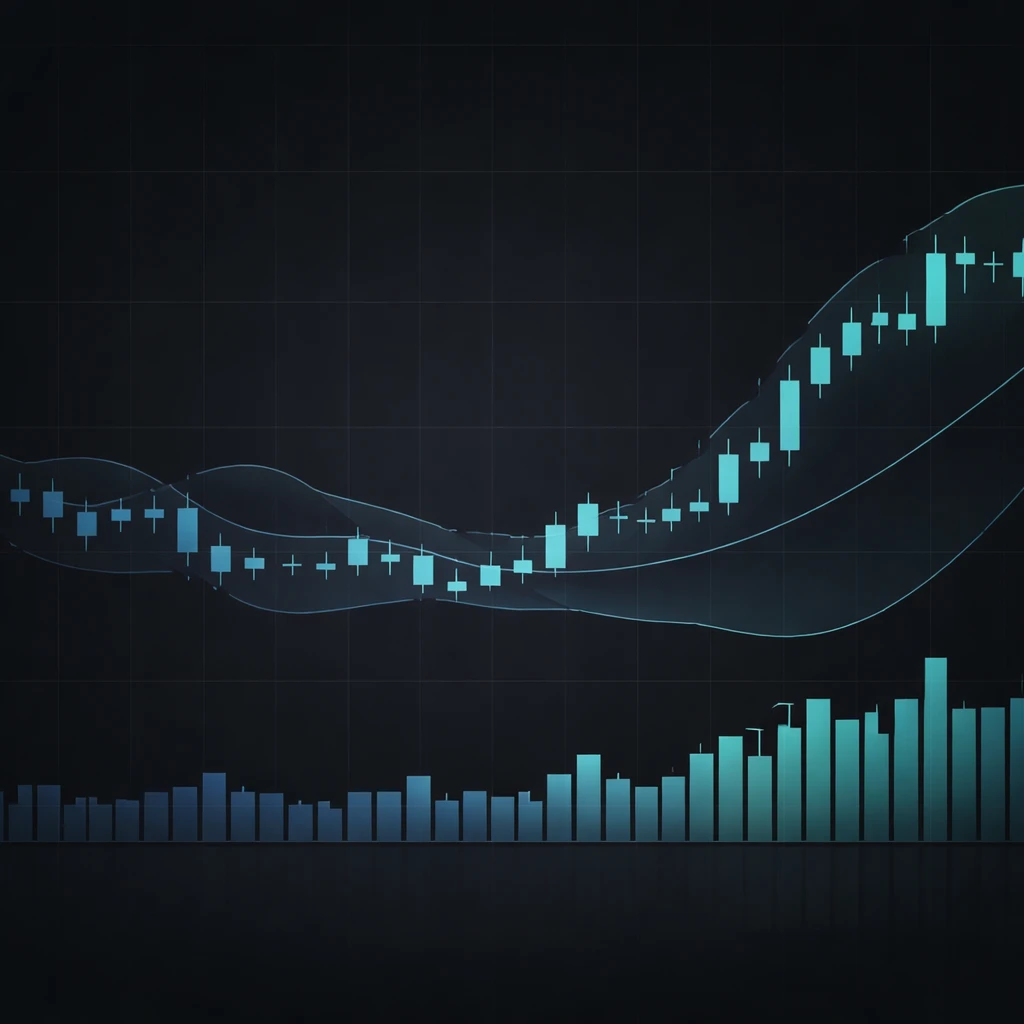
Volatility is the observable variability of price over time. In technical analysis, volatility is not treated as a vague notion of how markets feel. It is measured, compared across periods, and placed in the context of price structure and liquidity conditions. Within that framework, two recurring regimes attract attention: volatility contraction and volatility expansion. These regimes do not predict direction by themselves, but they often mark transitions in market behavior. Understanding how they form, how they appear on charts, and how volume often interacts with them improves the quality of interpretation and risk awareness.
Defining Volatility Expansion and Contraction
Volatility contraction is a phase in which the typical range of price movement narrows relative to recent history. Candles or bars become smaller, intraday swings diminish, and price often oscillates in a tighter band. In statistical terms, the dispersion of returns decreases. The contraction can be brief or can persist for multiple sessions when participants are waiting for new information or when liquidity providers are comfortable keeping spreads tight and inventories balanced.
Volatility expansion is the opposite regime. Average ranges increase, intraday swings become larger, and the dispersion of returns rises. Expansion often accompanies new information, inventory imbalances, or changes in order flow dynamics. It may unfold rapidly after a quiet period or may develop gradually as a trend matures and uncertainty accumulates.
These regimes tend to cluster. Periods of low volatility often beget low volatility until a catalyst intervenes. Periods of high volatility often remain high until market-making capacity or participant conviction reasserts control. This clustering is a well-documented feature of financial time series and underpins the practical observation that quiet markets can stay quiet, and turbulent markets can stay turbulent, for longer than expected.
What Volatility Means in Practice
Volatility can be described using several related quantities:
- Range-based volatility: the difference between high and low over a bar or over a sequence of bars. Range-based measures work directly with price extremes.
- True range and Average True Range (ATR): true range accounts for gaps between sessions by comparing the current high and low to the previous close. ATR smooths true range over a set window to reduce noise.
- Standard deviation or historical volatility: the standard deviation of returns over a rolling window, often annualized. This connects chart behavior with the statistical concept of dispersion.
None of these measures provides direction. They quantify the scale of movement. A rise in ATR or in rolling standard deviation indicates expansion. A fall indicates contraction. Chart readers rely on these signals to frame expectations about potential price variability without implying a particular path for price.
How Volatility Contraction and Expansion Appear on Charts
Chart representations make the regime shifts visible even without computing statistics by hand. Several recurring visual patterns are worth learning to recognize.
Candle and Bar Size
During a contraction, successive candles often have smaller bodies and wicks. The distance between intraday highs and lows narrows. When expansion begins, bodies and shadows typically lengthen. Seeing a cluster of small candles followed by larger ones is a straightforward illustration of the transition from contraction to expansion.
Envelope and Band Width
Indicators that scale with volatility help objectify the visual impression:
- Bollinger Bands are constructed from a moving average with bands set at a multiple of standard deviation. During a contraction, the bands draw closer together. During an expansion, they widen as dispersion rises. A visible band pinch followed by widening is a textbook depiction of contraction giving way to expansion.
- Keltner Channels are built around an exponential moving average with bands based on ATR. Narrow channels indicate contraction. A visible increase in channel width signals expansion.
- Donchian Channels span the highest high and lowest low over a lookback window. A flat, narrowing channel often accompanies contraction, while rapid extension of highs or lows typically accompanies expansion.
Clustering and Break of Compression
Contractions often take the form of a tight consolidation with overlapping bars, modest day-to-day closes, and reduced excursion beyond intraday means. Expansion may begin with a single outsized bar compared with the preceding cluster, or it may unfold over several sessions as ranges gradually build. The transition is easier to see when combined with a band or ATR reference, since the change in scale becomes explicit.
Why Analysts Pay Attention to Volatility Regimes
Interpreting volatility regimes supports multiple aspects of analysis without dictating decisions. The concept matters because volatility is tied to market function and risk.
- Risk context: A market that transitions from contraction to expansion has increased dispersion of outcomes. This alters the expected amplitude of price paths and can change how sensitive a portfolio is to adverse moves.
- Price discovery: Expansion often accompanies the incorporation of new information. When prices move rapidly and ranges widen, the market is renegotiating value. The process can produce directional trends, sharp reversals, or wide oscillations. The regime label does not predict which will occur, but it signals that price discovery has accelerated.
- Liquidity and microstructure: Contraction is common when liquidity is abundant relative to order flow imbalances. Expansion can reflect a temporary shortfall of liquidity, wider spreads, or inventory constraints among market makers.
- Regime identification: Many technical tools behave differently across volatility regimes. An indicator calibrated for quiet conditions may lag or generate frequent signals in an expansion. Recognizing the regime clarifies which observations are more or less reliable in the moment.
The Role of Volume
Volume tracks the quantity of transacted shares, contracts, or units. Although volatility is about price variability and volume is about participation, the two often interact in recognizable ways.
During contraction, volume commonly moderates as fewer participants are motivated to cross the spread. Market makers can manage inventory within tighter bands, and many orders rest rather than aggressively lift offers or hit bids. The chart may show a gentle decline in volume histograms alongside narrowing price envelopes.
During expansion, volume often increases. As prices move away from recent balance areas, previously dormant participants may engage, and short-term traders may accelerate activity. The increase in aggressive orders can widen spreads and force larger positional adjustments. The visible combination is larger candles, wider bands, and taller volume bars. Exceptions exist. Occasionally a price expands on thin volume due to limited liquidity, especially in off-hours sessions or in smaller instruments. That type of expansion can be fragile and prone to retracement when liquidity returns.
Volume by itself is not a confirmation tool for direction. Instead, the co-movement of volume and volatility informs how robust a move might be from a microstructure standpoint. Large expansion with unusually low volume can hint at transitory conditions. Large expansion with sustained volume suggests broad participation and a more complete price discovery process.
Quantifying Contraction and Expansion
Beyond visual inspection, analysts often define contraction and expansion with rules grounded in relative change. The goal is to compare the current environment to the instrument’s own history.
- ATR percentile: Compute ATR over a window, then locate the current value within a multi-month or multi-year percentile distribution. Values in a low percentile represent contraction relative to the instrument’s history, while high percentiles represent expansion.
- Band width ratios: For Bollinger Bands, calculate the percentage width of the bands relative to the moving average. Track whether the ratio is at a local or historical extreme.
- Rolling standard deviation: Evaluate the current standard deviation of returns relative to its trailing average or to a longer reference window. A sharp divergence indicates a regime change.
- Range compression counts: Count sequences of consecutive bars whose ranges are below a threshold. Longer sequences indicate deeper contraction. A break in the sequence may signal the start of expansion.
Each method uses relative context. An absolute ATR of 2 points might be large for one instrument and small for another. The aim is to learn what is typical, compressed, or extended for the specific market and timeframe under study, then use that knowledge to classify the current state.
Chart-Based Context and Examples
Examples can make the regimes concrete. The following scenarios are stylized and used to illustrate how contraction and expansion commonly unfold. They are not trade setups.
Example 1: Post-trend Consolidation
Consider an equity index that has advanced for several weeks. Momentum cools and the index begins to oscillate within a narrow horizontal band. Candle bodies shrink, intraday excursions fade, and Bollinger Bands draw closer around price. Volume fades from earlier levels as fewer participants are compelled to chase price. This is a classic contraction. After a scheduled economic release, the index posts an outsized daily range and the bands widen. Volume increases as many participants reposition. This is an expansion phase initiated by new information. The direction of the move depends on how price discovery resolves, not on the regime label.
Example 2: Currency Pair around a Central Bank Meeting
A major currency pair trades quietly before a central bank decision. Daily ranges compress and ATR drops into a low historical percentile. The Donchian Channel flattens as the pair fails to make new highs or lows over the lookback window. After the policy announcement, spreads briefly widen, the first impulsive move prints a much larger candle than prior sessions, and ATR begins to climb. Participation increases as global desks align to the new rate path. Volatility has expanded. In the subsequent days, ranges remain elevated while markets digest guidance and forward-rate expectations.
Example 3: Commodity under Seasonal Uncertainty
A commodity futures contract approaches a seasonal report. In the preceding weeks, price shows alternating small candles and overlapping bars as producers and consumers hedge opportunistically without forcing price far from perceived value. Keltner Channels narrow and volume trends lower. The report introduces new supply data. The first trading session post-release shows a broad trading range with several intraday swings and significantly wider channels. The increase in realized variability is the expansion phase. The specific path that follows can be trend formation, two-sided volatility, or eventually a return to contraction as a new balance emerges.
Regime Transitions and Sequencing
Volatility regimes often follow a recognizable sequence. A market may exhibit a prolonged contraction, sometimes called a squeeze, defined by narrow bands and low ATR. Expansion often follows, sometimes suddenly. After the first burst of activity, the market may continue in an elevated volatility state for several sessions before gradually calming. The settling phase often features a decline in ATR and narrower envelopes as participants assimilate the new information and inventory positions normalize.
This sequence is not clockwork. Occasionally a contraction breaks with a brief expansion that quickly fades, followed by another contraction. At other times, expansion persists for longer than recent history would suggest. Analysts treat the sequence as a probabilistic tendency rather than a rule.
Timeframe and Scale Considerations
Volatility expansion and contraction are scale dependent. A contraction on a daily chart can contain multiple intraday expansions and contractions. Conversely, a violent expansion on a 5 minute chart may appear as minor noise within a weekly contraction. Proper interpretation requires aligning the assessment of regime with the timeframe of interest. Many chart readers examine at least two adjacent timeframes to see whether intraday behavior aligns with the broader daily or weekly regime.
Multi-scale analysis also helps prevent misclassification. An apparent expansion on a narrow lookback can be merely a return to normal conditions when viewed in a wider historical context. Without a sense of the instrument’s typical distribution of ranges, it is easy to label normal variability as expansion or to mistake deep quiet for routine consolidation.
Interpreting the Role of Price Structure
Volatility regimes interact with chart structure. Contractions often coincide with well-defined trading ranges bounded by recent highs and lows. Expansion often appears near structural features such as prior swing points, gaps, or value areas where many orders are clustered. These features are not deterministic triggers. They create conditions where a change in volatility is more likely because pending orders can exhaust, spreads can widen, or price can traverse lightly traded zones more quickly.
Price structure can also shape how expansion proceeds. If a market breaks into a zone with limited historical trading, expansion may be larger as price searches for the next area of acceptance. If price meets dense historical activity, expansion may be short-lived as opposing orders absorb the move and slow the discovery process.
Microstructure, Liquidity, and Volatility
At a microstructure level, volatility is tied to how orders interact with available liquidity. In contraction, limit orders rest near the prevailing price and market orders are modest, so the book refills quickly and price changes are small. In expansion, larger market orders or a thinning of the order book can push price through multiple levels before new resting orders replenish depth. Spreads can widen and slippage can increase. The pattern is visible as larger candles and more frequent excursions beyond recent averages.
Scheduled events illustrate the mechanism. Before an event, many participants reduce size, and market makers manage inventory to minimize risk. The result is often a contraction. Immediately after the event, latent supply and demand become active, and resting orders can be overwhelmed. The result is an expansion. The transition is mechanical, not mystical.
Limitations and Common Misinterpretations
Volatility expansion and contraction are descriptive, not prescriptive. They require careful handling to avoid over-interpretation.
- No directional signal: An expansion can resolve up, down, or into two-sided churn. The regime shift does not provide directional evidence by itself.
- False cues in thin markets: Overnight sessions, holidays, or illiquid instruments can produce apparent expansion on limited volume that is not sustained once normal participation returns.
- Over-reliance on a single metric: ATR or band width alone can mislead if the underlying price structure or event context is ignored.
- Regime whipsaw: Markets can oscillate between brief expansions and contractions. Short lookbacks or excessive smoothing can hide or exaggerate these flips.
Integrating Volatility with Broader Analysis
Analysts usually combine volatility regime assessment with other forms of information. Price structure, such as support and resistance or balance areas, provides context for where expansion might emerge. Volume patterns indicate whether participation is broad or narrow. The macroeconomic calendar and earnings schedules frame when regime shifts are statistically more likely. For derivatives, implied volatility from options markets can add a forward-looking dimension to the observed realized volatility on charts.
The aim is coherence. When range measures, bands, and volume convey a consistent message about the current regime, interpretations are cleaner. When they diverge, it signals uncertainty and the need for caution in reading the chart.
Practical Chart-Reading Process
A structured process helps maintain consistency in interpretation while avoiding prescriptive rules. The steps below focus on observation and measurement rather than tactics.
- Identify the recent regime: Visually assess candle size, band width, and ATR relative to the last several weeks. Note whether the instrument is quiet, active, or transitioning.
- Quantify relative position: Place the current ATR or band width in historical context using percentiles or rolling comparisons.
- Locate relevant structure: Mark recent swing highs and lows, gaps, or balance areas to understand where order flow may change character.
- Assess participation: Compare current volume to its recent average. Determine whether expansion or contraction is accompanied by unusually high or low participation.
- Document observations: Keep notes on regime changes and subsequent behavior. Over time, the notes provide instrument-specific intuition about how long regimes tend to persist.
Cross-Asset and Instrument Differences
Not all instruments express volatility regimes the same way. Equity indices can show long quiet periods punctuated by event-driven expansions. Individual equities may exhibit frequent expansions around earnings or corporate news. Currency pairs often compress around policy meetings and expand on macro surprises. Commodities can swing between deep contraction and wide expansion during seasonal cycles. Even within an asset class, the typical magnitude and persistence of regimes vary by instrument, exchange hours, and liquidity conditions.
Because of these differences, comparing volatility across instruments is most useful when normalized to each instrument’s history. An ATR that appears small on a commodity contract might be large on a bond future. The relevant question is whether the current reading is unusual for that market and timeframe.
Measurement Details: True Range and ATR
True range is a foundational building block for many volatility measures. For a given bar, true range is the largest of three quantities: current high minus current low, absolute value of current high minus previous close, or absolute value of current low minus previous close. This definition incorporates gaps between sessions that simple range would miss. ATR averages true range over a chosen window, typically using a simple or exponential moving average. Rising ATR indicates expansion. Falling ATR indicates contraction.
ATR reacts to persistent changes in range. One outsized bar can lift ATR noticeably, but sustained elevation requires multiple large bars. This property helps ATR distinguish between a single shock and a durable regime shift. In contrast, band width measures tied to standard deviation may react more quickly to a cluster of volatile closes, offering a different perspective on how rapidly dispersion is changing.
Historical Volatility and Dispersion
Historical volatility, often computed as the standard deviation of log returns over a rolling window, connects chart observations to statistical dispersion. A climb in historical volatility confirms that the distribution of returns has widened, while a decline indicates compression. Analysts sometimes compare historical volatility to implied volatility from options to gauge whether the market expects larger or smaller future moves than currently realized. Even without options data, the evolution of historical volatility reinforces what the eye sees in shrinking or widening trading ranges.
Event Catalysts and Seasonal Patterns
Contractions and expansions do not require news, but scheduled events can influence their timing. Earnings, economic releases, policy decisions, and index rebalancing often precede contractions as participants await information. Post-event periods often bring expansions as price incorporates the news. Seasonal patterns can have similar effects. For example, certain commodities may experience regular contractions during planting or harvest lulls and expansions around crop reports or weather updates. Recognizing the calendar context frames expectations for how long a contraction might persist and how pronounced an expansion might become, without assuming direction.
Documentation and Empirical Review
Because volatility behavior is instrument specific, empirical review is valuable. Many analysts maintain a log of when ATR percentiles fall below certain thresholds or when band width reaches historically tight levels. They note the subsequent behavior over various horizons and record the role of volume and structure. The log does not generate prescriptions. It builds a reference library that helps interpret future regimes with greater nuance and fewer assumptions.
Putting It All Together
Volatility expansion and contraction describe how the scale of price movement changes through time. On charts, contractions appear as clusters of small candles, narrow bands, and subdued volume. Expansions appear as larger candles, widening envelopes, and often elevated volume. The regimes reflect underlying dynamics of liquidity, information flow, and order book depth. They are descriptive of risk and context, not predictive of direction.
Measured carefully and interpreted alongside price structure, volume, and calendar context, volatility regimes support more coherent reading of market behavior. Analysts who consistently classify the regime, quantify its magnitude relative to history, and observe how it interacts with structure and participation tend to build a more disciplined framework for understanding price. The result is not a signal generator but a clearer map of the terrain through which prices travel.
Key Takeaways
- Volatility contraction and expansion describe changes in the scale of price movement, not direction.
- Contractions appear as smaller candles, narrow bands, and often lighter volume; expansions show larger candles, wider envelopes, and frequently higher volume.
- ATR, band width, and rolling standard deviation provide practical ways to quantify regimes relative to an instrument’s history.
- Regime changes often cluster around events or structural price areas but can occur without news when liquidity shifts.
- Interpreting regimes alongside volume, structure, and timeframe context improves analysis without implying specific trades or recommendations.